 The remains of 16th century astronomer and priest Nicholas Copernicus have apparently been found by archeologists in Poland. Way cool. The picture (right) is a reconstruction.
Via Evolving Thoughts.

The remains of 16th century astronomer and priest Nicholas Copernicus have apparently been found by archeologists in Poland. Way cool. The picture (right) is a reconstruction.
Via Evolving Thoughts.
Dr. John Morris, president of the Institute for Creation Research is at it again. Apparently not content with advertising his abject ignorance of zoology as he did a few months ago when he listed tunicates (phylum chordata) along with sea stars as members of the phylum echinodermata, he is now letting everyone know that he is equally incompetent to comment intelligently on the subject of paleontology (I know, I am as shocked as you are).
More specifically he has come out attacking the classic fossil evidence for the evolution of the horse in the September (2008) issue of ICR’s Acts & Facts.
Morris: Horse evolution prominently appears in textbooks as a supreme example of the evolution of one body style into another. All students remember the “horse series” sketches, tracing the development of a small browser named Hyracotherium (formerly known as Eohippus) with four toes on the front feet and three on the rear, into the large one-toed horse of today. Intermediate steps included the three-toed Mesohippus, a modified horse with one toe touching the ground… [Emphasis mine]

Wrong right off the bat. The fact is that with Mesohippus all three toes touch the ground as can be seen in the above photo of a mounted fossil at the Chicago Field Museum. This is especially true when it is taken into account that Mesohippus probably would have had pads on its feet similar to those found in tapirs.

Tapir hooves
My wife (Kathy) woke me up this morning telling me there was a “baby in the bathroom”. Naturally enough I asked “baby what?”. “A lizard” she said.
Now we generally have only two types of lizards around where I live (in Southern California), the Southern Alligator Lizard (Elgaria multicarinata) and the Western Fence Lizard (Sceloporus occidentalis). Usually when I find a lizard in the house it’s an alligator lizard. They’re nasty little buggers who bite (the larger ones can draw blood), wipe feces on you and drop their tails if you breath on them too hard.

Elgaria multicarinata
So I asked my wife which kind it was. She said, rather insistently, that she didn’t know and that I should get out of bed and look for myself. Here is what I found in all its cuteness:
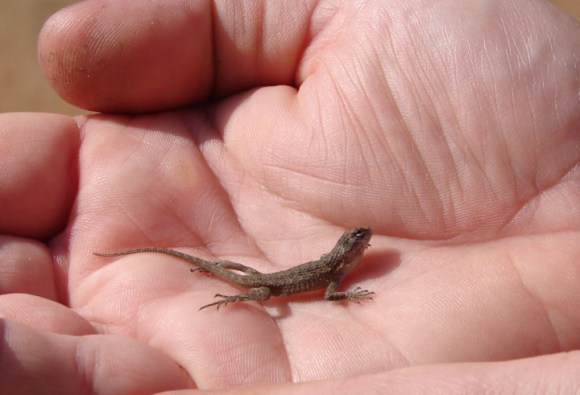
After briefly toying with the idea of keeping it (because it was so damn adorable) we decided to let it go in an area beside the house where we frequently see its relatives. We wished it best of luck and sent our tiny intruder on its way.
Creationist nut-job Tom Willis (Creation Science Association for Mid-America), apparently without a sense of irony, accuses evolutionists of being Nazis/communists (or at least fellow travelers of the Nazis and communists) and concludes from this that it might be a good idea to (amongst other possibilities) round up evolutionists and put them in forced labor camps.
Other options include torturing recantations out of evolutionists, forcing them to wear identifying signs or plaques, or perhaps forced relocations to Antarctica (or Mars).
Poe’s Law is in full effect here, it seems like it should be a parody but it’s not.
Found via Pharyngula.
The wife made the mistake of insisting on going to a used bookstore last weekend. The result is that my library has grown a bit larger (and my wallet a bit thinner). For those not familiar the entire contents of the Britain Research Library can be found on my personal web site at the previous link.
Anstey, Robert L. & Chase, Terry L. (1979) Environments Through Time: A laboratory manual in historical geology (2nd Edition), Burgess Publishing Company, VI +140
Brockman, John (Editor) (2006) Intelligent Thought: Science versus the intelligent design movement, Vintage Books, XIII + 256
Cherfas, Jeremy (1982) Darwin Up To Date (A New Scientists Guide), IPC Magazines Ltd, 72
Desmond, Adrian J. (1975) The Hot-Blooded Dinosaurs, The Dial Press/James Wade, 238
Skybreak, Ardea (2006) The Science of Evolution and The Myth of Creationism: Knowing what’s real and why it matters, Insight Press, VIII + 338
Von Koenigswald, G. H. R. (1962) The Evolution of Man, The University of Michigan Press, 148
Watson, James D. et al (1983) Recombinant DNA: A short course, Scientific American Books, XIII + 260
White, Michael & Gribbin, John (1995) Darwin: A life in science, Dutton, IX + 322
And from the dark side:
Latham, Antony (2005) The Naked Emperor: Darwinism exposed, Janus Publishing Company, VI + 257
The May (2008) issue of the Institute for Creation Research‘s monthly newsletter Acts & Facts contains an article by the current President of ICR, Dr. John Morris, titled “Evolution’s Biggest Hurdles“. The article is ostensibly about enumerating unsolved questions in evolutionary theory but instead what it does is highlight a deeply rooted set of character flaws in the “creation science” movement and its leaders: intellectual laziness (and/or dishonesty) combined with a lack of basic scientific literacy and colossal hubris.
While I understand that this article is a relatively short, non-technical piece, this does not in my opinion excuse the glaring omissions of relevant evidence about its supposed subject. Nor does the fact that Dr. Morris has a background in geological engineering forgive the zoological ignorance it displays. I am not a zoologist. I don’t have any degrees, but still I was able to immediately spot some of the rather glaring zoological errors and omissions in what Dr. Morris wrote. For someone who has been involved in the creation/evolution debate as long as Dr. Morris has it is difficult to fathom how he could not be better informed on such basic issues.
I ran across this video of some beautiful spiders, apparently from Thailand. The third one shown threw me for a second. If it’s not trying to be an ant mimic it is doing a pretty good job of it regardless. Anyway after seeing this I went looking and found a couple more interesting spider vids, check’em out.
Original video missing from YouTube.
Whatever you do, don’t piss it off…
This one is another jumping spider, this time doing a mating dance. Make sure your sound is turned on because you can hear it tapping, thumping and buzzing as it dances.
Original video missing from YouTube.
…the horse is of course the famous Eohippus.
One of my favorite corners of the alternate universe that is creationism is where creationists get to talking about (denying) horse evolution. The fossil record for horses and their relatives (rhinos, tapirs and some extinct groups) is so well documented it is amusing seeing how creationists rationalize their way around the evidence and when I find something about horses on a creationist site I often take a look to see what sort of silliness they’ve gotten up to.
Case in point: Answers in Genesis put up a short piece on their site recently titled “Not Just Horsin’ Around” which directs their readers to a site called “eQuest 4 Truth.com”. They report that the owner of the website (Rebekah Holt) started it to “… steer young people away from the incorrect information that they receive in many public school textbooks and encyclopedias” and that the site “…helps refute the claim that the modern horse evolved from a much smaller, non-horse ancestor.”
On the site is a page titled “Horse Evolution – Fact or Horse Manure?” written by creationist Arthur Biele, who, judging by a Google search on his name, has been pestering people with nonsense in various internet discussion forums for years. His article here attacking the evidence for horse evolution is a barely readable hodgepodge of unsupported assertions, factual errors and standard quotes from “The Creationist Joke Book™”.
Given that there is so much creationist nonsense out there on the web I normally wouldn’t have taken as much time as I did to dissect it but since Answers in Genesis put their seal of approval on it I figured it would be worth the time.
OK, we’re off to the Eohippus races…
Sorry for the lack of new posts but I am working on about three different things right now (and remember I have a day job ;) ). One is a big post on fossil horses, another post has to do with ICR and tunicates and lastly I am supposed to be helping on a rewrite of the Talk Origins Archive FAQ on the Lewis Overthrust (hi John).
The horse piece is dragging on a bit as it involves an ongoing correspondence with people from two major museums and a major university, and I’ve had to make two trips to the local UC library to pick up relevant papers.
So please bear with me, and hopefully it will all be worth the wait.
“When you said “ORFan”, did you mean “ORFan” – a gene unique to one species that appear to have no relatives in other species, or “OFTen”, frequently?” *
In a previous post about a Expelled Q & A event held at Biola University, I mentioned that Paul Nelson (of the Discovery Institute), who chaired the event, had said something about “orphan genes” in our after event discussions (I now know it is ‘ORFan’ rather than ‘orphan’) . Well he brought them up again in the comments section of that post and now
[ * My apologies to Gilbert & Sullivan …and Musgrave.]
 Playing Chess with Pigeons