Open mouth, insert hoof

Ken Ham, president/CEO of Answers in Genesis (USA), which is headquartered in Kentucky has attacked an exhibit at the Kentucky Horse Park on horse evolution in a recent post to his blog “Around the World with Ken Ham” and it is yet another glittering example of creationist scholarship.

Reading it immediately brought to mind the words supposedly* whispered by Thomas Huxley as he rose to respond to Samuel Wilberforce in their exchange at the 1860 Oxford evolution debate:

“The Lord hath delivered him into mine hands”.

The reason this came to mind was that it is clear from his comments that he has not bothered to educate himself on the subject and is just mindlessly repeating tired, long refuted creationist clichés on the subject of horse evolution.  In other words, he’s lobbing softballs at defenders of science like me.

Alright, without further ado let’s saddle up and ride forth into the mind of Ham:

Read on»

Is that what it takes?

Now I have no illusions about my blog being another Pharyngula or anything but with at least a couple hundred views a day, from around the world, you’d think I’d be getting few more comments.

Where are all the would-be “creation scientists” eager to show me the error of my ways? Here I am writing post after post spanking the heck out of their intellectual leaders and rather than reasoned defenses or even primal screams of rage I get:

Fine, let’s try Chuck & Beans advice:

inteligent design ain’t science!

Now I know this might seem like little more than a blatant cry for attention (which of course it is) but I am honestly curious about the seeming lack of comments around here. Is there a ‘visits per day’ threshold that one has to cross in order to overcome some sort of comment inertia? Has there been any research on this?

Oh, and hat tip to Scott Weitzenhoffer for the cartoon.

A lizardy day

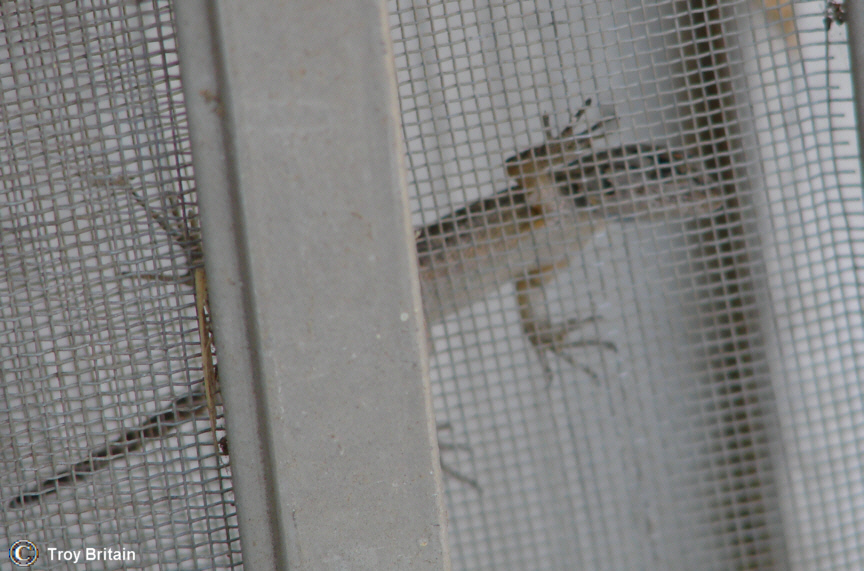
The weather was nice today (Sunday 4-22-12); sunny but not too hot, so I spent a couple hours over at my parents’ house today wandering around the yard looking for critters like I used to do when I was kid. Only this time I was armed with a camera instead of a jar or coffee can, intending to capture images rather than bodies. My target was the host of lizards that have taken up residence in my parents’ yard; specifically Western fence lizards (Sceloporus occidentalis).

When I  was a kid used to find all sorts of invertebrates, miscellaneous insects (of course), solifugids (“sun” or “wind scorpions”) and one time I even found a tarantula (probably a Aphonopelma; I damn near stepped on it while running through the back yard).

As for vertebrates I often found Slender salamanders (Batrachoseps) and the feisty Southern alligator lizard (Elgaria) but never any fence lizards. To find them I had to hike three quarters of a mile or so to an undeveloped area dominated by a rocky hill (a modest pluton locally known to us a “Lionshead”) where they were fairly abundant amongst boulders of decomposing granite.

This is not the case anymore.

I had noticed on previous visits that the fence lizards were around my parents’ yard but today I realized that the place was absolutely crawling with them. I have no idea what has changed in the environment that has led to an expansion of their range, from the hills and undeveloped areas to the middle of the suburbs, but personally I’m glad of it.

At first they played a little hard to get. It was already afternoon and while it wasn’t really hot it was warm so their metabolizes were no doubt running at nearly at mammalian levels. So they would dash for cover before I got too close.
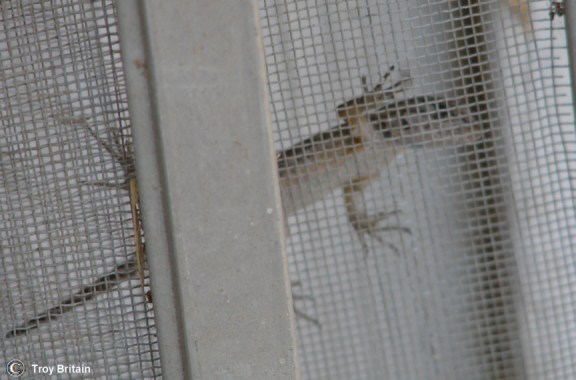
This little one was hiding behind some old window screens at the back of the garage. It had a larger companion who was missing part of its tail, however I couldn’t get a picture of it. Read on»

Scientific American Responds, receives a “Tip of the Hat”

I recently reported that Scientific American had posted some misinformation about the extinct equid Hyracotherium (Eohippus) on their website and have since received a short e-mail from Katherine Harmonauthor of the slide show which drew my irethanking me for catching the mistake and informing me that she had changed the entry.

When I checked it out I found that not only had she removed the inaccurate information about Richard Owen thinking that Hyracotherium had been some sort of hyrax but she put in an asterisk and footnote stating that the correction had been made! So she not only corrected the mistake but owned having made it by noting the correction rather than simply flushing it down the memory hole.

Well done Ms. Harmon; much respect!

Now I have to start seriously thinking about changing the darn Wikipedia entry that caused the confusion in the first place…

Symphony of Science – The World of the Dinosaurs

[Hat tip to Brian Switek]

Something creationists wish existed

[Hat tip to Larry Moran at Sandwalk.]

Camouflage

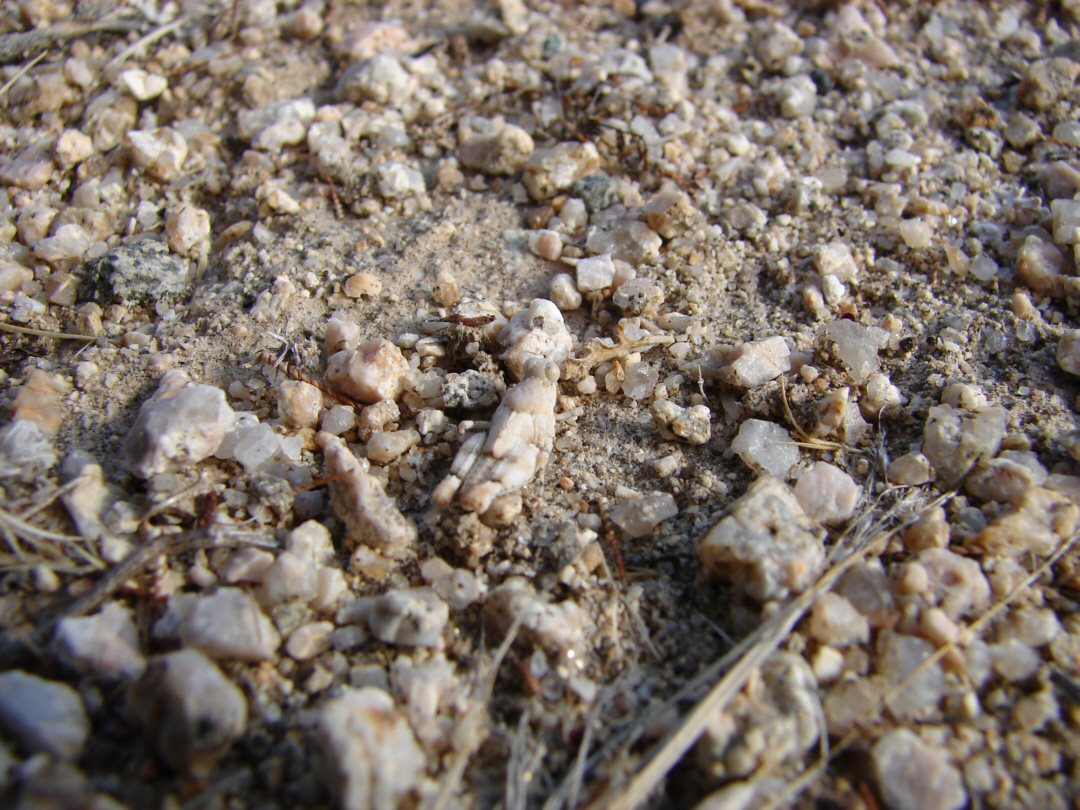
I was looking through some “old” pictures I had taken and ran across this excellent example of crypsis:

Can you see me?

Photo taken in Joshua Tree National Park (California), six years ago tomorrow (3-12-2006).

The 45th Carnival of Evolution is now available!

And it’s just lousy with bugs! This month the Carnival of Evolution hive is infesting Splendour Awaits, weblog of photographer and amateur insect enthusiast Adrian Thysse.

Creep or crawl your way over there and check out all the invertebrate wonderfulnessness!

Note: The Carnival is trying something a bit new this go around by presenting the article summaries and links in Google Docs – Presentation (a slide show format). If you have any difficulties seeing the slide window, please try another browser (Google Chrome worked best for me).

Previous Carnivals of Evolution:

If you missed any of these you’ll definitely want to go check them out!

Creationists are just buggy about bugs

A few months back Frank Sherwin,  “Senior Science Lecturer” at the Institute for Creation Research, launched an amusing attack on evolution that is nigh on word-salad; this time focusing on insects, and how they are supposedly problematic for evolutionary theory.

As usual it is stated with the confidence and the faux authority that is typical of “creation science” practitioners but when you actually look at it and try to make sense of what is being said it quickly becomes apparent that much of it is really unintelligible nonsense.

Read on»

Hyracotherium misinformation at scientificamerican.com

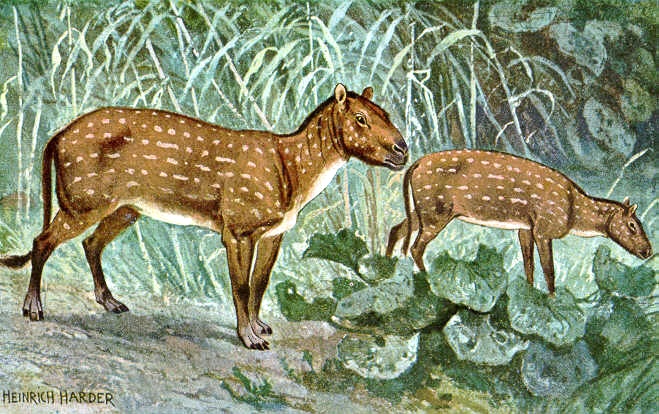
I am going to give another wag of the finger, this time to Scientific American. They posted a number of paintings of reconstructions of various extinct “horses” in a picture gallery titled “Ancient Miniature Horses”, which includes an entry for the famous “dawn horse”, Hyracotherium.

However, the problems lies not in the painting, which is probably a reasonable guesstimate of what Hyracotherium might have looked like in life but rather with the blurb of information included with the painting:

Hyracotherium This genus of small early horse roamed the early woodlands of Asia, Europe and North America some 55 million to 45 million years ago. It was already larger than Sifrhippus, weighing about 22.7 kilograms. But when Richard Owen first discovered Hyracotherium in 1876, it was so diminutive that he thought it was some unknown hyrax species, a group of extant mammals that live in Africa and the Middle East. 

Painting by Heinrich Harder used by S.A.

No, no, no, a thousand times no! It is bad enough when creationists claim that Hyracotherium is merely a hyrax (rather than a ancestral horse) and claim that Richard Owen thought so as well but to have a venerable science publication like Scientific American falling into the same pit of misinformation is extremely vexing.

Read on»