
Answers in Genesis memory holes a glaring error but fails to notice others

While doing some research for a potential post, I was going back and reviewing some of the obvious and indisputably false statements made by creationists that I have documented here on PCwP and in doing so discovered that Answers in Genesis has relegated one of these blunders to the memory hole.  In this case, it seems that AiG would rather we forget that their in house “anatomist”, Dr. David Menton, apparently cannot keep his saurischian (“lizard hipped”) dinosaurs and his ornithischian (“bird hipped”) dinosaurs straight—a basic distinction that any child interested in dinosaurs knows.

This by itself would be reason enough to revisit Dr. Menton’s article however an even better reason might be the fact that the interwebs is currently abuzz with the news that Bill Nye (The Science Guy) has agreed, perhaps unwisely, to debate creationist preacher Ken Ham—Dr. Menton’s boss at AiG—this coming February 4th (2014). I believe what follows should give the reader some insight into both the commitment to principled scholarship and the scientific caliber of the people behind Answers in Genesis.

Now You See It, Now You Don’t

As I noted in back in my February 2009 post,Four and twenty sauropods baked in a pie“, Menton erroneously identified sauropod dinosaurs—long necked giants like Apatosaurus, a.k.a brontosaurus—as being “bird-hipped”, or ornithischian, dinosaurs, making a point of how un-birdlike these massive dinosaurs were, in an article titled “Did Dinosaurs Turn Into Birds?“.

Here is how this section of the article read at the time:

Menton: All dinosaurs are divided into two major groups based on the structure of their hips (pelvic bones): the lizard-hipped dinosaurs (saurischians) and the bird-hipped dinosaurs (ornithiscians)[sic]. The main difference between the two hip structures is that the pubic bone of the bird-hipped dinosaurs is directed toward the rear (as it is in birds) rather than entirely to the front (as it is in mammals and reptiles).

But in most other respects, the bird-hipped dinosaurs, including such huge quadrupedal sauropods as Brachiosaurus and Diplodocus, are even less bird-like than the lizard-hipped, bipedal dinosaurs such as the theropods. This point is rarely emphasized in popular accounts of dinosaur/bird evolution. [Emphasis mine]

This conspicuous blunder, of both taxonomy and comparative anatomy, remained on the AiG site for about five years, then somewhere between April 19th and May 22nd 2013—going by the snap-shots the Internet Archive Wayback Machine takes of websites—they quietly changed this part of the article to read thusly (changes in bold):

Menton: All dinosaurs are divided into two major groups based on the structure of their hips (pelvic bones): the lizard-hipped dinosaurs (saurischians) and the bird-hipped dinosaurs (ornithiscians)[sic]. The main difference between the two hip structures is that the pubic bone of the bird-hipped dinosaurs is directed toward the rear (as it is in birds) rather than entirely to the front (as it is in mammals and reptiles).

But in most other respects, the bird-hipped dinosaurs, including such bizarre creatures as the armor-plated ankylosaurs and the horned ceratopsian dinosaurs, are even less bird-like than the lizard-hipped, bipedal dinosaurs such as the theropods. This point is rarely emphasized in popular accounts of dinosaur/bird evolution. [Emphasis mine]

As you can see, the inaccurate listing of saurischian sauropods, as ornithischians, has become an accurate listing of some actual ornithischians. Which is all well and good, however there is no asterisk, no editor’s note, no update, nothing to let their readers know about this rather spectacular error or the changes made to correct it. It is just gone as if it never happened.

Way to be intellectually honest Answers in Genesis!

Innuendo Ad Nauseam

I will not rehash all the information about the similarities between the hipbones of theropod dinosaurs and various birds, both fossil and living, you can go back and look at my previous post on Menton’s mistake for that. However I am going to take a run at his attempted insinuation (in the last sentence quoted above) that paleontologists are somehow embarrassed by the fact that ornithischian dinosaurs, with their bird-like hips, were otherwise not particularly bird-like and therefore don’t like to bring them up when talking about bird origins.

This makes sense only if you A) have a low very opinion of scientists and think they are involved in a conspiracy to hide things from the general public (which creationists do). And B) are wed to the idea that the superficial resemblance of one feature must imply a close evolutionary relationship; but who does this (aside from creationists that is)?

These two paragraphs of Menton’s article are essentially an irrelevancy, which exists solely for making this innuendo. There may have been some 19th century paleontologists who were impressed by the superficial resemblance of the pelvic bones of ornithischians to those of birds but with very few exceptions (Galton 1970), this idea has been long abandon. If this is “rarely emphasized” in popular discussions of bird evolution it is because it is only of historical interest and not relevant to the current best science on the subject.

That said, some popular works on the subject do in fact discuss it, even including discussions of the armored dinosaurs that Dr. Menton is so keen for us to consider.  For example, pulling something of my bookshelf, there is a section of Lowell Dingus & Timothy Rowe’s book The Mistaken Extinction (1998, pp.170-177) where they go on for several pages discussing the different types of ornithischians and how they are, or rather are not, similar to birds.

On the web, there is The University of California, Berkeley Museum of Paleontology’s website that talks about this on their page about ornithischians and hidden in the deep recesses of Wikipedia, where no one is likely to find them, there are multiple references to ornithischians in relation to birds. For example, both the Origins” section of Wikipedia’s entry on the evolution of birds and the entry for ornithischia talk about ornithischians and birds.

Finally, returning to the printed page, there is every creationist’s most favorite expert on bird evolution* Alan Feduccia (Professor Emeritus at the University of North Carolina), who discussed this in his book The Origin and Evolution of Birds (1999):

Very early on …dinosaurs branched into two major groups delineated by the structure of their hips: the reptile-hipped saurischians and the bird-hipped ornithischians. There has long been a strong temptation to try to derive birds from ornithischians because of this amazing but anatomically superficial resemblance of the hips. Gerard Hellmann in 1926 wrote that “the mere fact that [the pubis] was directed backward, like that of the birds, has evidentially hypnotized several scientists that they have overlooked, or tried to set aside, the many conspicuous differences between the birds and the Predentates [Ornithischia]” (148). …Ornithischians were highly specialized herbivores, too far removed from the main line of dinosaurian evolution to have given rise to any major group. Their line dead-ended with such forms as the duckbills, armored ankylosaurs, plated stegosaurs, and horned ceratopsians like Triceratops.  [Feduccia 1999, pp.51-52, Emphasis mine]

As you can see, it is all a big dark secret that evolutionists do not want getting around, so please, please, dear reader, do keep it to yourself.

This Little Piggy Went To Market…

Of course here I have once again been picking the fly poop out of the pepper, taking time to quibble over something nuanced when I should be telling you about how Dr. Menton, has dropped another huge coprolite into our collective cornflakes.

You see while I was revisiting Dr. Menton’s article I decided to take a little more time with it and in doing so I noted a few more amusing anatomical errors. The most glaring having to do with the dromaeosaurid dinosaur called Deinonychus:

Menton: While evolutionists now agree that birds are related in some way to dinosaurs, they are divided over whether birds evolved from some early shared ancestor of the dinosaurs within the archosauria (which includes alligators, pterosaurs, plesiosaurs, ichthyosaurs, and thecodonts) or directly from advanced theropod dinosaurs (bipedal meat-eating dinosaurs, such as the wellknown [sic] Tyrannosaurus rex). The latter view has gained in popularity since 1970, when John Ostrom discovered a rather “bird-like” early Cretaceous theropod dinosaur called Deinonychus.

An adult Deinonychus measured about 12 feet (3.5 m) long, weighed over 150 pounds (68 kg), and was about 5 feet (1.5 m) tall standing on its two hind legs. Like other theropods (which means “beast foot”), Deinonychus had forelimbs much smaller than its hind limbs, with hands bearing three fingers and feet bearing three toes. The most distinctive feature of Deinonychus (which means “terrible claw”) is a large curved talon on its middle toe. [Emphasis mine]

Without getting distracted with the false equivalency Dr. Menton makes between the minority, “(unknown) archosaur origin” camp and the majority “theropod origin” camp*, his description here of the feet of Deinonychus is wrong on at least two counts.

First, Deinonychus like most theropods (and birds) had four toes, not three as Dr. Menton states. In Deinonychus‘ case, three robust forward facing toes and one somewhat reduced backward facing toe—the fifth digit is reduced to a splint bone (Ostrom 1969, p.124).
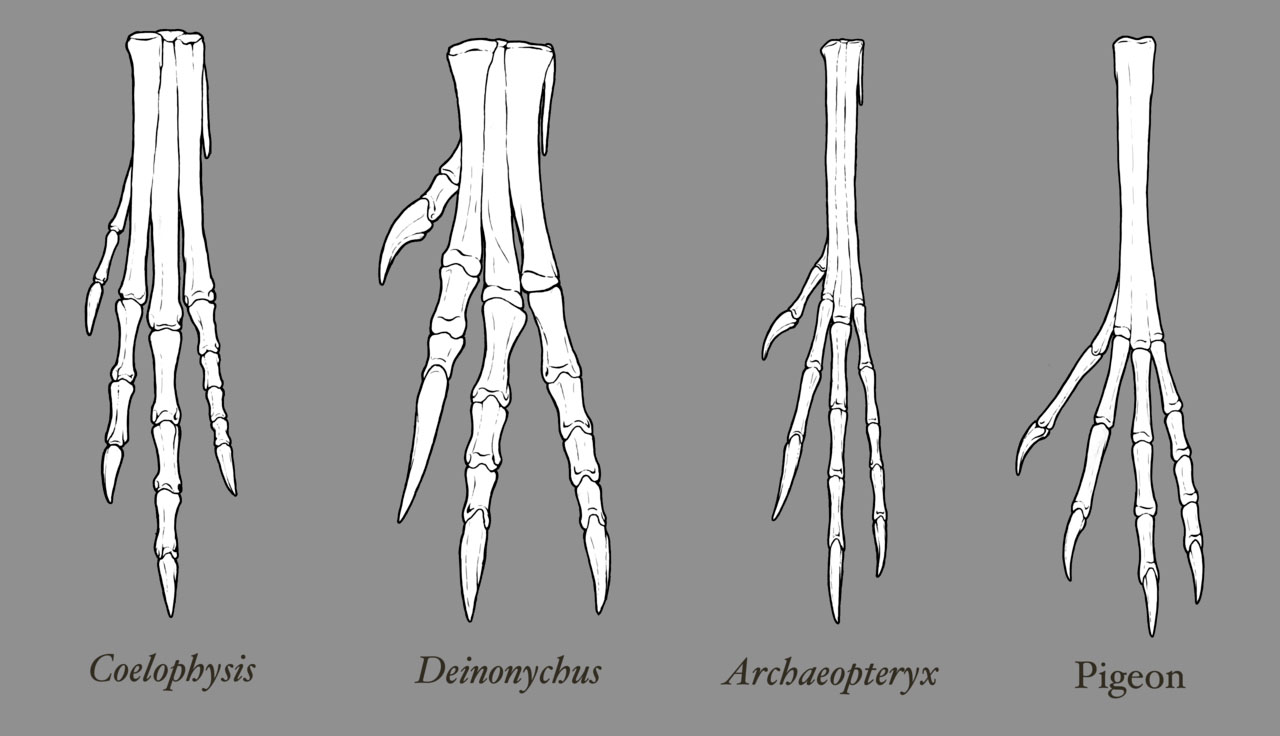

dino-bird-feet-compComparative illustration composed by Emily Willoughby (used with permission).


Second, the large curved claw that gives Deinonychus its name is on the anatomically second toe, not the third, which is the “middle” toe in tetrapods. Nor is it on the “middle toe” if we ignore the existence of Deinonychus‘ reduced first toe (hallux) and pretend it only had three forward facing toes. Even in this case the enlarged toe claws of Deinonychus are on the inside toes of its feet, not the middle toes.
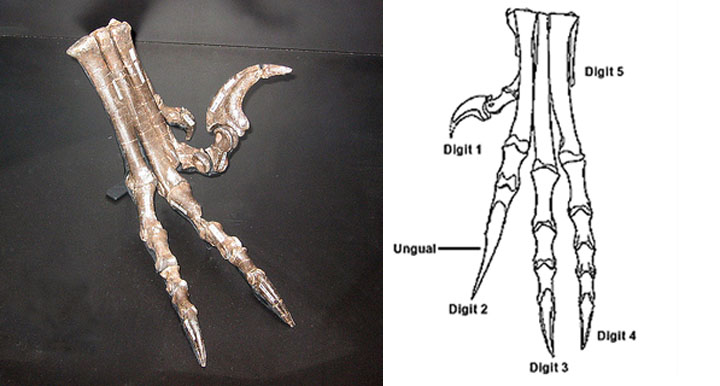

Deinonychus feetThe photograph on the left is by Denver W. Fowler and was taken of a specimen on display at Museum or the Rockies, Bozeman, Montana (used with permission, for more on Deinonychus see Fowler et al., 2011). The drawing on the right is from the Yale Peabody Museum website.


So no matter how you count these little piggies, whether from a technical anatomical perspective, or just informally, Dr. Menton, creationist anatomist extraordinaire, is mistaken once again.     

This leads to a couple of questions. If Dr. Menton does not know such basic facts as, what types of dinosaurs are ornithischians or saurischians, how many toes theropod dinosaurs had, or which toes are which, why should anyone take his opinions on the more complex question of the evolutionary relationship between theropods and birds seriously?  

And why would anyone put their trust in Answers in Genesis as a reliable source of information if they apparently willing to cover up this sort of ignorance, which had been on their site, misinforming their readers for years, by quietly changing things without any sort of notice or acknowledgement?

I leave the answers to the reader.

It Is Thus Because It Pleased God To Make It Thus

There is much more in Menton’s article that needs to be addressed and I am going to separate those into a second post. However, there is one last statement by Menton to attend to here. You see just about right in the middle of his article Menton dropped an anti-science bomb that seems to render the rest of his arguments effectively meaningless.   

Menton: What would it prove if features common to one type of animal were found on another? Nothing. Simply put, God uses various designs with various creatures. Take the platypus, for example—a mosaic. It has several design features that are shared with other animals, and yet it is completely distinct. So if a dinosaur (or mammal) is ever found with feathers, it would call into question our human criteria for classification, not biblical veracity. What’s needed to support evolution is not an unusual mosaic of complete traits, but a trait in transition, such as a “scale-feather,” what creationist biologists would call a “sceather.” [Emphasis mine]

I’ll save my barbs about the platypus, feathered mammals and “sceathers”, for part two, because the main point here (which makes those things and pretty much everything else in his article irrelevant) is Menton’s offhanded dismissal of the significance such things as feathered dinosaurs. His statement essentially boils down to an argument that such things as feathered dinosaurs, fish with feet or “ape-men”—you know, transitional or intermediate forms—are merely the creations of a whimsical deity who chose to arbitrarily to mix and match characteristics of different groups of organisms and are therefore irrelevant. After all God can make anything, in anyway he chooses and for any reason he see fit to do so.

This is also known as “using the miracle card” or an appeal to magic. Dr. Menton is of course free to do this; however, in doing so he abandons all pretence of doing science, or even attempting to make rational arguments.   

Why does he bother arguing about different anatomical or physiological features of dinosaurs and birds? Why does he bother to fold, spindle, or mutilate the facts about these things and to misquote scientists regarding them (more on this in part two), if in the end you just going to say, “regardless of the facts, it is the way it is because God did it that way, period”?

It would save everyone a lot of time if he just said this sort of thing up front, so that rational people, who actually accept science and who care about the facts, will know that his claims can be dismissed without further consideration.

So, those are the major things I wanted to address first—and where some of you might want to stop and get off—however, for those of you who are gluttons for punishment, there is, as I said, much more in Dr. Menton’s article that is of false and or misleading nature to be addressed. I will examine those in a separate post.

Fairly warned ye be!

Footnote

*Alan Feduccia is part of a shrinking minority of scientists who deny the evidence that birds evolved from theropod dinosaurs in favor of an older hypothesis that birds evolved from an earlier unknown group of archosaurs (a group that includes crocodilians, pterosaurs, dinosaurs and smattering of other extinct types). Their frequent and often strident attacks on the evidence that birds evolved from theropod dinosaurs make Feduccia, and others like him (the late Larry Martin for example), the go to scientists for creationists to quote on the subject of bird evolution. Creationists use their attacks on the mainstream view of bird evolution to try to cast doubt on whether birds evolved at all.

See:

References

Dingus, Lowell & Rowe, Timothy (1998) The Mistaken Extinction, W. H. Freeman and Company, New York, NY

Fedducia, Alan (1999) The Origin and Evolution of Birds (2nd Edition), Yale University Press, New Haven, CT  

Fowler DW, Freedman EA, Scannella JB, Kambic RE (2011) “The Predatory Ecology of Deinonychus and the Origin of Flapping in Birds“, PLoS ONE 6(12): e28964

Galton, Peter M. (1970) “Ornithischian Dinosaurs and the Origin of Birds”, Evolution, 24(2): 448-462

Ostrom, John H. (1969) “Osteology of Deinonychus antirrhopus, an Unusual Theropod from the Lower Cretaceous of Montana”, Peabody Museum of Natural History Bulletin, 30:1-165

All in the family

Credit: M.F. Bonnan via "I f***ing love science (on Facebook).

Credit: M.F. Bonnan via “I f***ing love science (on Facebook).

Yes, exactly! A significant percentage of the population (cough, creationists, cough) doesn’t understand that the evolutionary relationships between species is a lot like that between extended family members; just over a much longer time scale. Phylogeny is primarily a branching (family) tree-like pattern, not a single file, ladder-like, progression (cladogenesis vs. anagenesis).


Addendum: It has been pointed out to me that the cartoons depiction of a family “tree” superimposed on a cladogram is somewhat inapt and I absolutely agree that the cartoon is by no means a perfect analogy (comparing speciation, species giving rise to new species, with two parents coming together and bearing children). However, I think it gets the idea across much better than the linear iconography that has become so entrenched in peoples minds. Especially, I think, concerning the relationships between fairly closely related species like between chimps and humans. People incorrectly tend to think of humans as somehow being directly descended from chimps rather than our being “cousins” descended from a common “grandparent” (that was probably somewhat chimp-like in appearance).


Once you grok this fact you will understand what is fundamentally wrongheaded about questions like: “If humans evolved from [share a common ancestor with] apes why are there still apes?”

This sort of question is, except for the timescale involved, just like asking: “If you and your cousin share a common ancestor (grandmother), how can you both exist at the same time?”

Understanding this also answers the common creationist objection against many transitional fossil series based on species overlapping in time. For example:

“Early” horses have been preserved in strata from the same evolutionary age as several ‘”later” horses

Hyracotherium/Eohippus and Orohippus do for instance appear in the fossil record at the same time as Epihippus. Mesohippus and Miohippus appear together with Merychippus and Parahippus. Almost all other horses (with a possible exception of one or two)—Parahippus, Merychippus, Pliohippus, Equus and possibly also Miohippus—are represented at the same time during much of the period when they have been found as fossils.16 (But especially in the newer evolutionary schemes, different names have been given to very similar animals, giving the appearence of evolution as well as providing fame to their discoverers; see examples in Froehlich 20029 and MacFadden 20054). Fossils of Hyracotherium (sic) have also been found very high up in the strata (Pliocene), but these findings have been rejected as reworked (i.e. eroded and deposited at a later strata) in spite of the fact that the geological observations do not show any signs of disturbance.17 Thus, the fact that most of the horses lived almost at the same time undermines their proposed evolution. (Molén, 2009, emphasis mine)

Buzzzt, sorry but that is incorrect, thank you for playing, here is a home version of our game as a consolation prize.*

The coexistence of two genera of horses does nothing to undermine their evolutionary relationship any more than your grandparent or cousin coexisting with you undermines your familial relationship.

Evolution does not require that a parent species become extinct after a speciation event (after it gives “birth” to a new daughter species) nor does it require that once two lineages split apart that both will change at the same rate or in the same direction.

Fossil species A could be directly ancestral to species B, persisting relatively unchanged after the two lineages have split. Or species A could be a cousin to species B that only strongly resembles an as yet undiscovered common grandparent species. Such distinction are very difficult to make in fossil organisms.

[* Note: This is not even close to a comprehensive dissection of the problems with quoted article or even this paragraph.]

Reference

Molén, Mats (2009) “The evolution of the horse“, Journal of Creation 23(2):59–63 (downloaded on 9-14-2013)

The evolution of feathers in about 3 and a half minutes

By Carl Zimmer:

[Hat tip to Brian Switek.]

Fossil Rock Anthem

A little bit of musical paleo fun (hat tip to Mr. Weitzenhoffer):

For those unfamiliar the video for the original “Party Rock Anthem” by LMFAO can be found here.


Fuzzy thinking about fuzzy dinosaurs

A visual approximation.

Casey Luskin, the Discoveryless Institute’s resident attack chihuahua, is on a roll. This time he’s gone off on a tangent about a recent find of yet another dinosaur fossil with evidence of protofeathers, Sciurumimus albersdoerferi and dinosaur evolution in general.

Luskin: The media that loyally serve Big Science are at it again, overstating the finds of a scientific paper to promote an evolutionary icon. This time, the icon is feathered dinosaurs, representing the purported ancestral relationship between dinos and birds. (Luskin 2012)

Ah, if only. If only Mr. Luskin’s conspiratorial fantasy were true and the media was that on the ball. The fact of the matter is that defenders of science education like me often cringe at the mischaracterizations and overstatements that come out of the popular media regarding evolution. I am constantly shaking my head and yelling at the TV or radio “no, that’s not what that means at all”, or words to that effect.

I wish I had a nickel (because being underemployed I could really use the money) for every time a silly reporter, while talking about some fossil discovery, described it as “overthrowing everything we thought we knew about the evolution of X”.

That is absolute bollocks, 99% of the time.

Read on»

How could evolutionary theory be falsified?

cambrianrabbit

A rabbit fossil in Cambrian rock would be difficult to understand under current evolutionary theory.

Creationists often charge that evolutionary theory is unfalsifiable; that there is no way to potentially disprove it, if it were in fact incorrect. This is in essence an “I know you are but what am I” response to their critics who have rightfully pointed out that “God did it” as an explanation is not testable against the evidence from the natural world and therefore not a valid scientific explanation for anything.

This is because hypotheses, in order to qualify as scientific, must be testable against observable evidence in the natural world. In other words, in addition to there being potential observations that might support a given hypothesis, there should likewise be some potential observations that would tend to disprove a hypothesis.

Since God can do anything in any way, for any reason, here are no potential observations of the natural world that could disprove God’s involvement, which means the “God did it” hypothesis is unscientific in character.

In any event, is it true, as creationists charge, that there are no potential observations that would tend to disprove evolutionary theory?

The short answer is no, it is not true. However, for something more in depth you should head over to Why Evolution Is True where biologist Jerry Coyne provides several scenarios that would be highly problematic for current evolutionary theory.

In my general talk on the evidence for evolution, I give a list of seven observations that, if repeated and confirmed, would disprove parts of the theory of evolution described above. This shows that it is a scientific theory in the Popperian sense of being falsifiable.  Here are some of those conceivable observations:

  • Fossils in the wrong place (e.g., mammals in the Devonian). If the fossil record were all out of order like this (a single anomalous fossil might not overturn everything, of course, since it could be in the wrong place for other reasons), we’d have to seriously question the occurrence of evolution.

I recommend you hop over and check out the rest.

The last thing I want to say about this particular creationist claim, is that in addition to it being false, it is also stands in rather blatant contradiction to what creationists do on a regular basis, which is to argue that this or that bit of evidence somehow counts against evolutionary theory.

I mean what sense can we make of Duane Gish’s book Evolution, the Fossils Say No! (1978) if he was not arguing that the fossil evidence was disconfirming of the evolution hypothesis?

The mind boggles.

[And now John Wilkins, or some other philosopher of science, will yell at me about Popperian Falsificationism being passé with regards to the demarcation problem. Just to head that off somewhat I am not advocating naive falsificationism.]

Uh oh, I may not be legal

To be filed under “Better Know Your Blogger”:

The archaeological dig being conducted by my mother at my parents house continues. Unfortunately this time she has unearthed evidence that I may not be a properly licensed Dinosaur Hunter (at least in the state of Utah)!

It seems that while I got the license itself (when I was 10 years old), it was never properly filled out:

The address has been redacted, but missing from the original is the signature of the Deputy Lizard Warden of the time, Al E. Oup. This could be a problem next time I’m in Utah!

Deputy Warden Oup (or Oop as it is more properly spelled) with one of his charges.

I had totally forgotten about this fun bit of tourist ephemera, which as it turns out, they still give out at Dinosaurland in Vernal, UT. In fact you can download a copy of the much fancier current Dinosaur Hunting Lic. from their website. Though I notice that the current Deputy Lizard Warden is now given as being “Al O’saurus” (obviously the Al E. Oup joke is for a past generation). But at least it comes pre-signed to spare future dinosaur hunters the legal difficulties that I am apparently going to have to endure.

Here’s a fun game kids, how many typographical and/or scientific errors can you find in the license?

“Reason and creationism”

My friend and colleague (frienlleague?) Dr. Eugenie Scott gave, yet another, excellent talk titled “Reason and creationism” at the Global Atheist Convention, Melbourne, Australia (4/15/2012). Have a watch:

NCSE Home Page

“What Can YOU Do to Support Intelligent Design?”

A visual approximation.

Over at the Discovery(less) Institute’s Complaint Dept., resident attack chihuahua, Casey Luskin answered some fan mail that supposedly asked how people, sans financial resources, could support intelligent design (creationism). He suggests a variety of things that boil down to: submerge yourself into the intelligent design creationism bubble and pester your kid’s teachers and school administrators into foisting creationist misinformation onto their students:

There are lots of ways you can support Discovery Institute and ID in ways that don’t involve money. One of them — liking Discovery Institute’s Center for Science & Culture on Facebook of course — you already did. You could also become a follower of our Twitter account, follow our podcast on Twitter, or listen to ID the Future online. Reading Evolution News & Views will help keep you up-to-date on the debate. You can also subscribe to our Nota Bene newsletter, which is free.

Those are all ways for you to stay informed. But there are also ways that you can reach out to others. These include:

  • Start your own ID blog, or participate in other ID blogs like Uncommon Descent. It’s always good to have pro-ID voices on the Internet, although I’ll warn you that lots of Internet ID-critics just want to shout you down and call you nasty names, so it’s not uncommonly the case that you’d be wasting your time by engaging them.
  • Become a voice for academic freedom in your local community. One easy thing you can do is sign the Academic Freedom Petition. You can write letters to the editor to local newspapers, calling on them to stand up for good science education and provide corrections to misinformation or biased reporting on this issue.
  • Another constant need is to ensure that your local public libraries, secondary school libraries, and university libraries have up-to-date copies of intelligent design books. Even if you don’t have the money to donate the books, recommend books to the library and ask if they would consider adding them to their collections.
  • You might consider starting a local organization to increase awareness about intelligent design. A great way to do this is to start an Intelligent Design and Evolution Awareness (IDEA) Club. These extracurricular clubs are affiliated with the IDEA Center (which is a distinct organization from Discovery Institute), but they can organize events on local college campuses or in communities to show videos or bring speakers to educate the public about the issue. IDEA Clubs are a great way to raise awareness and understanding of the scientific case for intelligent design in your local community — you could start one yourself, or help a student do so. See www.ideacenter.org for details.
  • Besides IDEA Clubs, if you know university students who are interested in ID, you can encourage them to get involved with Discovery Institute’s Summer Seminars on Intelligent Design. And if you know pre-college students who are college-shopping, encourage them to consider how the school they’re going to attend deals with topics like the origins of life and of human beings. (Note: I went to a science-focused public university that was largely anti-ID and had a great experience, so I’m not saying students must go to a pro-ID college. But they might want to consider this issue, one way or another, when they apply.)

Finally, another way you can make a difference is to advocate for positive changes in education in your local school or community. If you have kids, find out how their schools cover evolution. For public schools, we recommend that they teach the scientific evidence for and against Darwinian evolution without getting into alternative theories like intelligent design. A lot of this is explained in our Briefing Packet for Educators — but if you want to get involved more directly, contact us here at Discovery Institute and we can help you. For private schools, we have another list of recommended resources, which I recently discussed here.

What is significant by its absence from this list is any suggestion that his readers should directly familiarize themselves with what the overwhelming majority scientists are actually saying or with the actual evidence, unfiltered by the ID creationist spin zones that he lists.

Now I understand that Mr. Luskin probably believes that all of mainstream science is engaged in a global satanic conspiracy to hide the Truth ™ from the masses, but for the sake of intellectual rigor he should want people to be familiar with the thing that they are fighting so fiercely against; and not just the version presented in the IDC echo chamber.

If someone asked me how they could prepare themselves to deal with creationists I would tell them that they need:

  • A good grasp of modern evolutionary theory and the broad evidence behind it both paleontological and neontological (preferably including some reading of the primary scientific literature), as well as a smattering of other sciences that touch on historical issues (cosmology etc.).
  • At least a basic knowledge of the history and philosophy of science (especially the histories of biology and geology).
  • And, most especially, a thorough knowledge of creationist arguments through direct reading of creationist literature (and other media) and the history of the creationist movement (I highly recommend Ronald Numbers book The Creationists (2006) for that last part).

Of course, no one can be an expert in all the relevant fields of science. Even most scientists, while they might be experts in their particular area of study, may have only a basic grasp of the several other fields outside of their own that is required in order to effectively counter creations claims. You can start off talking with a creationist about cosmology—because many of them do not understand that the Big Bang theory is not part of evolution—and in quick succession be grilled about various aspects of geology, biology and physics.

Worse yet, most scientists have only superficial level of knowledge regarding creationist arguments and tactics, which makes sense given that they trained in doing science and not counter apologetics. Moreover, many feel, with some justification, that to get such training is a waste of their valuable time. Unfortunately, this can lead to public relations setbacks for science education if they then allow themselves to be snookered into formal debates with professional creationists.

Again, from my experience you need not only a basic knowledge of a variety of scientific subjects—especially geology, paleontology and biology—but a good knowledge of creationist arguments in order to keep from getting steamrolled by the creationist shotgun approach to debate (a.k.a. the “Gish Gallop“).*

For that reason, unlike Mr. Luskin, I strongly encourage people, both scientists and interested laypersons, to study the work of the opposition, not just what people like me say about it.

[*I would generally advise against live public debates in the first place. Instead, stick to written ones that do not allow creationists effective use of the Gallop in the first place.]