
More scientific ignorance from Dr. John Morris

Dr. John Morris, president of the Institute for Creation Research is at it again. Apparently not content with advertising his abject ignorance of zoology as he did a few months ago when he listed tunicates (phylum chordata) along with sea stars as members of the phylum echinodermata, he is now letting everyone know that he is equally incompetent to comment intelligently on the subject of paleontology (I know, I am as shocked as you are).

More specifically he has come out attacking the classic fossil evidence for the evolution of the horse in the September (2008) issue of ICR’s Acts & Facts.

Morris: Horse evolution prominently appears in textbooks as a supreme example of the evolution of one body style into another. All students remember the “horse series” sketches, tracing the development of a small browser named Hyracotherium (formerly known as Eohippus) with four toes on the front feet and three on the rear, into the large one-toed horse of today. Intermediate steps included the three-toed Mesohippus, a modified horse with one toe touching the ground [Emphasis mine]

Mesohippus_toes_arrows

Wrong right off the bat. The fact is that with Mesohippus all three toes touch the ground as can be seen in the above photo of a mounted fossil at the Chicago Field Museum. This is especially true when it is taken into account that Mesohippus probably would have had pads on its feet similar to those found in tapirs.

Tapir hooves

Tapir hooves

Read on»

A tiny intruder

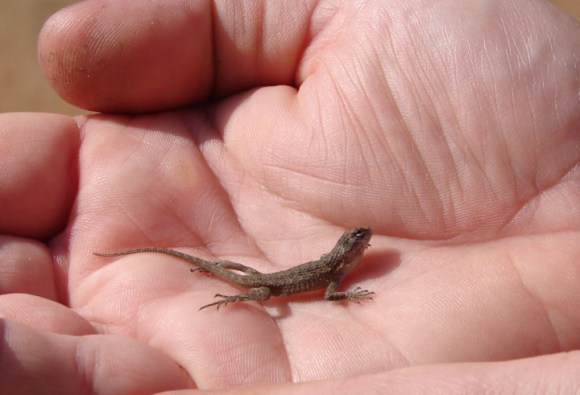
My wife (Kathy) woke me up this morning telling me there was a “baby in the bathroom”. Naturally enough I asked “baby what?”. “A lizard” she said.

Now we generally have only two types of lizards around where I live (in Southern California), the Southern Alligator Lizard (Elgaria multicarinata) and the Western Fence Lizard (Sceloporus occidentalis). Usually when I find a lizard in the house it’s an alligator lizard. They’re nasty little buggers who bite (the larger ones can draw blood), wipe feces on you and drop their tails if you breath on them too hard.

Elgaria multicarinata

So I asked my wife which kind it was. She said, rather insistently, that she didn’t know and that I should get out of bed and look for myself. Here is what I found in all its cuteness:

baby_liz

After briefly toying with the idea of keeping it (because it was so damn adorable) we decided to let it go in an area beside the house where we frequently see its relatives. We wished it best of luck and sent our tiny intruder on its way.

You can tune a piano but you can’t tunicate…

The May (2008) issue of the Institute for Creation Research‘s monthly newsletter Acts & Facts contains an article by the current President of ICR, Dr. John Morris, titled “Evolution’s Biggest Hurdles“. The article is ostensibly about enumerating unsolved questions in evolutionary theory but instead what it does is highlight a deeply rooted set of character flaws in the “creation science” movement and its leaders: intellectual laziness (and/or dishonesty) combined with a lack of basic scientific literacy and colossal hubris.

While I understand that this article is a relatively short, non-technical piece, this does not in my opinion excuse the glaring omissions of relevant evidence about its supposed subject. Nor does the fact that Dr. Morris has a background in geological engineering forgive the zoological ignorance it displays. I am not a zoologist. I don’t have any degrees, but still I was able to immediately spot some of the rather glaring zoological errors and omissions in what Dr. Morris wrote. For someone who has been involved in the creation/evolution debate as long as Dr. Morris has it is difficult to fathom how he could not be better informed on such basic issues.

Read on»

Arachnophilia

I ran across this video of some beautiful spiders, apparently from Thailand. The third one shown threw me for a second. If it’s not trying to be an ant mimic it is doing a pretty good job of it regardless. Anyway after seeing this I went looking and found a couple more interesting spider vids, check’em out.

Original video missing from YouTube.

Whatever you do, don’t piss it off…

This one is another jumping spider, this time doing a mating dance. Make sure your sound is turned on because you can hear it tapping, thumping and buzzing as it dances.

Original video missing from YouTube.

I’m still here…

Sorry for the lack of new posts but I am working on about three different things right now (and remember I have a day job ;) ). One is a big post on fossil horses, another post has to do with ICR and tunicates and lastly I am supposed to be helping on a rewrite of the Talk Origins Archive FAQ on the Lewis Overthrust (hi John).

The horse piece is dragging on a bit as it involves an ongoing correspondence with people from two major museums and a major university, and I’ve had to make two trips to the local UC library to pick up relevant papers.

So please bear with me, and hopefully it will all be worth the wait.

More from the Antarctic seas

Man that thing looks eerily like a trilobite! But unfortunately it is isn’t. It is however a neat little baby isopod (Ceratoserolis). Isopoda is the group that the woodlice, AKA pill-bugs, AKA sow bugs, that live in your garden belongs to. This probably won’t stop some young earth creationist from claiming it is a trilobite and that therefore evolution is (somehow) disproved, but what can you do?

From National Geographic News, “Bizarre New Deep-Sea Creatures Found Off Antarctica“:

A treasure trove of more than 700 new species has been uncovered in the dark depths of oceans surrounding Antarctica, researchers report. (See a photo gallery of the finds.)

Cool stuff!

Now those are some impressive echinoderms

1_461

They’re Macroptychaster sea stars and apparently they go along with a whole slew of possibly newly discovered species and large specimens of previously know ones found in Antarctic waters near New Zealand by a biological survey team.

Read on »

Quality control in science and history television

As you might imagine I enjoy watching science programing on TV, Nova, Nature etc. on PBS, and the commercial channels like the Discovery Channel and the History Channel. But you really have to take this stuff with a rather sizable grain of salt, especially the commercial channels which seem to have absolutely no quality control at all. The following are a few of examples that managed to aggravate me to the point of blogging on the subject.

Read on »