The not so itsy bitsy spider climbed out of the cactus

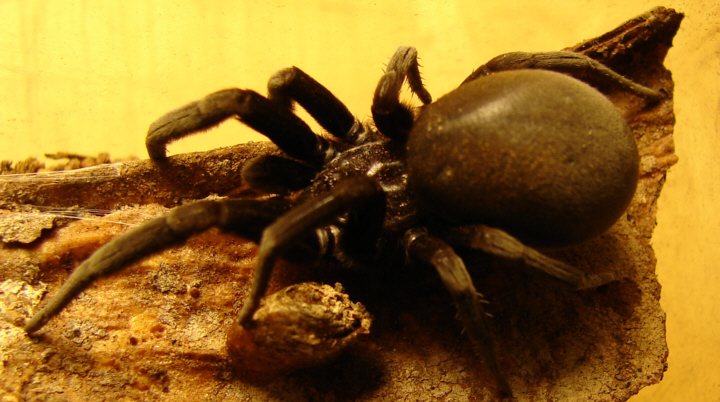
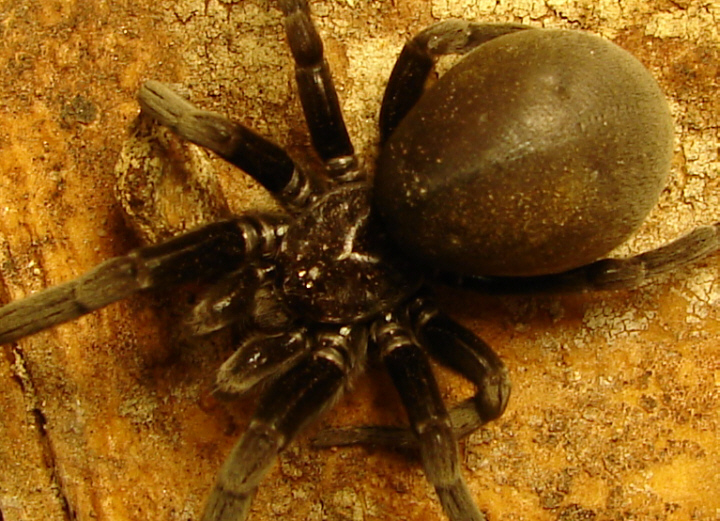
I was doing some long neglected yard work today and while pulling out some weeds around a dying bit of prickly pear cactus in the back yard I came upon this “little” beauty:

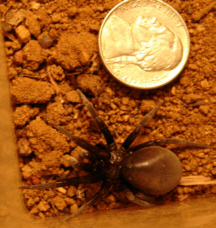
And here is one for scale:

OK, so it’s not a bird eating spider, the size of a dinner plate, but outside of a full blown tarantula it is the biggest spider I’ve seen in the wild around these parts (Southern California) since I was a kid. My first attempt at an identification would be a California trapdoor spider (Bothriocyrtum californicum), though it looks a little different from the pics I can find on the web and I didn’t find it associated with a trapdoor setup. It was just clinging to a bit of old prickly pear skin (an environment it was sharing with literally hundreds and hundreds of Eleodes).

Any spider guys out there that can confirm or correct my I.D.?

We need creationists lecturing us on evolution like we need another fenestra in the head

The Institute for Creation Research has presented the world with another taxonomic turd from the cat box of creationist wisdom. This time it comes from ICR’s “Senior Science Lecturer” Frank Sherwin. However before I get to the main event, I want to take a closer look at the litter in which Mr. Sherwin’s little jewel is nestled.

In the February (2010) issue of ICR’s monthly Acts & Facts Mr. Sherwin (whose background is in parasitology) graced us with an article titled “Darwinism’s Rubber Ruler” in which he argues that descent with modification is untestable and that “any and all scientific evidence” can be “stretched to fit” the theory.

The first thing that comes to my mind when reading this is to ask: if this is so, then how is it that I could have in my personal collection literally hundreds of books and pamphlets, many of them originating from Mr. Sherwin’s organization, that purport to contain absolutely scads of evidence that contradict evolutionary theory?

How about Dr. Duane Gish’s (the emeritus vice president of ICR) books Evolution the Fossils Say NO! (1978) and the update Evolution: the fossils STILL say NO! (1995)? How can the fossils say “no” to evolution if any scientific evidence (in this case fossils) can be “stretched to fit” the theory?

Read on»

Cetacean Intelligence

Here are a couple of great videos that I encountered via different sources within minutes of each other. Both demonstrate cooperative hunting and problem solving in toothed whales  (Odontoceti). The first, pointed out to me by my mother, is a beautifully photographed and (as always) nicely narrated by David Attenborough, clip of bottlenose dolphins (Tursiops) working together to create silt nets by hitting their tail flukes on the sea floor which they use to corral fish into a tight group.

The second is a CNN clip that comes via Jerry Coyne’s blog Why Evolution is True and it shows killer whales (Orcinus orca) working together to wash seals off of sea ice.

Fascinating stuff!

Epic Horse Exhaust

OK, it took me a while to get to it but I am, as promised, responding to creationist Arthur Biele’s lengthy comments left in response to my criticisms of his writings on horse evolution. For those interested I suggest you go back and read Mr. Biele’s article and my original critique first. Those that do I think will find that his response didn’t really answer any of my original criticisms. Instead what he did was dump a new load of barely coherent nonsense on me.

A warning though, this goes on for quite a bit (it sure felt like it while I wrote it), which is of course due to the well known fact that accurately and substantially responding to horseshit takes considerably more time and effort than it does to spewing it.

Biele: With regard to Eohippus, If you knew anything about the actual fossil record, Eohippus finds are many and that category has been a dumping ground for certain archaic partial skulls that defy any specific classification, nor are they known to be ancestors of any known ‘evolved’ descendants, and they are mostly from Europe.

While apparently attempting to impugn my knowledge of the “the actual fossil record” Mr. Biele clearly demonstrates his own ignorance of the subject at hand. Let’s break this down in order:

Read on»

Bow-chicka-bow-wow

And now ladies and gentlemen…, some HOT parrot on man action:

Or more specifically Kakapo (Strigops habroptila) on man action.

Is that not one of the funniest things you’ve ever seen?

Diane Blackwood on her alligator encounter

Vodpod videos no longer available.

Here’s another longer TV news story on the incident:

Vodpod videos no longer available.

Scary stuff!

Diane Blackwood, wife of my friend Wesley Elsberry, was attacked by an alligator in a park in St. Petersburg Florida while taking one of their dogs (Ritka) for a walk!

Diane & Ritka

Diane & Ritka

Wesley tells the story on his blog (The Austringer):

This past Monday, Diane was out house-hunting. She checked out a listing for a house that was interesting in part because it was close to a park. After looking at the house, Diane went over to the park to have a look at it, too. This was Sawgrass Lake Park in St. Petersburg, Florida, near I-275 and Gandy Boulevard. She took Ritka, our Vizsla, walking with her. Diane and Ritka were near the water’s edge at about 4:30 PM when Diane saw the water churn. She immediately called to Ritka and started moving away from the water. Ritka’s usual behavior is to run ahead, and that’s just what Ritka did. Diane, though, slipped on the slope and fell to her hands and knees, perhaps in part due to the slip-on “Crocs”-like shoes she was wearing at the time. The churning water was, indeed, a sign of a gator making a lunge, coming out of the water. The gator didn’t connect with anything on his first lunge, but he grabbed Diane’s left calf with his second lunge.

Fortunately Diane kept her wits about her and was able to escape with relatively minor injuries (‘minor’ only when considering how bad it could have been).

Diane turned and grabbed the gator’s jaw to discourage it from ripping her calf muscle. The gator then released her calf, but when it snapped its jaws shut the second time, Diane’s left thumb was caught there by a tooth. She says that she didn’t care to play tug with a gator, not with just her thumb as the part in the middle. She reached over with her right hand and grabbed the gator’s eye ridge. Diane says that after maybe 30 seconds to a minute of this standoff, the gator opened his jaws, releasing Diane’s thumb. Diane released the gator’s eye ridge. She says that she briefly had considered trying to hold the gator’s jaws closed and using Ritka’s leash to tie it up, but that she didn’t think that she was up to any more tussling with the gator. So the gator headed back to the water and Diane on up the bank and away.

Another bit of good news is that the authorities were apparently able to apprehend the offending (6+ foot) crocodilian:

This is one of those stories you hear about  on the news but don’t think about happening to people you know personally. Very scary!

My, and my wife Kathy’s, best wishes go out to Diane and we hope for her speedy recovery.

Fun with critters

Here we have a Ten-lined June beetle (Polyphylla s.) that my uncle found at work and thought I might like to have. What is fun about these critters is that they make a defensive hissing noise when touched. And that is beetle and not “bug” as I mistakenly say in the video.

Here’s a nice close up picture of a Polyphylla by Derrick Ditchburn on a site called “Whispers in Nature” (looks like they’ve got lots of nice critter pics):

Ten-lined June beetle (Polyphylla)

Ten-lined June beetle (Polyphylla)

Anyway, the poor little guy (actually I don’t know the sex of this individual), goes into the freezer to be dispatched. Later I will thaw it out, pin it up, and add it to my small insect collection.

Intermediate fossils and the pre-Darwin (creationist) geologists

RBH left a comment to a previous posting that inspired me to put some material together to address his (or anyone’s) reservations on the subject of intermediate fossil forms and the pre-Darwin (creationist) geologists.

Another really helpful post, Troy. Thanks!

Thanks RB!


Addendum

I realized during my discussions with RBH in the comments to this post that my main point behind writing about this subject might not be transparent to the average reader who doesn’t eat, sleep, and breath the creation/evolution debate. So I add this preface to give the reader a context for why I am going on at length about early 19th century geologists.

My point in all this is less about understanding the often vague and sometimes even contradictory views of the pre-Darwin scientists (as worthy as that subject of study is) and more about countering the arguments from modern antievolutionists that intermediate fossils do not exist and that those paleontologists who claim that they do, do so only because they are reading their “evolutionary beliefs” into the evidence.

If the pre-Darwin creationist geologists saw intermediates this tends, strongly I think, to falsify that argument. The same applies to the overall pattern of the fossil record and the geologic column that illustrates it (which is also frequently claimed by antievolutionists to be a evolutionary invention).


RBH: I do have one reservation. You wrote

The changing pattern of the fossil record and the existence of intermediate fossil forms was recognized by scientists (who were creationists) long before Darwin brought evolutionary theory into the scientific mainstream.

The changing pattern in the fossil record was surely observed; Cuvier in France and Owen in England — both eminent comparative anatomists in the first half of the 19th century — were very clear on that.

Indeed, Cuvier, Owen and just about every other geologist/paleontologist in the world at the time.

RBH: But Owen opposed Darwin’s hypothesis of species transmutation and common ancestry specifically because he did not see transitional/intermediate forms in the fossil record to which he had access.

I can’t speak much about Cuvier, but Owen is a little difficult to pigeon-hole into modern categories (perhaps a theistic evolutionist of sorts). He did oppose Darwin, particularly Darwin’s mechanism of natural selection but seemed to have been open to the idea of some sort of secondary causation for living things (as opposed to their direct creation by God).

Read on»

Tiktaalik (Your Inner Fish)

Because there are not enough songs about fossil organisms…

And you have to love the name of the band as well…