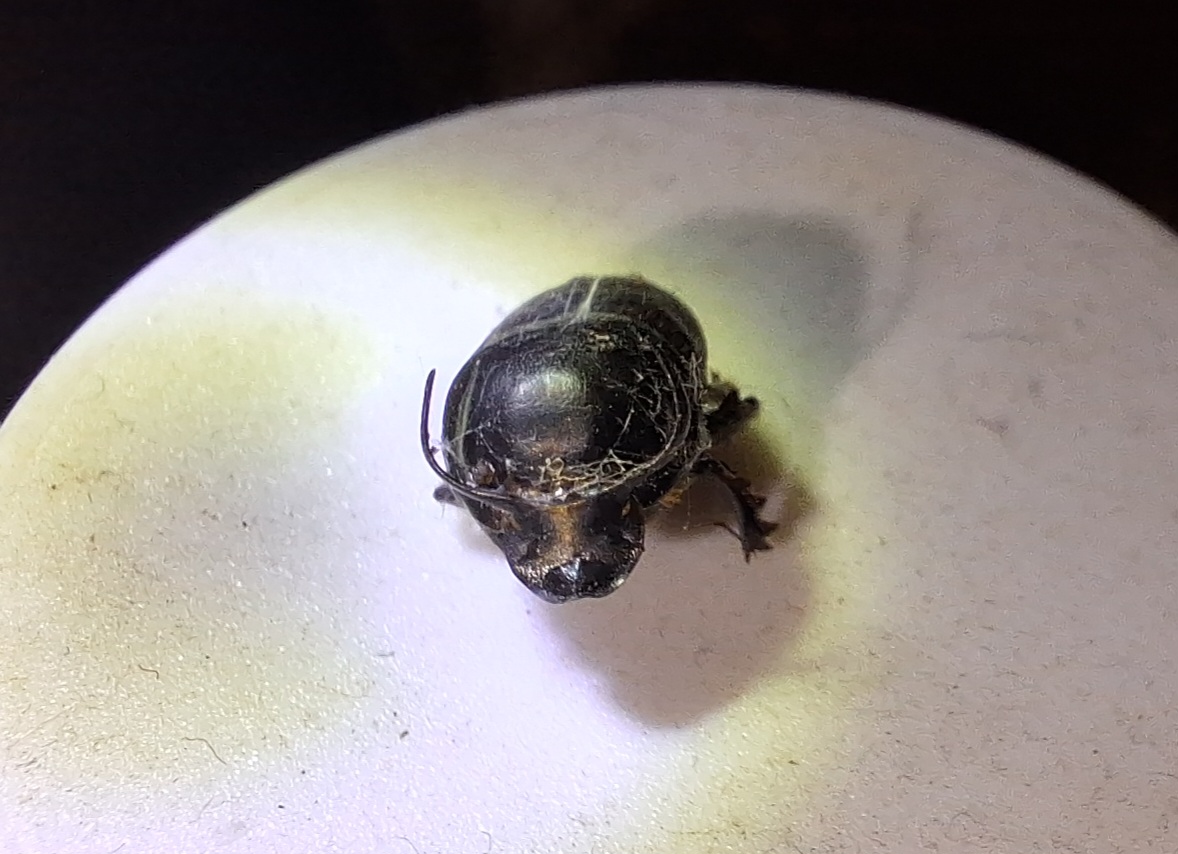
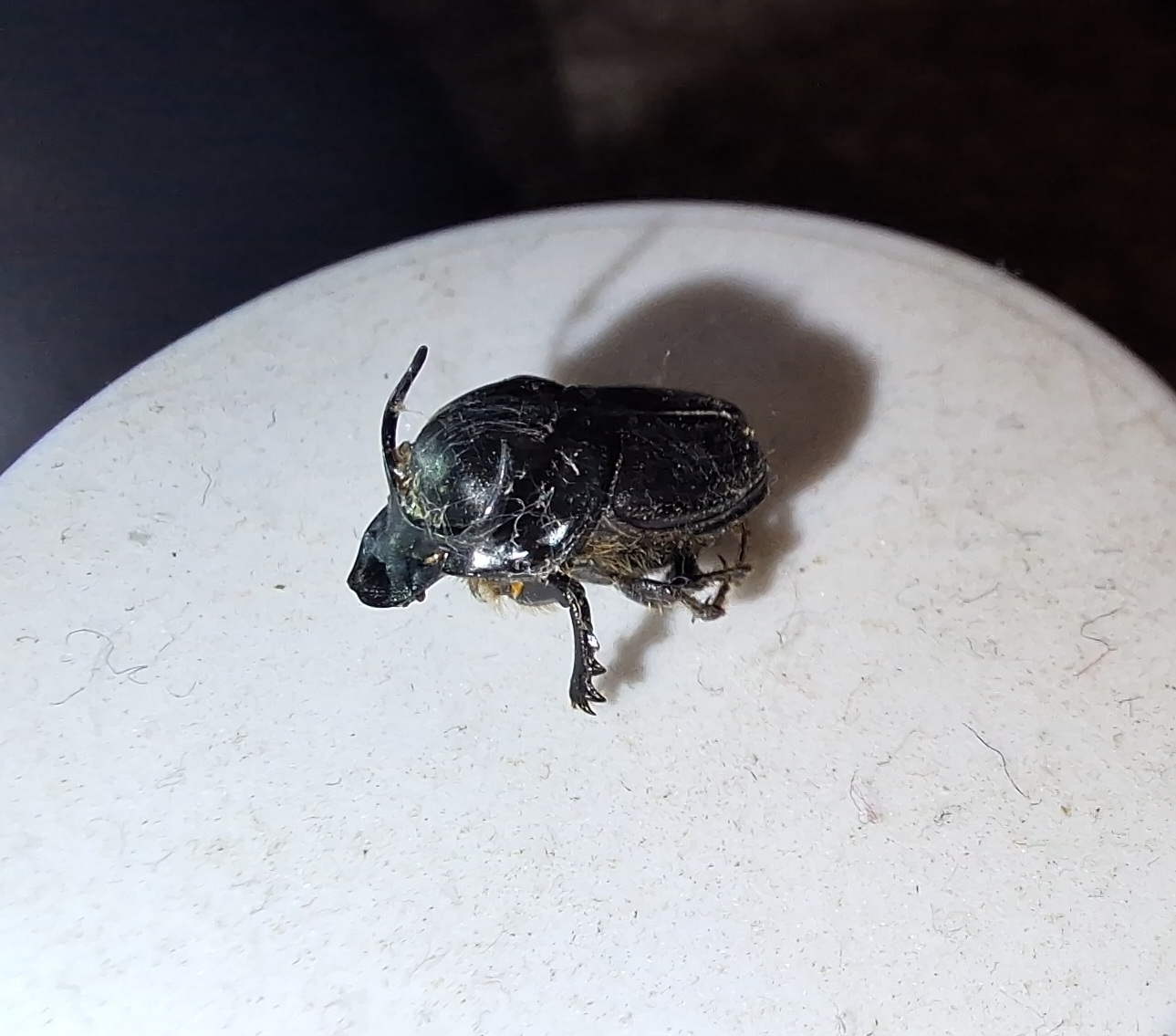
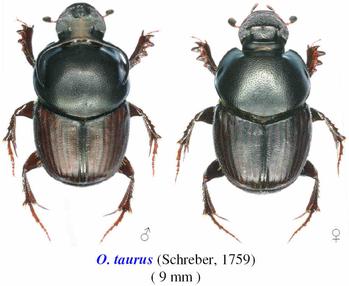
I found this little beetle in a Japanese beetle (Popillia japonica) trap several years ago in the vicinity of Ontario, California. I was able to identify it as a male (you can tell by the horns) Onthophagus taurus, a type of dung beetle native to areas around the Mediterranean (southern Europe, North Africa and the middle East). Apparently they were introduced in the U.S. in the late 1960’s to early 1970’s to help control cow dung, and have now spread to most of North America.
Isn’t he gorgeous? He’s an Australian peacock spider (Maratus volans) and the photo is by Jürgen Otto. He has a whole gallery of even better photos of this spectacular little arachnid that you’ll want to check out. However what you really have to see is his video of the dance the males perform to attract the females (you might want to watch it on YouTube for the slightly larger format):
Absolutely wonderful images that demonstrate how apt the common name for these little spiders is. Thank you Jürgen for sharing them.
Two more episodes from the excellent television series Inside Natures Giants are now available for viewing on YouTube. As I wrote in a previous post, this is a fascinating zoology program wherein the bodies of various large animals are dissected to demonstrate the details of their anatomy. This is combined with discussions of the living animals and their natural history with occasional incites from Richard Dawkins about evolutionary biology.
First of the newly available episodes is a two for one in which both a lion and tiger are examined, contrasted and compared. Here is part one of four:
In my previous posting on this series I wished for them to focus an episode on something like a giant squid so as to show something on invertebrate anatomy and my wish has come true. Here is part one of five:
I couldn’t find a play list for this episode so here are individual links to the different segments: part 2, part 3, part 4, and part 5.
As before I really cannot speak more highly of this program. It is fascinating television for anyone with even the slightest curiosity about the natural world and a absolute must see for anyone interested in biology, zoology and evolution.
Gush, gush, gush!
[Thanks to P.Z. (squee) Myers over at Pharyngula for the heads up on the squid episode and to the WhyEvolutionisTrue YouTube channel for hosting the videos!]
I recently stumbled upon (on YouTube) a BAFTA award winning British TV series titled Inside Natures Giants and I’ve fallen in love. What we have here is a television show in which various large animals, all vertebrates so far, are dissected on camera (and often in front of a live audience of students) by a team of biologists in order to show the details of their anatomy while presenting elements of their physiology, natural history and evolution (including commentary by evolutionary biologist Richard Dawkins).
I’m hoping they work in a ostrich or emu in there sometime soon and maybe a giant squid or octopus to show some invertebrate anatomy as well.
These programs deal with the dissection of actual animals in graphic detail so if you’re squeamish at all you might find them difficult to watch, howeverthis show is an absolute must see for anyone interested in zoology and evolution.
Of particular interest was the dissection of the giraffe. Among the various interesting adaptations towards tree top browsing is a classic example of one of the cloven hoofprints of evolutionary history, the recurrent laryngeal nerve; the dissection of which has apparently not been done (according to one of the scientists in the show) in a giraffe since the 1830’s.
Here is the first episode of the first series on the Asian elephant:
A play list of all the videos available on YouTube can be found here, and I really cannot recommend them more highly.
Go watch them… NOW!
but there is a whole series of videos showing several different large animals being dissected while their anatomy, physiology, and how these evolved are discussed. A must see for those interested in zoology and evolution.
My wife (Kathy) woke me up this morning telling me there was a “baby in the bathroom”. Naturally enough I asked “baby what?”. “A lizard” she said.
Now we generally have only two types of lizards around where I live (in Southern California), the Southern Alligator Lizard (Elgaria multicarinata) and the Western Fence Lizard (Sceloporusoccidentalis). Usually when I find a lizard in the house it’s an alligator lizard. They’re nasty little buggers who bite (the larger ones can draw blood), wipe feces on you and drop their tails if you breath on them too hard.
Elgaria multicarinata
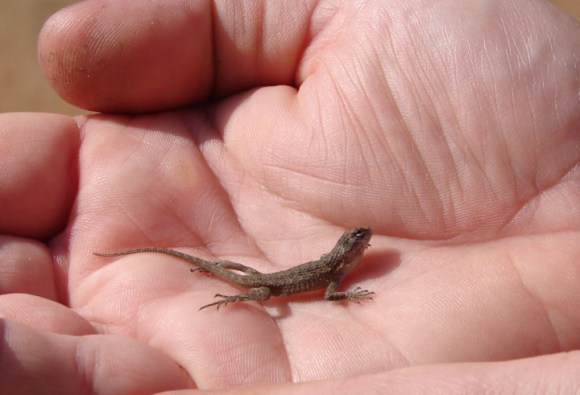
So I asked my wife which kind it was. She said, rather insistently, that she didn’t know and that I should get out of bed and look for myself. Here is what I found in all its cuteness:
After briefly toying with the idea of keeping it (because it was so damn adorable) we decided to let it go in an area beside the house where we frequently see its relatives. We wished it best of luck and sent our tiny intruder on its way.






 Playing Chess with Pigeons