Art imitates life once again in Jesus and Mo:

[Hat tip to Jerry Coyne.]

The latest in my “just for kicks” collection of evolution related signage:
 Thanks to Ryan for taking the picture with his phone for me.
Yes, according to U.K. creationist YouTuber davemakesawave who started leaving comments in response to a short video I did regarding so called “polystrate” fossils and the claims creationists make about them. However this post, as the title suggests, is not about “polystrate” fossils; for those interested in them I suggest the following links as good starting places.
As I said davemakesawave started off commenting on my “polystrate fossil” video but the topic of our exchange veered of that subject immediately with him making some rather grand claims about the state of science education at “top UK universities”. Given the limitations of YouTube video comments I thought this would be a better venue to thoroughly examine his allegations.
The following is the exchange that davemakesawave and I have had so far:
davemakesawave: Polystrate fossils are creation nonsense? What?
Me: It says “linked comment” but there’s no link. Was there something that you weren’t clear about regarding the nonsense creationists spout about “polystrate” fossils?
davemakesawave: No nothing at all thank you, I am quite clear about polystrate fossils especially as some UK universities now openly concede that the fossil record does not show evolution.
Me: No doubt. There are so called “universities” in the U.S. that spread lies and misinformation as well (Liberty U., Bob Jones U. etc.). Of course with the U.K. being historically so central to the formation of modern geology there is even less excuse for it.
davemakesawave: Interestingly it is the top UK universities that are teaching the fossil record does not show evolution, even though the lecturers are also promoting atheism; it is not based on bias, it is based on real science but without evolution, atheism has no basis whatsoever. Interesting isn’t it? And this is partly why I dumped atheism some 28 years ago; this and God revealing and proving himself to me. My story is on YT An Atheist Saved In Jesus Name if you want to watch it. Tx
Me: Sorry Dave, I’m going to call bullshit, on this. I don’t believe for a second that the biology & geology departments of, say Oxford or Cambridge, would teach any such thing. The time ordered pattern of change in the fossil record is perfectly consistent with descent with modification (evolution), indeed evolution is currently the only logical and coherent explanation for this and other patterns found in nature.
So name specifically which “top UK universities” are staffed with incompetents or shut up. And spare me your atheist baiting and witnessing. Defend your scientific claims or take it somewhere else.
And now we’ll look at davemakesawave’s response to my demand that he back up his claim:
Institute for Creation Research President Dr. John Morris has taken to recycling; in this case he’s dusted off some nonsense from an article he wrote 3 years ago titled “Evolution’s Biggest Hurdles” (Morris 2008) and repackaged it as “The Biggest Problems for Evolution” (Morris 2011).
As I usually do I started out writing a point by point re-rebuttal to Morris’s new article; even though I already wrote a fairly extensive rebuttal to the earlier version. However, as I was writing, and as it got longer and longer, I realized that I was going to bury the lead way too deep. So, I am dropping most of the rehashing and jump to the new issues I want to address.
First though just a little of the lead in for context:
Morris: Even though the gaps in the fossil record are found between each basic animal type, there are two huge gaps in particular that should be emphasized. The evolutionary distance between single-cell organisms and the vast array of multicellular, highly complex marine invertebrates precludes even rapid evolution.
Oh boy, this is déjà vu all over again.
From earlier context (see below) the “rapid evolution” he is referring to here is supposed to be punctuated equilibrium, however P.E. about apparent, geologically, “rapid” transitions (say a few tens of thousands of years) and concerns species level transitions (like those necessary to evolve horses and zebras from a common ancestor) not multicellular organisms from unicellular ones. Again, I’ll have more on his use of P.E. below.
As for the gap between unicellular and multicellular organisms the (really) short answer is: choanoflagellates (colony forming single celled organisms that are strikingly similar to cells found in sponges called choanocytes). Again, see my earlier post “You can tune a piano but you can’t tunicate” for more.
Morris: In the supposedly 600-million-year-old layers of rock designated as Cambrian (which contain the first appearance of varied multi-cell life), sponges, clams, trilobites, starfish, etc., are found without the required evolutionary ancestors.
Wrong, wrong, wrong. I covered this before as well.
1) There are fossils of multicellular organism in Precambrian strata (the Ediacaran biota for example).
2) Amongst those Precambrian multicellular organisms are sponges and jellyfish.
3) “Clams” (bivalve mollusks) are known from the Cambrian but only from few tiny extinct types.
4) Starfish or sea stars (Class Asteroidea) fossils do not appear in the fossil record until the Ordovician.
Morris: The gap from marine invertebrates to the vertebrate fish is likewise immense.
Again, Dr. Morris doesn’t want you to know about invertebrate chordates or the evidence for a relationship between chordates and echinoderms. I’ll have more on this in a few moments.
OK, now we get to it:
Morris: To make matters worse for the evolutionists, fish fossils are also found in Cambrian strata.
If we define the colloquial term “fish” in the usual way (in reference to all aquatic, gill bearing, vertebrates) then yes, a few genera of “fish fossils” have indeed been found in Cambrian strata.
However the word “fish”, is not a scientific term, so the question must be; exactly what sort of “fish” has been found in the Cambrian strata? Dr. Morris does not grace his readers with any further comment on this question; there is however a prominent illustration of a fossil fish that accompanies the article. Here is a screen shot of the page the article appears on:
 And here is a larger version of the fish fossil picture:

I think it is fair to say that most people who are not particularly familiar with vertebrate phylogeny and paleontology—including most of Dr. Morris’s readers—might assume when they read in his article that “fish fossils are also found in Cambrian strata” that the large centrally displayed picture of a fossil fish might in fact be one of the Cambrian fish Morris is referring to.
 I’m trying to do a little customization to the code on my blog (just trying to widen the content area) but the stuff isn’t really cooperating so things might look a bit ugly for a while.
My apologies and suggestion are welcome.
Update: OK, so I’ve implemented some (most?) of the changes I was planning…how does it look? Comments? Criticisms?
…the former (abysmal) Governor of California Arnold-don’t bore me with the death of your son-Schwarzenegger:
I’m ashamed for having voted for him in his first run.

Isn’t he gorgeous? He’s an Australian peacock spider (Maratus volans) and the photo is by Jürgen Otto. He has a whole gallery of even better photos of this spectacular little arachnid that you’ll want to check out. However what you really have to see is his video of the dance the males perform to attract the females (you might want to watch it on YouTube for the slightly larger format):
Absolutely wonderful images that demonstrate how apt the common name for these little spiders is. Thank you Jürgen for sharing them.
[Hat tip to Jerry Coyne.]
Asks the most recent Jesus and Mo:
 And then they flew off to their respective flocks to claim victory…
[Hat tip to Wonderful Life.]
Intelligent Design creationist Denyse O’Leary, in the midst of rationalizing (over at Uncommon Descent) why ID creationists spend all their time attacking science rather than doing science, has provided yet another example of how antievolutionists are pretty much pathologically unable to portray evolutionary theory (or its supporting evidence) accurately:
O’Leary: To me, Darwinism is like bad money. It becomes an intellectual vice. People are always looking for natural selection to generate random mutation, the way they are always trying to pass on the likely-bogus G-bill (when they are not out looking for the lucky strike). [Emphasis mine]
Yeah, right Denyse, it’s scientists engaging in an “intellectual vice” not creationists like yourself who spend all their time confidently bashing something they clearly don’t understand.
Newsflash: natural selection does not “generate” mutation; mutation is an independently occurring source of variation from which natural selection “selects” after the fact.
For heaven’s sake, Google it Denyse! Here, I’ll do it for you; the top two hits for “natural selection” are:
Wikipedia – Natural Selection
U.C. Berkley – Natural Selection
That took mere seconds and after mere minutes of reading you won’t find anything on either of those two pages about natural selection “generating” mutations, random or otherwise. Here’s a bonus one on genetic variation from Wikipedia.
Is it really so much to ask for them to have a basic understanding of the science they put so much energy into repudiating?

[Hat tip to Larry Moran over at Sandwalk. Larry took the time to address O’Leary’s aforementioned rationalizations, have a look-see.]
Creationists often portray natural selection —usually citing Herbert Spencer’s expression, “survival of the fittest”— as being a matter of the strong subjugating or eliminating the weak, usually tying it to eugenics, racism and ultimately (of course) to Adolf Hitler.
Here is a fun cartoon by Jay Hosler (author of Drawing Flies) that amusingly illustrates that this is at best an extreme oversimplification of the how natural selection actually works (click on the image for a larger version).
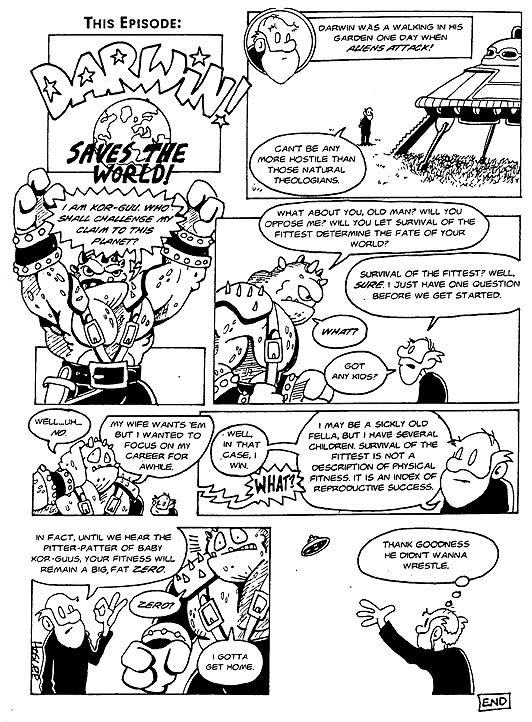 So if you really want to ‘win’ the evolutionary race, the way to do it is to “make love, not war”.
Of course it does sometimes happen in nature that organisms attempt to directly eliminate competition for resources—lions killing hyenas (between species), older larger bird chicks pushing younger siblings out of the nest (within a species)— but it is usually through the more indirect method of simply leaving more offspring and thus eventually dominating the environment. That way the competition fizzles out and goes extinct on its own rather than being directly attacked in any way.
Also such “might makes right” caricatures of natural selection ignore the fact that cooperative behavior within species can also lead to increased “fitness” as is seen in social species like ourselves as well as between different species as is the case with mutualistic relationships; the Yucca plant and some species of Yucca Moths for example.
Then there is the problem that creationists are trying to project the is-ought fallacy onto evolution. The idea being that though the process of natural selection sometimes leads to behavior that we would normally consider cruel or immoral, since it is natural, it is therefore good and we should encourage it.
However the mere fact that we observe something to happen in nature in one context does not mean that it is something upon which we would want to model our own behavior. In fact our success as a species in largely due to the fact that we don’t model our behavior on what we see in nature, or allowing nature to take its course.
See:
Index to Creationist Claims – Claim CA002 and Claim CA002.1
Evolution and Philosophy – Does evolution make might right? by John S. Wilkins
[Hat tip to NCSE on Facebook for the cartoon]
 Playing Chess with Pigeons