
“Gill slits” by any other name…

Charles Darwin once said that he thought the evidence from the comparative anatomy of embryos was “by far the strongest single class of facts” in favor of common descent (Darwin, 1860) and while it has since been eclipsed by genetics, it remains one of most compelling subsets of evidence for evolution. And perhaps the single most striking detail in the comparative embryology of vertebrates, are the structures colloquially known as “gill slits”.  

Embryonic “gill slits” or “branchial clefts” (branchia is Greek for gill) or more properly pharyngeal clefts (grooves, folds, etc.) are part of what is called the “pharyngeal apparatus” found in front (ventral) and sides (lateral) of the head/neck region of all vertebrates in the “pharyngula stage” of development. In “fish”, and the larva of amphibians, these develop into respiratory organs used to extract oxygen from water while in amniotes (reptiles, birds and mammals) they are modified into other structures.

Before I go on, a brief digression about “fish”. Throughout this article I will often use “fish” in the generic sense; but it should be noted that the term as it is commonly used—to refer to any vertebrate that swims in the water, has fins and gills—is not a valid scientific classification. This is because the three main types of animals commonly called “fish” —the Chondrichthyes (sharks, rays, skates and chimaeras), the Actinopterygii (ray fined fish, which constitutes the majority of living fishes), and the Sarcopterygii (lobe fined fish, the group from which four legged land animals, i.e. tetrapods, evolved)—are not a monophyletic group. That is they are not very closely related to each other despite some of their outward similarities (like gills). For example the living Sarcopterygii, lung fish and coelacanths share a more recent common ancestor with us (and all tetrapods) than with the other “fishes”.

OK, so the “pharyngeal apparatus” consists of a series of paired pharyngeal arches and fissures which develop on the exterior with a corresponding set of pharyngeal pouches on the inside of the throat, separated from the external fissures by a thin membrane (more on the details in a moment). And in fact the possession of these structures at some point in development, along with a hollow dorsal nerve cord, a notochord and a post anal tail, are the defining characteristics of the phylum chordata to which we and all other vertebrates belong.

Copyright © 1999 McGraw-Hill Companies, Inc.

Please note that the above illustration is diagrammatic and not intended to be photographically accurate (I have to say that lest I be accused by creationists of conveying a fraud). Below are actual photographs of both a skate embryo and a human embryo for comparison. Also note: the gill structures in the embryos of Elasmobranch fishes—the subdivision of Chondrichthyes which contains sharks, rays and skates—are much less derived than in other “fishes” and therefore generally more similar to those of amniote embryos than the corresponding structures in the bony “fishes” (which are significantly modified).

(Gillis et al 2009, p.5721)
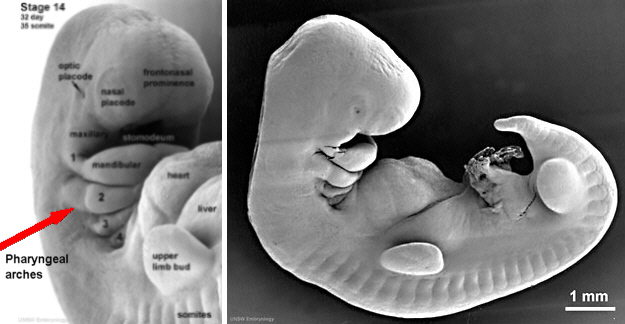
The first of the arches, the mandibular arch, forms the jaw in all jawed vertebrates (Gnathostomes). Most vertebrates develop a total of six arches but the full complement is usually only retained into adulthood by hexanchiform sharks. Hexanchiformes are very plesiomorphic which means that they are more like earlier types of sharks.  Some species of hexanchiformes even develop a seventh arch. Likewise the extant jaw-less vertebrate, the lamprey, also have seven gill openings.
Read on»

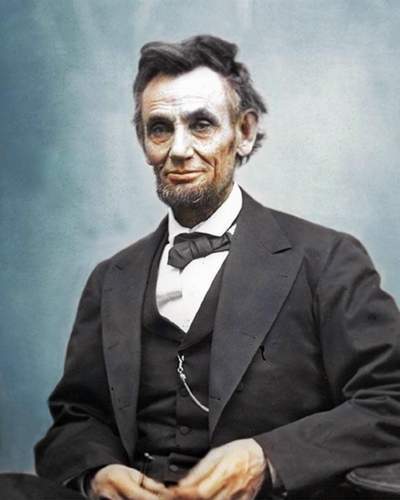
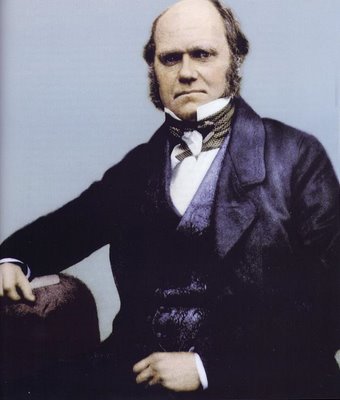
Happy Darwin/Lincoln Day!

…the Emancipator and the Evolutionizer, together again!!!

Happy Darwin/Lincoln Day everyone!!!

Happy Darwin/Lincoln Day!

A day to celebrate science and freedom!

New acquisitions for the Britain Research Library

Thanks in part to an anonymous donor the Britain Research Library has recently made a number of new acquisitions in its science, pseudoscience, and political collections.

Science

Arthur, Wallace (1997) The Origin of Animal Body Plans: A study in evolutionary developmental biology, Cambridge University Press, XII + 338

Ayala, Francisco J. (2010) Am I A Monkey?: Six big questions about evolution, John Hopkins University Press, XIII + 83

Keynes, Randal (2009) Creation: The true story of Charles Darwin, Riverhead Books, XVII + 430

Kurtén, Björn (1972) Not From The Apes, Pantheon Books, New York, NY, VIII + 183

Levinton, Jeffrey S. (2001) Genetics, Paleontology, and Macroevolution (2nd edition), Cambridge University Press, XV + 617

Newman, Horatio Hackett (1926) The Gist of Evolution, The MacMillan Company, IX + 154

Pseudoscience

Gibbons, William J. & Hovind, Kent (1999) Claws, Jaws, & Dinosaurs, CSE Publications, 72

Walsh, Robert E. (editor) (1994) Proceedings of the Third International Conference on Creationism, Creation Life Fellowship, Inc. VII + 645

Politics

Hayek, F. A. (Caldwell, Bruce – Editor) (2007) The Road To Serfdom: Text and documents, The University of Chicago Press XI + 283

Thanks to whomever it was!


Classic Badass Quote

Stealing a concept from my friend Ed Brayton, the following is a quote from George Orwell which I recently ran across and thought was brilliant:

Political languageand with variations this is true of all political parties, from Conservatives to Anarchistsis designed to make lies sound truthful and murder respectable, and to give an appearance of solidity to pure wind. – George Orwell

This is from Orwell’s essay: Politics and the English Language (1946), do give it a read.

[Hat tip to Jerry Coyne for the reading suggestion.]

Theocratic talking points smackdown

Dan Barker of the Freedom From Religion foundation gives a Faux News talking head (who was spouting right-wing,  revisionist history, talking points) a spot on concise U.S. history and Constitutional law lesson regarding the 1st Amendment separation of church and state, check it out:

[Via Why Evolution is True]

We need creationists lecturing us on evolution like we need another fenestra in the head

The Institute for Creation Research has presented the world with another taxonomic turd from the cat box of creationist wisdom. This time it comes from ICR’s “Senior Science Lecturer” Frank Sherwin. However before I get to the main event, I want to take a closer look at the litter in which Mr. Sherwin’s little jewel is nestled.

In the February (2010) issue of ICR’s monthly Acts & Facts Mr. Sherwin (whose background is in parasitology) graced us with an article titled “Darwinism’s Rubber Ruler” in which he argues that descent with modification is untestable and that “any and all scientific evidence” can be “stretched to fit” the theory.

The first thing that comes to my mind when reading this is to ask: if this is so, then how is it that I could have in my personal collection literally hundreds of books and pamphlets, many of them originating from Mr. Sherwin’s organization, that purport to contain absolutely scads of evidence that contradict evolutionary theory?

How about Dr. Duane Gish’s (the emeritus vice president of ICR) books Evolution the Fossils Say NO! (1978) and the update Evolution: the fossils STILL say NO! (1995)? How can the fossils say “no” to evolution if any scientific evidence (in this case fossils) can be “stretched to fit” the theory?

Read on»

Happy Darwin/Lincoln day!

Happy Darwin/Lincoln day everyone!


Wilkins on Darwin and race

John Wilkins, philosopher from down under, has written a nice blog post on Darwin and race, “Myth 7: Darwin thought that Australian aborigines were closer to apes than to Europeans“:

Actually, this one is better called “Darwin was a racist”, but as the text concerned is from the same source as those claims, I thought it might be easier to evaluate a single claim and generalise from that.

Our gospel for today is chapters V and VI of The Descent of Man, published in 1871.

If you read Darwin sloppily, or to find evidence that he really was a Very Bad Man for rhetorical – usually religious – purposes, you soon come across this statement. In fact, you can find paraphrases of it in literally hundreds of creationist documents and sites. Here is the offending passage, from towards the end of chapter VI of the Descent:

At some future period, not very distant as measured by centuries, the civilised races of man will almost certainly exterminate and replace throughout the world the savage races. At the same time the anthropomorphous apes, as Professor Schaaffhausen has remarked, will no doubt be exterminated. The break will then be rendered wider, for it will intervene between man in a more civilised state, as we may hope, than the Caucasian, and some ape as low as a baboon, instead of as at present between the negro or Australian and the gorilla. [p201]

Many folk read this to be making the following claims:

1. It is right that civilised races should exterminate the savage races

2. It is right that the great apes (which Darwin calls “anthropomorphous” or “humanlike”) will be made extinct.

3. When this happens the gap between humans and apes will be wider because the intermediates, apes and negroes or Australian aborigines, will be gone.

Hence: Aborigines and negroes are more apelike than Caucasians.

Let’s look at a bit of context here. I do not propose to defend Darwin from his biases, but let’s be quite clear on what they are first (and note, if Darwin turned out to be a baby eating white supremacist, it no more makes evolution false than the fact that most baby eating white supremacists are Christians discredits Christianity).

Check out the rest over on Evolving Thoughts.

It’s Playing Chess with Pigeons 1st Birthday!

It was one year ago today (March 1st 2008) that I posted my first blog entry. Thank you to all my readers who have given this blog over 67,000 views so far.

I would also like to thank my friends and colleagues who have helped me with research and all those who were kind enough to link to my offerings. I’d like to think that it hasn’t been a bad first year and I hope to do even better in the next.

Once again thanks everyone!