Open mouth, insert hoof

Ken Ham, president/CEO of Answers in Genesis (USA), which is headquartered in Kentucky has attacked an exhibit at the Kentucky Horse Park on horse evolution in a recent post to his blog “Around the World with Ken Ham” and it is yet another glittering example of creationist scholarship.

Reading it immediately brought to mind the words supposedly* whispered by Thomas Huxley as he rose to respond to Samuel Wilberforce in their exchange at the 1860 Oxford evolution debate:

“The Lord hath delivered him into mine hands”.

The reason this came to mind was that it is clear from his comments that he has not bothered to educate himself on the subject and is just mindlessly repeating tired, long refuted creationist clichés on the subject of horse evolution.  In other words, he’s lobbing softballs at defenders of science like me.

Alright, without further ado let’s saddle up and ride forth into the mind of Ham:

Read on»

Is that what it takes?

Now I have no illusions about my blog being another Pharyngula or anything but with at least a couple hundred views a day, from around the world, you’d think I’d be getting few more comments.

Where are all the would-be “creation scientists” eager to show me the error of my ways? Here I am writing post after post spanking the heck out of their intellectual leaders and rather than reasoned defenses or even primal screams of rage I get:

Fine, let’s try Chuck & Beans advice:

inteligent design ain’t science!

Now I know this might seem like little more than a blatant cry for attention (which of course it is) but I am honestly curious about the seeming lack of comments around here. Is there a ‘visits per day’ threshold that one has to cross in order to overcome some sort of comment inertia? Has there been any research on this?

Oh, and hat tip to Scott Weitzenhoffer for the cartoon.

The 45th Carnival of Evolution is now available!

And it’s just lousy with bugs! This month the Carnival of Evolution hive is infesting Splendour Awaits, weblog of photographer and amateur insect enthusiast Adrian Thysse.

Creep or crawl your way over there and check out all the invertebrate wonderfulnessness!

Note: The Carnival is trying something a bit new this go around by presenting the article summaries and links in Google Docs – Presentation (a slide show format). If you have any difficulties seeing the slide window, please try another browser (Google Chrome worked best for me).

Previous Carnivals of Evolution:

If you missed any of these you’ll definitely want to go check them out!

Creationists are just buggy about bugs

A few months back Frank Sherwin,  “Senior Science Lecturer” at the Institute for Creation Research, launched an amusing attack on evolution that is nigh on word-salad; this time focusing on insects, and how they are supposedly problematic for evolutionary theory.

As usual it is stated with the confidence and the faux authority that is typical of “creation science” practitioners but when you actually look at it and try to make sense of what is being said it quickly becomes apparent that much of it is really unintelligible nonsense.

Read on»

The Proceedings of the 44th Carnival of Evolution is now available

Ladies and Gentlemen… Mesdames et Messieurs… Damen und Herren… The Carnival of Evolution XLIV! This month the carnival is inhabiting The Atavism (great name) and is cleverly set up as a scientific symposium. See for yourself.


Previous Carnivals of Evolution:

If you missed any of these you’ll definitely want to go check them out!

The Carnival of Evolution #42 is up!

Oh no, not again…

Yep, it’s time for the Carnival of Evolution (#42)!!!  This month it is being held at The Ocelloid and in case you can’t tell there is a Hitchhikers Guide to the Galaxy theme. So grab your towel, pour yourself a Pan Galactic Gargle Blaster and head on over for the latest batch of evolutionary goodness.

It’s either that or Vogon poetry…

Previous Carnivals of Evolution:

Life! Don’t talk to me about life.

The Carnival of Evolution #38 is up!

And it’s a doozy! I know I say something like that every month and I mean it, but this time it’s truer than ever. This months host is the estimable Larry Moran (Professor in the Department of Biochemistry at the University of Toronto) on his excellent blog Sandwalk.

There are lots and lots of great links to evolution related articles for you to peruse (even if none of them are mine because my opus on creationists and arthropods keeps getting longer and longer).

As a bit of housekeeping I am going to list links to the past CoE below so I can clean up the blog a bit (all those green glowy spheres make me feel bad about not being more productive /honest self reflection).

If you missed any of these you’ll definitely want to go check them out!

Help the TalkOrigins Archive’s bid to buy “Expelled”

Premise Media, the production company that produced the creationist pseudo-documentary “Expelled“, has gone bankrupt and is putting the film up for auction. The opportunity having presented itself, the TalkOrigins Archive Foundation is making a run at acquiring it.

Getting the rights to the film and related production material (unedited interviews of scientists etc.)  could be an invaluable source of ammunition in the defense of science education against the attacks of intelligent design creationists, so if you’re able please consider making a donation to the Foundation (if the bid is unsuccessful your money still goes to a worthy cause) .


Update: TalkOrigins lost the biding war. Oh well, it would have been interesting.

There’s something fishy about that fish

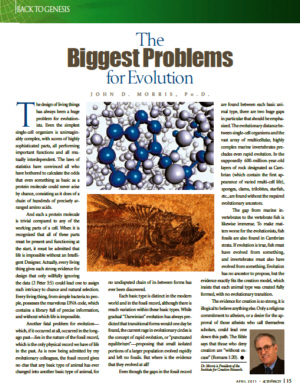
Institute for Creation Research President Dr. John Morris has taken to recycling; in this case he’s dusted off some nonsense from an article he wrote 3 years ago titled “Evolution’s Biggest Hurdles” (Morris 2008) and repackaged it as “The Biggest Problems for Evolution” (Morris 2011).

As I usually do I started out writing a point by point re-rebuttal to Morris’s new article; even though I already wrote a fairly extensive rebuttal to the earlier version. However, as I was writing, and as it got longer and longer, I realized that I was going to bury the lead way too deep. So, I am dropping most of the rehashing and jump to the new issues I want to address.

First though just a little of the lead in for context:

Morris: Even though the gaps in the fossil record are found between each basic animal type, there are two huge gaps in particular that should be emphasized. The evolutionary distance between single-cell organisms and the vast array of multicellular, highly complex marine invertebrates precludes even rapid evolution.

Oh boy, this is déjà vu all over again.

From earlier context (see below) the “rapid evolution” he is referring to here is supposed to be punctuated equilibrium, however P.E. about apparent, geologically, “rapid” transitions (say a few tens of thousands of years) and concerns species level transitions (like those necessary to evolve horses and zebras from a common ancestor) not multicellular organisms from unicellular ones. Again, I’ll have more on his use of P.E. below.

As for the gap between unicellular and multicellular organisms the (really) short answer is: choanoflagellates (colony forming single celled organisms that are strikingly similar to cells found in sponges called choanocytes). Again, see my earlier post You can tune a piano but you can’t tunicate” for more.

Morris In the supposedly 600-million-year-old layers of rock designated as Cambrian (which contain the first appearance of varied multi-cell life), sponges, clams, trilobites, starfish, etc., are found without the required evolutionary ancestors.

Wrong, wrong, wrong. I covered this before as well.

1) There are fossils of multicellular organism in Precambrian strata (the Ediacaran biota for example).

2) Amongst those Precambrian multicellular organisms are sponges and jellyfish.

3) “Clams” (bivalve mollusks) are known from the Cambrian but only from few tiny extinct types.

4) Starfish or sea stars (Class Asteroidea) fossils do not appear in the fossil record until the Ordovician.

Morris: The gap from marine invertebrates to the vertebrate fish is likewise immense.

Again, Dr. Morris doesn’t want you to know about invertebrate chordates or the evidence for a relationship between chordates and echinoderms. I’ll have more on this in a few moments.

OK, now we get to it:

Morris:  To make matters worse for the evolutionists, fish fossils are also found in Cambrian strata.

If we define the colloquial term “fish” in the usual way (in reference to all aquatic, gill bearing, vertebrates) then yes, a few genera of “fish fossils” have indeed been found in Cambrian strata.

However the word “fish”, is not a scientific term, so the question must be; exactly what sort of “fish” has been found in the Cambrian strata? Dr. Morris does not grace his readers with any further comment on this question; there is however a prominent illustration of a fossil fish that accompanies the article. Here is a screen shot of the page the article appears on:
And here is a larger version of the fish fossil picture:
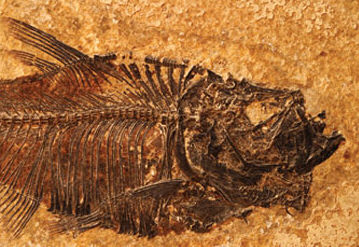
I think it is fair to say that most people who are not particularly familiar with vertebrate phylogeny and paleontology—including most of Dr. Morris’s readers—might assume when they read in his article that “fish fossils are also found in Cambrian strata” that the large centrally displayed picture of a fossil fish might in fact be one of the Cambrian fish Morris is referring to.

Read on »

If humans descended from apes, why are there still apes?

Asks the most recent Jesus and Mo:

And then they flew off to their respective flocks to claim victory…

[Hat tip to Wonderful Life.]