How could evolutionary theory be falsified?

cambrianrabbit

A rabbit fossil in Cambrian rock would be difficult to understand under current evolutionary theory.

Creationists often charge that evolutionary theory is unfalsifiable; that there is no way to potentially disprove it, if it were in fact incorrect. This is in essence an “I know you are but what am I” response to their critics who have rightfully pointed out that “God did it” as an explanation is not testable against the evidence from the natural world and therefore not a valid scientific explanation for anything.

This is because hypotheses, in order to qualify as scientific, must be testable against observable evidence in the natural world. In other words, in addition to there being potential observations that might support a given hypothesis, there should likewise be some potential observations that would tend to disprove a hypothesis.

Since God can do anything in any way, for any reason, here are no potential observations of the natural world that could disprove God’s involvement, which means the “God did it” hypothesis is unscientific in character.

In any event, is it true, as creationists charge, that there are no potential observations that would tend to disprove evolutionary theory?

The short answer is no, it is not true. However, for something more in depth you should head over to Why Evolution Is True where biologist Jerry Coyne provides several scenarios that would be highly problematic for current evolutionary theory.

In my general talk on the evidence for evolution, I give a list of seven observations that, if repeated and confirmed, would disprove parts of the theory of evolution described above. This shows that it is a scientific theory in the Popperian sense of being falsifiable.  Here are some of those conceivable observations:

  • Fossils in the wrong place (e.g., mammals in the Devonian). If the fossil record were all out of order like this (a single anomalous fossil might not overturn everything, of course, since it could be in the wrong place for other reasons), we’d have to seriously question the occurrence of evolution.

I recommend you hop over and check out the rest.

The last thing I want to say about this particular creationist claim, is that in addition to it being false, it is also stands in rather blatant contradiction to what creationists do on a regular basis, which is to argue that this or that bit of evidence somehow counts against evolutionary theory.

I mean what sense can we make of Duane Gish’s book Evolution, the Fossils Say No! (1978) if he was not arguing that the fossil evidence was disconfirming of the evolution hypothesis?

The mind boggles.

[And now John Wilkins, or some other philosopher of science, will yell at me about Popperian Falsificationism being passé with regards to the demarcation problem. Just to head that off somewhat I am not advocating naive falsificationism.]

“Reason and creationism”

My friend and colleague (frienlleague?) Dr. Eugenie Scott gave, yet another, excellent talk titled “Reason and creationism” at the Global Atheist Convention, Melbourne, Australia (4/15/2012). Have a watch:

NCSE Home Page

“What Can YOU Do to Support Intelligent Design?”

A visual approximation.

Over at the Discovery(less) Institute’s Complaint Dept., resident attack chihuahua, Casey Luskin answered some fan mail that supposedly asked how people, sans financial resources, could support intelligent design (creationism). He suggests a variety of things that boil down to: submerge yourself into the intelligent design creationism bubble and pester your kid’s teachers and school administrators into foisting creationist misinformation onto their students:

There are lots of ways you can support Discovery Institute and ID in ways that don’t involve money. One of them — liking Discovery Institute’s Center for Science & Culture on Facebook of course — you already did. You could also become a follower of our Twitter account, follow our podcast on Twitter, or listen to ID the Future online. Reading Evolution News & Views will help keep you up-to-date on the debate. You can also subscribe to our Nota Bene newsletter, which is free.

Those are all ways for you to stay informed. But there are also ways that you can reach out to others. These include:

  • Start your own ID blog, or participate in other ID blogs like Uncommon Descent. It’s always good to have pro-ID voices on the Internet, although I’ll warn you that lots of Internet ID-critics just want to shout you down and call you nasty names, so it’s not uncommonly the case that you’d be wasting your time by engaging them.
  • Become a voice for academic freedom in your local community. One easy thing you can do is sign the Academic Freedom Petition. You can write letters to the editor to local newspapers, calling on them to stand up for good science education and provide corrections to misinformation or biased reporting on this issue.
  • Another constant need is to ensure that your local public libraries, secondary school libraries, and university libraries have up-to-date copies of intelligent design books. Even if you don’t have the money to donate the books, recommend books to the library and ask if they would consider adding them to their collections.
  • You might consider starting a local organization to increase awareness about intelligent design. A great way to do this is to start an Intelligent Design and Evolution Awareness (IDEA) Club. These extracurricular clubs are affiliated with the IDEA Center (which is a distinct organization from Discovery Institute), but they can organize events on local college campuses or in communities to show videos or bring speakers to educate the public about the issue. IDEA Clubs are a great way to raise awareness and understanding of the scientific case for intelligent design in your local community — you could start one yourself, or help a student do so. See www.ideacenter.org for details.
  • Besides IDEA Clubs, if you know university students who are interested in ID, you can encourage them to get involved with Discovery Institute’s Summer Seminars on Intelligent Design. And if you know pre-college students who are college-shopping, encourage them to consider how the school they’re going to attend deals with topics like the origins of life and of human beings. (Note: I went to a science-focused public university that was largely anti-ID and had a great experience, so I’m not saying students must go to a pro-ID college. But they might want to consider this issue, one way or another, when they apply.)

Finally, another way you can make a difference is to advocate for positive changes in education in your local school or community. If you have kids, find out how their schools cover evolution. For public schools, we recommend that they teach the scientific evidence for and against Darwinian evolution without getting into alternative theories like intelligent design. A lot of this is explained in our Briefing Packet for Educators — but if you want to get involved more directly, contact us here at Discovery Institute and we can help you. For private schools, we have another list of recommended resources, which I recently discussed here.

What is significant by its absence from this list is any suggestion that his readers should directly familiarize themselves with what the overwhelming majority scientists are actually saying or with the actual evidence, unfiltered by the ID creationist spin zones that he lists.

Now I understand that Mr. Luskin probably believes that all of mainstream science is engaged in a global satanic conspiracy to hide the Truth ™ from the masses, but for the sake of intellectual rigor he should want people to be familiar with the thing that they are fighting so fiercely against; and not just the version presented in the IDC echo chamber.

If someone asked me how they could prepare themselves to deal with creationists I would tell them that they need:

  • A good grasp of modern evolutionary theory and the broad evidence behind it both paleontological and neontological (preferably including some reading of the primary scientific literature), as well as a smattering of other sciences that touch on historical issues (cosmology etc.).
  • At least a basic knowledge of the history and philosophy of science (especially the histories of biology and geology).
  • And, most especially, a thorough knowledge of creationist arguments through direct reading of creationist literature (and other media) and the history of the creationist movement (I highly recommend Ronald Numbers book The Creationists (2006) for that last part).

Of course, no one can be an expert in all the relevant fields of science. Even most scientists, while they might be experts in their particular area of study, may have only a basic grasp of the several other fields outside of their own that is required in order to effectively counter creations claims. You can start off talking with a creationist about cosmology—because many of them do not understand that the Big Bang theory is not part of evolution—and in quick succession be grilled about various aspects of geology, biology and physics.

Worse yet, most scientists have only superficial level of knowledge regarding creationist arguments and tactics, which makes sense given that they trained in doing science and not counter apologetics. Moreover, many feel, with some justification, that to get such training is a waste of their valuable time. Unfortunately, this can lead to public relations setbacks for science education if they then allow themselves to be snookered into formal debates with professional creationists.

Again, from my experience you need not only a basic knowledge of a variety of scientific subjects—especially geology, paleontology and biology—but a good knowledge of creationist arguments in order to keep from getting steamrolled by the creationist shotgun approach to debate (a.k.a. the “Gish Gallop“).*

For that reason, unlike Mr. Luskin, I strongly encourage people, both scientists and interested laypersons, to study the work of the opposition, not just what people like me say about it.

[*I would generally advise against live public debates in the first place. Instead, stick to written ones that do not allow creationists effective use of the Gallop in the first place.]

The Carnival of Evolution #49 is up!

Another month has passed and another Carnival of Evolution(#49) has arrived for your edification. This month it is being hosted by Mousetrap: ecology & evolution footnotes and you NEED to go and absorb ALL the evolutionary knowledge it contains! Fly my minions, fly!!!

[OK, I don’t know where that came from… Maybe too much time spent around P.Z.. But it’s still a good idea!]

Previous Carnivals of Evolution:

If you missed any of these you’ll definitely want to go check them out!

“The Curmudgeon’s Guide to Creation Science”

The Sensuous Curmudgeon has given us an eloquent exposition on why “creation scientists” are immune to empirical evidence and why there is no science in “creation science”. I highly recommend you give it a read.

[Hat tip to Richard Hoppe over at Panda’s Thumb.]

Creationist horse feathers

If creationists keep spewing nonsense about horses and horse evolution, there may come a day when I run out of literary references and idioms involving horses to play off of in my post titles. But today is not that day.

Before I start I want to promise any regular readers of this blog that despite this being yet another post that is (in part) about creationists and horses, I promise there will be no mention of Hyracotherium this time. No quotes of Richard Owen. No references to hyraxes whatsoever, you have my word.

Once again the source of my ire is the Institute for Creation Research (ICR) who sent forth one of their minions, Christine Dao, to dutifully report what the institute’s “creation scientists” had to say about the recent news that the South Korea is going to be altering their school textbooks to pander to creationists in that country.

Dao: Science gained a victory when South Korea’s Ministry of Education, Science and Technology announced last month that textbook publishers will correct editions that contain misinformation regarding evolution.

Yes, absolutely, if there is misinformation in the textbooks we would certainly want to weed that out. The problem is, to a creationist, any of the data that makes up the mountain of empirical evidence supporting evolutionary theory is “misinformation”. Let us examine the two examples of supposed misinformation the South Korean “Ministry of Education, Science and Technology” is planning of removing from textbooks and the “scientific” reasons why the ICR agrees that they should be removed; starting in reverses order with “feathers” (figuratively speaking):

Read on»

The Carnival of Evolution #48 is up and it has been Pharyngulated!

The Squidmiester himself, P-Zed Myers, who inscribes his electronic tome of iniquity (a blog) from atop a throne of humans skulls (a ordinary office chair), ensconced in his deep sea fortress of doom (the University of Minnesota Morris), is hosting the 48th Carnival of Evolution at his retched hive of scum and atheistic villainy, Pharyngula!!! You are not going to want to be late for this one, because the lucky ones will be eaten first!!!

Welcome your new Cephalopod overlord! I think he likes you…

Bwahahahahaha!!!

Praise be to Cthulhu for this invisible line break! Pain in the ass html…

Previous Carnivals of Evolution:

If you missed any of these you’ll definitely want to go check them out!

“Gill slits” by any other name…

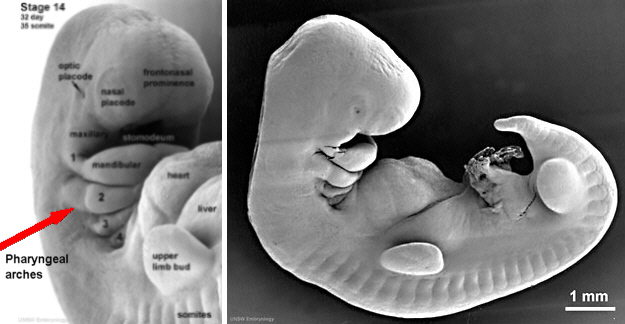
Charles Darwin once said that he thought the evidence from the comparative anatomy of embryos was “by far the strongest single class of facts” in favor of common descent (Darwin, 1860) and while it has since been eclipsed by genetics, it remains one of most compelling subsets of evidence for evolution. And perhaps the single most striking detail in the comparative embryology of vertebrates, are the structures colloquially known as “gill slits”.  

Embryonic “gill slits” or “branchial clefts” (branchia is Greek for gill) or more properly pharyngeal clefts (grooves, folds, etc.) are part of what is called the “pharyngeal apparatus” found in front (ventral) and sides (lateral) of the head/neck region of all vertebrates in the “pharyngula stage” of development. In “fish”, and the larva of amphibians, these develop into respiratory organs used to extract oxygen from water while in amniotes (reptiles, birds and mammals) they are modified into other structures.

Before I go on, a brief digression about “fish”. Throughout this article I will often use “fish” in the generic sense; but it should be noted that the term as it is commonly used—to refer to any vertebrate that swims in the water, has fins and gills—is not a valid scientific classification. This is because the three main types of animals commonly called “fish” —the Chondrichthyes (sharks, rays, skates and chimaeras), the Actinopterygii (ray fined fish, which constitutes the majority of living fishes), and the Sarcopterygii (lobe fined fish, the group from which four legged land animals, i.e. tetrapods, evolved)—are not a monophyletic group. That is they are not very closely related to each other despite some of their outward similarities (like gills). For example the living Sarcopterygii, lung fish and coelacanths share a more recent common ancestor with us (and all tetrapods) than with the other “fishes”.

OK, so the “pharyngeal apparatus” consists of a series of paired pharyngeal arches and fissures which develop on the exterior with a corresponding set of pharyngeal pouches on the inside of the throat, separated from the external fissures by a thin membrane (more on the details in a moment). And in fact the possession of these structures at some point in development, along with a hollow dorsal nerve cord, a notochord and a post anal tail, are the defining characteristics of the phylum chordata to which we and all other vertebrates belong.

Copyright © 1999 McGraw-Hill Companies, Inc.

Please note that the above illustration is diagrammatic and not intended to be photographically accurate (I have to say that lest I be accused by creationists of conveying a fraud). Below are actual photographs of both a skate embryo and a human embryo for comparison. Also note: the gill structures in the embryos of Elasmobranch fishes—the subdivision of Chondrichthyes which contains sharks, rays and skates—are much less derived than in other “fishes” and therefore generally more similar to those of amniote embryos than the corresponding structures in the bony “fishes” (which are significantly modified).

(Gillis et al 2009, p.5721)

The first of the arches, the mandibular arch, forms the jaw in all jawed vertebrates (Gnathostomes). Most vertebrates develop a total of six arches but the full complement is usually only retained into adulthood by hexanchiform sharks. Hexanchiformes are very plesiomorphic which means that they are more like earlier types of sharks.  Some species of hexanchiformes even develop a seventh arch. Likewise the extant jaw-less vertebrate, the lamprey, also have seven gill openings.

Read on»

Pay no attention to the creationists behind the ID curtain!

Dr. Barbara Forrest of Southeastern Louisiana University (AKA “Evil, evil woman“), who testified to devastating effect during the 2005 intelligent design trial, Kitzmiller v. Dover (Pennsylvania), has written a scathing expose of the recent shenanigans that intelligent design proponents have been up to in Louisiana (and Tennessee) which I highly recommend you read.  It seems that once again the ID proponents are having difficulty keeping their creationist petticoats from showing.

I’m shocked! Shocked, I tell you!

See: Discovery Institute to LA Family Forum: “Repeat after me: ‘The LA Science Education Act is *NOT* a creationism law.’”

Extra! Extra! The Carnival of Evolution #47 is up!

Read all about it at Evolving Thoughts, blog of eccentric Australian philosophy mogul John Wilkins!


Previous Carnivals of Evolution:

If you missed any of these you’ll definitely want to go check them out!