An example of “intelligent design”?

Ah yes, surely if there ever was a perfect example of the handy work of a benevolent intelligent designer it must be parasitic wasps.

Warning: You may not want to watch this prior to eating if you are squeamish at all.

All things bright and beautiful,
All creatures great and small,
All things wise and wonderful,
The Lintelligent designerd made them all.

[Via Pharyngula]

An exciting day

I had something of an exciting day today. First, after some running back and forth (which hurt, a lot, due to the gout attack I am currently suffering from) I managed to capture two of three feral kittens that have been living behind  my workplace. The third, a dark haired and slightly older kitten belonging to a different mother cat managed to elude capture, for now.

Unlike the raccoon and electrical sparks pictured below, these are the actual kittens in question, who are, as of this writing, residing in our bathtub.

Kathy (the wife) doesn’t seem inclined to keep them (despite her love of kitties), so they’re probably destined for the animal shelter. This gives them a better chance at a decent life than living on the streets eating out of dumpsters.

Second while trying to locate one of the kittens I looked between the building I work in and the bank next door (which is a space about a foot and a half wide) only to find myself being looked back at by a large mother raccoon with her kits (cubs?). This had the whole office and a few customers out peering between the buildings, which no doubt had the momma raccoon wondering why all the big hairless monkeys were staring at her.

This was the first wild raccoon I have seen in this part of Southern California (after 30 some odd years of living here). I’ve seen possums, skunks, and coyotes before but despite having heard they were around I had never run across a raccoon before until today.

Finally in the afternoon while I was working on my press, I noticed that the lights flickered and went out. This was followed very shortly by a loud buzzing coming from the circuit breaker panels in the back of the shop and then a series of extremely loud bangs from outside the back of the building (right above where I had caught the kittens in the morning).

I ran outside to see one of the electrical wires that feed our shop sparking, exploding, and burning a few feet past a transformer on a telephone pole in our back parking lot. This was followed shortly by a visit from the fire dept. and the electric company guys who informed us that the power would be out for the rest of the day.

What’s next?

Oh hail no!

This apparently occurred on May 16th (2010) in Oklahoma City, OK.

Words fail.

Just watch the video and be glad you weren’t standing out in it:

Night of the Tenebrionids!

My back yard is overrun with tenebrionid beetles (genus Eleodes), aka stink beetles. This is in Southern California, early May 2010. My wife Kathy is behind the camera making comments from the peanut gallery.

Here is a picture of a larger version I took a couple years ago:

This was a good sized female who was a little worse for wear (note the dent in her elytron/back). She was ovipositing in a dirt road.

The not so itsy bitsy spider climbed out of the cactus

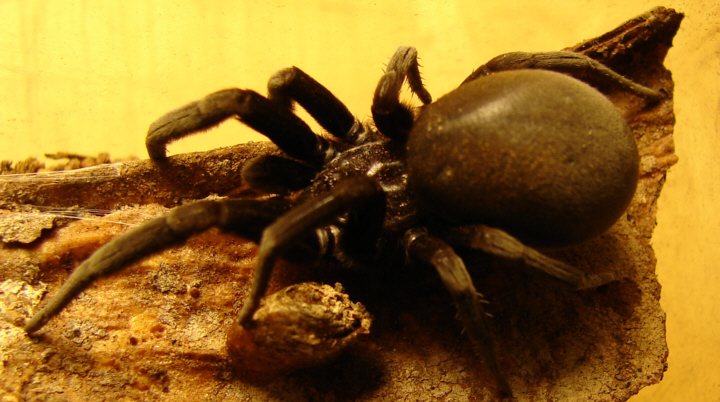
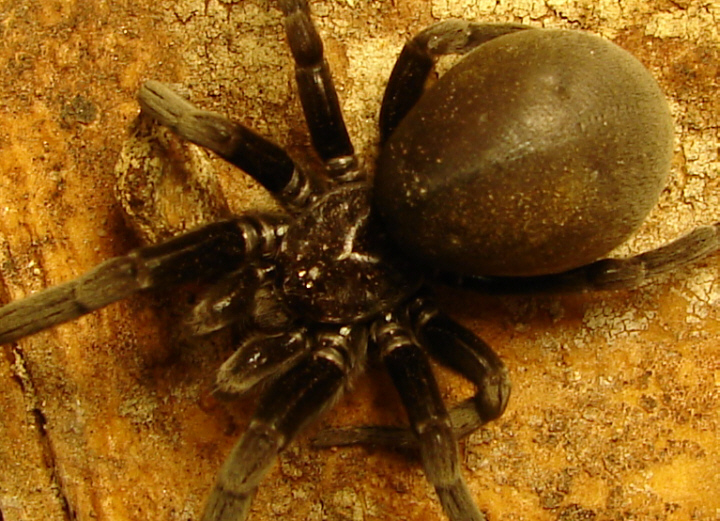
I was doing some long neglected yard work today and while pulling out some weeds around a dying bit of prickly pear cactus in the back yard I came upon this “little” beauty:

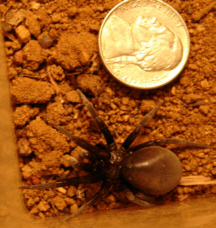
And here is one for scale:

OK, so it’s not a bird eating spider, the size of a dinner plate, but outside of a full blown tarantula it is the biggest spider I’ve seen in the wild around these parts (Southern California) since I was a kid. My first attempt at an identification would be a California trapdoor spider (Bothriocyrtum californicum), though it looks a little different from the pics I can find on the web and I didn’t find it associated with a trapdoor setup. It was just clinging to a bit of old prickly pear skin (an environment it was sharing with literally hundreds and hundreds of Eleodes).

Any spider guys out there that can confirm or correct my I.D.?

One more time with Biele

Creationist Arthur Biele responded to my response, to his response of my critique of something he wrote on horse evolution [inhales abruptly].

Thankfully he respected my wishes that he not post another book length set of arguments in the comments to my post. He has of course taken this as a blanket refusal on my part to allow him to respond:

Biele: Since you refuse me a full response to your article…

Mr. Biele, I only asked that you not post another extremely lengthy response, in the comments section of my blog and indeed this is a rule of mine, one not restricted to you. If you look at my comments policy you’ll see that this is a  request I make of everyone who comments on my blog. Still, I welcomed you to respond to one or two specific points, which we could then discuss further; something which I think would be a more productive way to continue our debate.  And I also specifically mentioned other options you could take if you wanted to respond at length.

Once again, you are free to start your own blog (they’re free) or web page and post as long a response to me as you like. Alternatively you could post your comments to the Talk Origins Newsgroup (or some other similar open forum), and simply leave a link in my comments as to where your response could be found (and then I might respond further here).

So it is really your choice.

Now, despite your complaints, you did in fact make a comment of a limited nature about punctuated equilibrium which I am happy to respond to.

Biele: …the PE’s views that theory is not at all complementary to Darwinisn evolution, but was meant to replace it.

Yes, I am aware that this is the caricature of punctuated equilibrium that antievolutionists like you believe in; the problem is it is a caricature, not reality. You see, Mr. Biele, for someone who has some understanding of both the neo-Darwinian synthesis and PE (and who has read the relevant literature), your portrayal of the situation is nonsensical.

Biele: In the plaeontologists views, evidence for Darwin’s gradualistic theory of evolution is refuted by the fossil record.

In some paleontologists’ views, the evidence for what Eldredge and Gould referred to as “phyletic gradualism” is refuted by the fossil record. Not Darwinian evolution as a whole, just what they termed its supposed phyletic gradualism. Furthermore, there are many, including myself, that think that Eldredge and Gould fashioned a bit of a straw-man in their characterization of the main-line synthetic theory.

Biele: The PE theory was a means to save The General Theory of Evolution by proposing a new means by which evolution occurs. Of course that theory of evolution also has its’ critical faults too.

[Sigh] I’m sorry Mr. Biele, but this is simply nonsense. Once again, Stephen Jay Gould:

Faced with these facts of evolution and the philosophical bankruptcy of their own position, creationists continually rely upon distortion and innuendo to buttress their rhetorical claim.  If I sound sharp or bitter, indeed I am – for I have become a major target of these practices.

I count myself among the evolutionists who argue for a jerky or episodic, rather than a smoothly gradual, change of pace.  In 1972, my colleague Niles Eldredge and I developed the theory of punctuated equilibrium.  We argued that two outstanding facts of the fossil record —geologically “sudden” origin of new species and failure to change thereafter (stasis) — reflect the predictions of evolutionary theory, not the imperfections of the fossil record. In most theories, small isolated populations are the source of new species, and the process of speciation takes thousands or tens of thousands of years.  This amount of time, so long when measured against our lives, is a geological microsecond.  It represents much less than one percent of the average lifespan for a fossil invertebrate species – more than 10 million years.  Large, widespread, and well-established species, on the other hand, are not expected to change very much.  We believe that the inertia of large populations explains the stasis of most fossil species over millions of years.

We proposed the theory of punctuated equilibrium largely to provide a different explanation for pervasive trends in the fossil record.  Trends, we argued, cannot be attributed to gradual transformation within lineages, but must arise from the differential success of certain kinds of species.  A trend, we argued, is more like climbing a flight of stairs (punctuations and stasis) than rolling up an inclined plane

Since we proposed punctuated equilibria to explain trends, it is infuriating to be quoted again and again by creationists – whether through design or stupidity, I do not know – as admitting that the fossil record includes no transitional forms.  Transitional forms are generally lacking at the species level, but they are abundant between larger groups.  Yet a pamphlet entitled: “Harvard Scientists Agree Evolution Is a Hoax” states: “The facts of punctuated equilibrium which Gould and Eldredge . . . are forcing Darwinists to swallow fit the picture that Bryan insisted on, and which God has revealed to us in the Bible.” – Gould (1983) “Evolution As Fact And Theory” in Hen’s Teeth and Horses Toes, pp.253-262, (Emphasis mine)

And now, 27 years later, Arthur Biele continues the distortion.

Biele: I was preparing a reply in my mind as I read each of your arguments and noting the many sophistical defenses you used in your long awaited reply. A long reply deserves an equal response, And it would have taken me a few days due to my busy schedule. But as you told me what amounts to be ‘take a hike’, that your site is reserved for your own views and accolades, I will honor your wishes. I indeed do plan to actually ‘take a hike’ as it would be good for my health.

As I said it’s your choice. You have several options open to you to give as long a response as you might like to my previous post, and of course you are welcome to respond on the more limited issue of PE discussed here in the comments below, just keep it concise.

If not, it’s no sand off my beach.

James – The Amazing – Randi comes out

Magician and skeptic James Randi, a long time hero of mine has, at 81, come out as a gay man. He has been ‘out’ to his friends and close colleagues forever, and I must admit to not being terribly surprised myself (I picked up on a few hints here and there that made me suspect that it might be the case).

He doesn’t want to make a big deal out it, and I don’t see why anyone else should.

As I said he has been a long time hero of mine in the fight against what he amusingly calls “woo-woo” (paranormal &  pseudoscientific claims) and his being gay does absolutely nothing to diminish my admiration for him and the work he has done.

For more on Randi and his work check out the James Randi Educational Foundation.

A New Major Award!

The National Center for Science Education has announced their ‘creation’ of a new annual  award, the “Upchucky”, to be “bestowed on the most noisome creationist of the year”.  I love it! And they certainly have a nominee rich environment which they can select from.

The contenders for the first annual Upchucky were:

  1. Recently deposed Texas board of education chairperson Don McLeroy; “for his longstanding efforts to undermine the teaching of evolution in the Lone Star state”.
  2. Creationist buffoon Ray Comfort (aka Banana Man) of Living Waters Ministries; “for his distribution of copies of the Origin disfigured with his own creationist introduction”.
  3. The possibly over-caffeinated intelligent design creationist Casey Luskin of the Disco toot’s Center for the Renewal of Science and Culture; “for his logorrheic zeal in reciting the “intelligent design” talking points du jour (“logorrheic”, that’s good, I’ll have to remember that one).
  4. And finally a group nomination for Arabic news channel Al Jazeera; “for its wildly misleading coverage of Ardipithecus ramidus“.

And the Upchucky goes to…

The virulently ignorant Don “Somebody’s got to stand up to experts” McLeroy! [pre-recorded applause].

I’m sure it was a tough decision for the judges but when one considers that he was someone with actual authority over what was taught in public schools I think he was the best choice of this line up.

Bravo NCSE!

[Hat-tip to Thoughts in a Haystack]

Smithsonian Magazine Editor Responds

Someone named Laura, who identifies herself as being an editor at the Smithsonian Magazine, left a comment on my post about their mix-up of hominid pictures in a paleoanthropology time line published in the March edition of the magazine and I figured I’d move it up to post level where more people would likely see it:

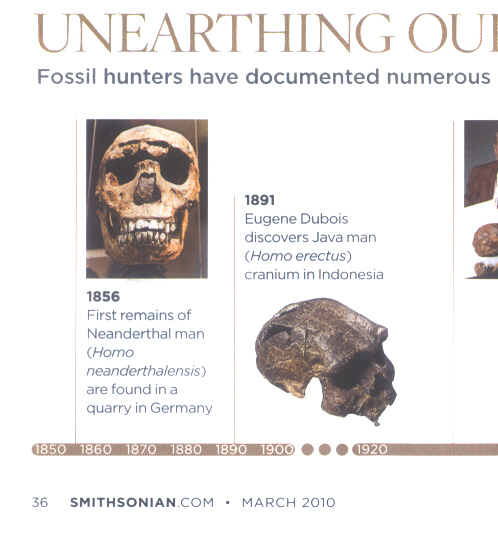
Troy, thanks for your post about Ann Gibbons’ story on Hominid Evolution in Smithsonian. I’m an editor there who worked on the story. We decided whenever possible to use images that would be easy for readers to understand. The timeline, especially, had to show many small images of specimens that some of our readers are reluctant to consider their ancestors. For Java Man, we did go with the more complete skull from the same place and species. We’re trying to figure out what happened with the Neanderthal image–the source we used labeled it as Neanderthal, but your comparison with Turkana Boy makes a good case. We’ll let you know if we figure out where the photo was taken and which specimen it shows.

First let me say thank you Laura for responding on this.

Regarding the Java Man thing, as I admitted in my post, I was perhaps being a bit nit-picky, and I don’t consider the switch from one Indonesian Homo erectus skull to another to be too much of a problem. However swapping out a H. ergaster (from Africa) for a H. neanderthalensis (mostly European) is obviously a different matter.  And while I am not a paleoanthropologist  and while I don’t even play one on the interwebs, I’ll bet you a years subscription to your magazine that you’ll find that the picture that was used to show a Neanderthal is instead a photo of the Turkana Boy.

Funny how I don’t get this sort of response from the antievolutionists who I catch making much larger mistakes than this (and I know some of them read this blog). Ah well…

Hominid Confusion

Just to show that I am an equal opportunity critic (proponents of mainstream science as well as pseudoscientists) I am going to give a wag of the finger to the Smithsonian Magazine.

The March 2010 issue has a feature article on human evolution that celebrates the opening of the Smithsonian Institutes new Hall of Human Origins titled “Our Earliest Ancestors” (Here is an online version) by Ann Gibbons. The problem, however, is not with the article per se but rather with some of the illustrations given in a timeline titled “Unearthing Our Roots” (Gibbons 2010, pp.36-37) which is found within the article.

The timeline gives the readers a brief outline of the history of paleoanthropology from the Neanderthal (Homo neanderthalensis) fossils discovered in German in 1856, to the more recent finds like those of Sahelanthropus tchadensis found at Chad in 2001. The first refers, as I said, to the 1856 Neanderthal find and includes what is supposed to be a picture of a Neanderthal. The second is the 1891 discovery of “Java Man” (Homo erectus) with a picture of a fairly compete skull of a H. erectus.

Read on»