A Tale of Two Dinosaurs

The Institute for Creation Research has graced us once again with a brilliant display of their scientific prowess. This time the focus of their efforts revolves around the recently published description of a newly unearthed dinosaur species Eodromaeus murphi.

Eodromaeus is a small (slightly over a meter in length) South American dinosaur from the mid-Triassic (230 MYA). This date makes it one of the earliest dinosaurs and its describers, Ricardo Martinez et al., argue that it should be classified as a basal theropod ―the carnivorous branch of the “lizard-hipped” or saurischian dinosaurs (Martinez et al., 2011).

What has ICR’s, or more specifically ICR “science writer” Brian Thomas‘ knickers in a twist is that in the same paper in which they describe Eodromaeus the authors also argue for the reclassification of another dinosaur, Eoraptor (described back in the early 1990’s), which is from the same location and roughly the same time period as Eodromaeus.

Read on »

Dinny the dinosaur (still) held hostage

A couple of years ago, after hearing that creationists had purchased Dinny the dinosaur and converted perverted him—and his sidekick Rex—into tools for peddling their rank ignorance, I went out to Cabazon to see for myself how badly they had been abused. What I found was not happy-making, nor would it be for anyone who cares about knowledge, science and truth, or who finds the thought of children being mislead distressing.

What I found was that Dinny had not only been taken hostage by creationists but judging by their posted material, creationists who seem to be enamored with the “teachings” of some of creationism’s lowest common denominators; professional hucksters such as (the felonious) “Dr.” Kent Hovind and “Dr.,” Carl Baugh, two people that even other young earth creationists (YEC) tend to distance themselves from.

Even worse they seemed to be doing fairly good business as they were in the process of expanding the attraction by adding a number of decently executed life size dinosaur models.

Dinny the dinosaur (foreground) and Rex (background).

As I said that was two years ago. Last summer my wife Kathy and I happened to find ourselves not far from Cabazon and I figured we should swing by and see what new devilry might have befallen Dinny.

Read on»

New acquisitions for the Britain Research Library

Thanks in part to an anonymous donor the Britain Research Library has recently made a number of new acquisitions in its science, pseudoscience, and political collections.

Science

Arthur, Wallace (1997) The Origin of Animal Body Plans: A study in evolutionary developmental biology, Cambridge University Press, XII + 338

Ayala, Francisco J. (2010) Am I A Monkey?: Six big questions about evolution, John Hopkins University Press, XIII + 83

Keynes, Randal (2009) Creation: The true story of Charles Darwin, Riverhead Books, XVII + 430

Kurtén, Björn (1972) Not From The Apes, Pantheon Books, New York, NY, VIII + 183

Levinton, Jeffrey S. (2001) Genetics, Paleontology, and Macroevolution (2nd edition), Cambridge University Press, XV + 617

Newman, Horatio Hackett (1926) The Gist of Evolution, The MacMillan Company, IX + 154

Pseudoscience

Gibbons, William J. & Hovind, Kent (1999) Claws, Jaws, & Dinosaurs, CSE Publications, 72

Walsh, Robert E. (editor) (1994) Proceedings of the Third International Conference on Creationism, Creation Life Fellowship, Inc. VII + 645

Politics

Hayek, F. A. (Caldwell, Bruce – Editor) (2007) The Road To Serfdom: Text and documents, The University of Chicago Press XI + 283

Thanks to whomever it was!


One more time with Biele

Creationist Arthur Biele responded to my response, to his response of my critique of something he wrote on horse evolution [inhales abruptly].

Thankfully he respected my wishes that he not post another book length set of arguments in the comments to my post. He has of course taken this as a blanket refusal on my part to allow him to respond:

Biele: Since you refuse me a full response to your article…

Mr. Biele, I only asked that you not post another extremely lengthy response, in the comments section of my blog and indeed this is a rule of mine, one not restricted to you. If you look at my comments policy you’ll see that this is a  request I make of everyone who comments on my blog. Still, I welcomed you to respond to one or two specific points, which we could then discuss further; something which I think would be a more productive way to continue our debate.  And I also specifically mentioned other options you could take if you wanted to respond at length.

Once again, you are free to start your own blog (they’re free) or web page and post as long a response to me as you like. Alternatively you could post your comments to the Talk Origins Newsgroup (or some other similar open forum), and simply leave a link in my comments as to where your response could be found (and then I might respond further here).

So it is really your choice.

Now, despite your complaints, you did in fact make a comment of a limited nature about punctuated equilibrium which I am happy to respond to.

Biele: …the PE’s views that theory is not at all complementary to Darwinisn evolution, but was meant to replace it.

Yes, I am aware that this is the caricature of punctuated equilibrium that antievolutionists like you believe in; the problem is it is a caricature, not reality. You see, Mr. Biele, for someone who has some understanding of both the neo-Darwinian synthesis and PE (and who has read the relevant literature), your portrayal of the situation is nonsensical.

Biele: In the plaeontologists views, evidence for Darwin’s gradualistic theory of evolution is refuted by the fossil record.

In some paleontologists’ views, the evidence for what Eldredge and Gould referred to as “phyletic gradualism” is refuted by the fossil record. Not Darwinian evolution as a whole, just what they termed its supposed phyletic gradualism. Furthermore, there are many, including myself, that think that Eldredge and Gould fashioned a bit of a straw-man in their characterization of the main-line synthetic theory.

Biele: The PE theory was a means to save The General Theory of Evolution by proposing a new means by which evolution occurs. Of course that theory of evolution also has its’ critical faults too.

[Sigh] I’m sorry Mr. Biele, but this is simply nonsense. Once again, Stephen Jay Gould:

Faced with these facts of evolution and the philosophical bankruptcy of their own position, creationists continually rely upon distortion and innuendo to buttress their rhetorical claim.  If I sound sharp or bitter, indeed I am – for I have become a major target of these practices.

I count myself among the evolutionists who argue for a jerky or episodic, rather than a smoothly gradual, change of pace.  In 1972, my colleague Niles Eldredge and I developed the theory of punctuated equilibrium.  We argued that two outstanding facts of the fossil record —geologically “sudden” origin of new species and failure to change thereafter (stasis) — reflect the predictions of evolutionary theory, not the imperfections of the fossil record. In most theories, small isolated populations are the source of new species, and the process of speciation takes thousands or tens of thousands of years.  This amount of time, so long when measured against our lives, is a geological microsecond.  It represents much less than one percent of the average lifespan for a fossil invertebrate species – more than 10 million years.  Large, widespread, and well-established species, on the other hand, are not expected to change very much.  We believe that the inertia of large populations explains the stasis of most fossil species over millions of years.

We proposed the theory of punctuated equilibrium largely to provide a different explanation for pervasive trends in the fossil record.  Trends, we argued, cannot be attributed to gradual transformation within lineages, but must arise from the differential success of certain kinds of species.  A trend, we argued, is more like climbing a flight of stairs (punctuations and stasis) than rolling up an inclined plane

Since we proposed punctuated equilibria to explain trends, it is infuriating to be quoted again and again by creationists – whether through design or stupidity, I do not know – as admitting that the fossil record includes no transitional forms.  Transitional forms are generally lacking at the species level, but they are abundant between larger groups.  Yet a pamphlet entitled: “Harvard Scientists Agree Evolution Is a Hoax” states: “The facts of punctuated equilibrium which Gould and Eldredge . . . are forcing Darwinists to swallow fit the picture that Bryan insisted on, and which God has revealed to us in the Bible.” – Gould (1983) “Evolution As Fact And Theory” in Hen’s Teeth and Horses Toes, pp.253-262, (Emphasis mine)

And now, 27 years later, Arthur Biele continues the distortion.

Biele: I was preparing a reply in my mind as I read each of your arguments and noting the many sophistical defenses you used in your long awaited reply. A long reply deserves an equal response, And it would have taken me a few days due to my busy schedule. But as you told me what amounts to be ‘take a hike’, that your site is reserved for your own views and accolades, I will honor your wishes. I indeed do plan to actually ‘take a hike’ as it would be good for my health.

As I said it’s your choice. You have several options open to you to give as long a response as you might like to my previous post, and of course you are welcome to respond on the more limited issue of PE discussed here in the comments below, just keep it concise.

If not, it’s no sand off my beach.

Smithsonian Magazine Editor Responds

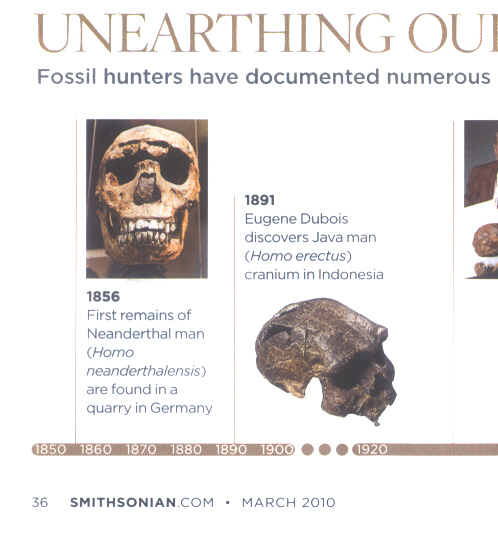
Someone named Laura, who identifies herself as being an editor at the Smithsonian Magazine, left a comment on my post about their mix-up of hominid pictures in a paleoanthropology time line published in the March edition of the magazine and I figured I’d move it up to post level where more people would likely see it:

Troy, thanks for your post about Ann Gibbons’ story on Hominid Evolution in Smithsonian. I’m an editor there who worked on the story. We decided whenever possible to use images that would be easy for readers to understand. The timeline, especially, had to show many small images of specimens that some of our readers are reluctant to consider their ancestors. For Java Man, we did go with the more complete skull from the same place and species. We’re trying to figure out what happened with the Neanderthal image–the source we used labeled it as Neanderthal, but your comparison with Turkana Boy makes a good case. We’ll let you know if we figure out where the photo was taken and which specimen it shows.

First let me say thank you Laura for responding on this.

Regarding the Java Man thing, as I admitted in my post, I was perhaps being a bit nit-picky, and I don’t consider the switch from one Indonesian Homo erectus skull to another to be too much of a problem. However swapping out a H. ergaster (from Africa) for a H. neanderthalensis (mostly European) is obviously a different matter.  And while I am not a paleoanthropologist  and while I don’t even play one on the interwebs, I’ll bet you a years subscription to your magazine that you’ll find that the picture that was used to show a Neanderthal is instead a photo of the Turkana Boy.

Funny how I don’t get this sort of response from the antievolutionists who I catch making much larger mistakes than this (and I know some of them read this blog). Ah well…

Hominid Confusion

Just to show that I am an equal opportunity critic (proponents of mainstream science as well as pseudoscientists) I am going to give a wag of the finger to the Smithsonian Magazine.

The March 2010 issue has a feature article on human evolution that celebrates the opening of the Smithsonian Institutes new Hall of Human Origins titled “Our Earliest Ancestors” (Here is an online version) by Ann Gibbons. The problem, however, is not with the article per se but rather with some of the illustrations given in a timeline titled “Unearthing Our Roots” (Gibbons 2010, pp.36-37) which is found within the article.

The timeline gives the readers a brief outline of the history of paleoanthropology from the Neanderthal (Homo neanderthalensis) fossils discovered in German in 1856, to the more recent finds like those of Sahelanthropus tchadensis found at Chad in 2001. The first refers, as I said, to the 1856 Neanderthal find and includes what is supposed to be a picture of a Neanderthal. The second is the 1891 discovery of “Java Man” (Homo erectus) with a picture of a fairly compete skull of a H. erectus.

Read on»

We need creationists lecturing us on evolution like we need another fenestra in the head

The Institute for Creation Research has presented the world with another taxonomic turd from the cat box of creationist wisdom. This time it comes from ICR’s “Senior Science Lecturer” Frank Sherwin. However before I get to the main event, I want to take a closer look at the litter in which Mr. Sherwin’s little jewel is nestled.

In the February (2010) issue of ICR’s monthly Acts & Facts Mr. Sherwin (whose background is in parasitology) graced us with an article titled “Darwinism’s Rubber Ruler” in which he argues that descent with modification is untestable and that “any and all scientific evidence” can be “stretched to fit” the theory.

The first thing that comes to my mind when reading this is to ask: if this is so, then how is it that I could have in my personal collection literally hundreds of books and pamphlets, many of them originating from Mr. Sherwin’s organization, that purport to contain absolutely scads of evidence that contradict evolutionary theory?

How about Dr. Duane Gish’s (the emeritus vice president of ICR) books Evolution the Fossils Say NO! (1978) and the update Evolution: the fossils STILL say NO! (1995)? How can the fossils say “no” to evolution if any scientific evidence (in this case fossils) can be “stretched to fit” the theory?

Read on»

Epic Horse Exhaust

OK, it took me a while to get to it but I am, as promised, responding to creationist Arthur Biele’s lengthy comments left in response to my criticisms of his writings on horse evolution. For those interested I suggest you go back and read Mr. Biele’s article and my original critique first. Those that do I think will find that his response didn’t really answer any of my original criticisms. Instead what he did was dump a new load of barely coherent nonsense on me.

A warning though, this goes on for quite a bit (it sure felt like it while I wrote it), which is of course due to the well known fact that accurately and substantially responding to horseshit takes considerably more time and effort than it does to spewing it.

Biele: With regard to Eohippus, If you knew anything about the actual fossil record, Eohippus finds are many and that category has been a dumping ground for certain archaic partial skulls that defy any specific classification, nor are they known to be ancestors of any known ‘evolved’ descendants, and they are mostly from Europe.

While apparently attempting to impugn my knowledge of the “the actual fossil record” Mr. Biele clearly demonstrates his own ignorance of the subject at hand. Let’s break this down in order:

Read on»

Four and twenty sauropods baked in a pie…

We find still more creationist ignorance about basic zoological facts, this time from Dr. David Menton of Answers in Genesis.

AiG recently republished on their website a Menton piece from last year attacking the evolutionary relationship between dinosaurs and birds.

Often my first instinct when I run across these things is to launch onto a point by point refutation but I am going to restrain myself this time and simply highlight one rather obvious error in Dr. Menton’s article that in my opinion should cast doubt on anything else he has to say on the subject (especially since he claims to be an anatomist).

Read on»

Dinosaur song

It makes a number of scientific errors but it’s still fun and kinda catchy.

[Via the Smithsonian’s Tracking Dinosaurs.]