If creationists keep spewing nonsense about horses and horse evolution, there may come a day when I run out of literary references and idioms involving horses to play off of in my post titles. But today is not that day.
Before I start I want to promise any regular readers of this blog that despite this being yet another post that is (in part) about creationists and horses, I promise there will be no mention of Hyracotherium this time. No quotes ofRichard Owen. No references to hyraxes whatsoever, you have my word.
Once again the source of my ire is the Institute for Creation Research (ICR) who sent forth one of their minions, Christine Dao, to dutifully report what the institute’s “creation scientists” had to say about the recent news that the South Korea is going to be altering their school textbooks to pander to creationists in that country.
Dao: Science gained a victory when South Korea’s Ministry of Education, Science and Technology announced last month that textbook publishers will correct editions that contain misinformation regarding evolution.
Yes, absolutely, if there is misinformation in the textbooks we would certainly want to weed that out. The problem is, to a creationist, any of the data that makes up the mountain of empirical evidence supporting evolutionary theory is “misinformation”. Let us examine the two examples of supposed misinformation the South Korean “Ministry of Education, Science and Technology” is planning of removing from textbooks and the “scientific” reasons why the ICR agrees that they should be removed; starting in reverses order with “feathers” (figuratively speaking):
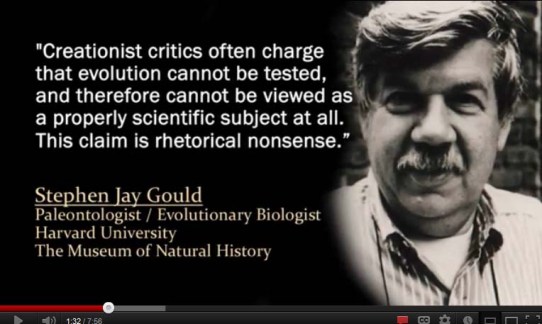
A Facebook friend posted a link to a YouTube video titled “Top Ten Creationist Arguments” by The Thinking Atheist. I had seen it before, it’s slickly produced and OK as far as it goes (though I would have a different list of 10 creationists arguments) but that’s not what got me going. In the video TTA gives a quote from the late Stephen Jay Gould:
This caught my eye because I have been researching stuff to do with philosophy of science, i.e. the testability of evolutionary theory and the difference between the so called experimental sciences and historical sciences. In particular I thought I had remembered reading a essay by Gould on the subject and I thought this quote might give me a lead on it. The problem is TTA doesn’t give a source for the quote. “No problem”, I thought, “I’ll just Google it and it should be a snap to find the source.” Bzzzt! Wrong. Oh if you Google the quote you’ll get a gillion links but none* of them give the source of the quote!
After a half and hour or so of Google mining I finally found a site that gave the source as Gould’s Dinosaur in a Haystack (1995), but it provided no page number! So I pulled my copy off the shelf, blew the dust off the top (damn dust) and checked the index for references to creationism.
There were a couple and while Gould did say something like this in one part of the book referenced, it wasn’t an exact quote. Finally I went to Amazon.com and found that they allowed one to search the contents of the book, and at last I got the information I was looking for.
The quote appears on page 397 (of the 1st hardback edition) and is not one of the places listed in the index for the term creationism. Here it is with some context:
One tangential point before I leave this elegant study [a genetic study of certain crabs, see below – T.B.]. Creationists critics often charge that evolution cannot be tested, and therefore cannot be viewed as a properly scientific subject at all (see the next essay for a fuller discussion of this important issue). This claim is rhetorical nonsense. How could one ask for a better test, based on a very risky prediction, than this? The counterintuitive link between king and hermit crabs was postulated on the basis of classical evidence from morphology (the arguments detailed previously in this essay as points 1-3). This prediction was then tested by the completely independent data set of DNA sequence comparisons — and confirmed in spades, with even closer propinquity than suspected between king crab and hermit crab lines.
I regard this story of king and hermit crabs as one of the most elegant I have learned of late in evolutionary biology–a lovely combination of a fascinating and counterintuitive tale; a multifaceted, rigorous and convincing pile of supporting data; and a lesson of intriguing generality (the difference between genealogical propinquity and any functional meaning of similarity–and the overriding importance of propinquity). (Gould 1995, p. 397, emphasis mine)
Great, curiosity satisfied!
So please, please, please, people, don’t just throw quote around willy-nilly. Give proper references. [I’ll make an exception for T-shirts, but that’s it!]
OK, I got that out of my system, end pedantic rant.
[* I didn’t look at every single Google result so this is a rhetorical “none”.]
Reference
Gould, Stephen Jay (1995) Dinosaur in a Haystack, Harmony Books, NY, 1st hardback edition
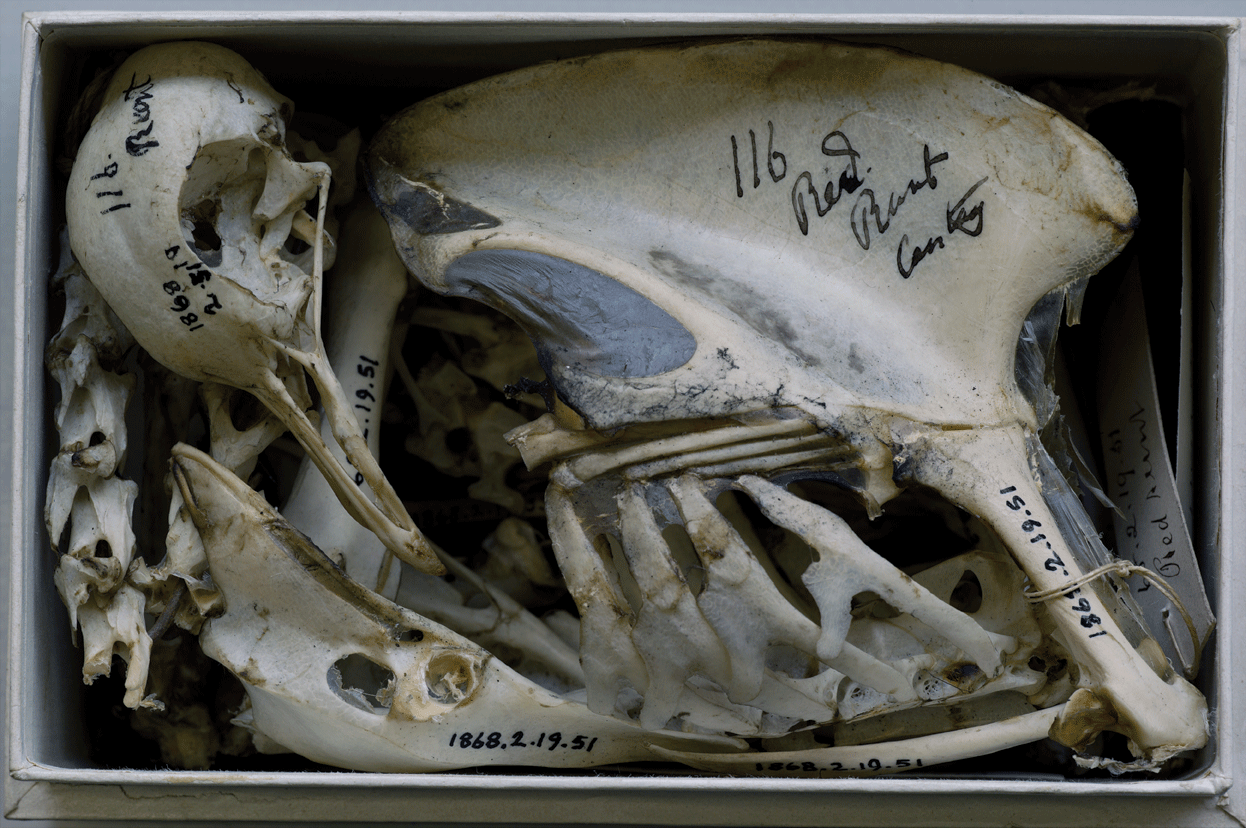
However it is not merely a pigeon that has shuffled off its mortal coil, tis a late pigeon that was once studied by Charles Darwin (Natural History Museum at Tring, Hertfordshire, England), making its image being shared here a matter of course. Photograph by Annie Leibovitz.
The Squidmiester himself, P-Zed Myers, who inscribes his electronic tome of iniquity (a blog) from atop a throne of humans skulls (a ordinary office chair), ensconced in his deep sea fortress of doom (the University of Minnesota Morris), is hosting the 48th Carnival of Evolution at his retched hive of scum and atheistic villainy, Pharyngula!!! You are not going to want to be late for this one, because the lucky ones will be eaten first!!!
Welcome your new Cephalopod overlord! I think he likes you…
Bwahahahahaha!!!
Praise be to Cthulhu for this invisible line break! Pain in the ass html…
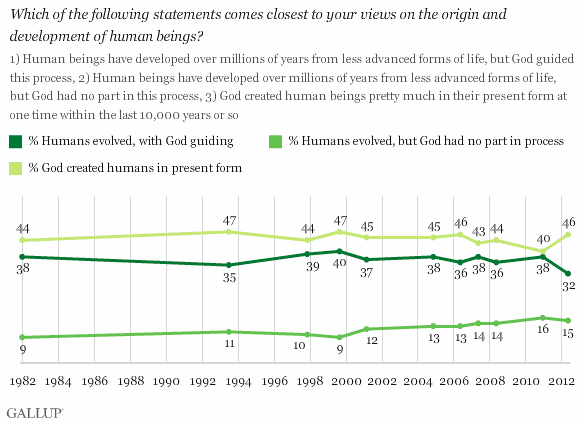
Gallup has issued the results of yet another poll on American’s views on evolution; human evolution to be specific (and that all most people care about). And the results are unfortunately in the same ballpark they’ve been in for decades. Roughly half (46%) of people in the U.S. believe that humans were created by God in the present form within the last 10,000 years.
The “good” news is that 32% of people polled accept that humans evolved over millions of years, but that God was involved in some way (though that is down from 38%!). To be sure that is not a scientifically defensible position but at least it isn’t an overtly science denying one. Combined with 15% who accept evolution, without adding any unscientific extras, that brings the total of evolution acceptors in the U.S. to 47%; which gives us a whopping 1% lead over the hard core creationists.
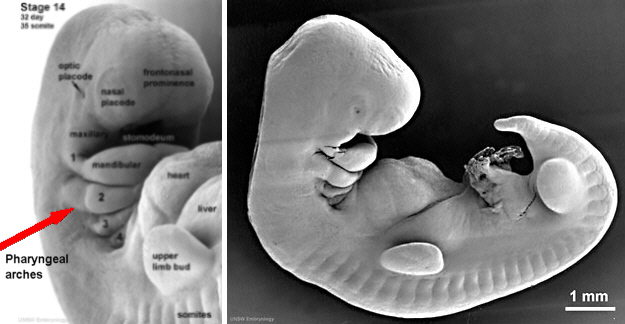
Charles Darwin once said that he thought the evidence from the comparative anatomy of embryos was “by far the strongest single class of facts” in favor of common descent (Darwin, 1860) and while it has since been eclipsed by genetics, it remains one of most compelling subsets of evidence for evolution. And perhaps the single most striking detail in the comparative embryology of vertebrates, are the structures colloquially known as “gill slits”.
Embryonic “gill slits” or “branchial clefts” (branchia is Greek for gill) or more properly pharyngeal clefts (grooves, folds, etc.) are part of what is called the “pharyngeal apparatus” found in front (ventral) and sides (lateral) of the head/neck region of all vertebrates in the “pharyngula stage” of development. In “fish”, and the larva of amphibians, these develop into respiratory organs used to extract oxygen from water while in amniotes (reptiles, birds and mammals) they are modified into other structures.
Before I go on, a brief digression about “fish”. Throughout this article I will often use “fish” in the generic sense; but it should be noted that the term as it is commonly used—to refer to any vertebrate that swims in the water, has fins and gills—is not a valid scientific classification. This is because the three main types of animals commonly called “fish” —the Chondrichthyes (sharks, rays, skates and chimaeras), the Actinopterygii (ray fined fish, which constitutes the majority of living fishes), and the Sarcopterygii (lobe fined fish, the group from which four legged land animals, i.e. tetrapods, evolved)—are not a monophyletic group. That is they are not very closely related to each other despite some of their outward similarities (like gills). For example the living Sarcopterygii, lung fish and coelacanths share a more recent common ancestor with us (and all tetrapods) than with the other “fishes”.
OK, so the “pharyngeal apparatus” consists of a series of paired pharyngeal arches and fissures which develop on the exterior with a corresponding set of pharyngeal pouches on the inside of the throat, separated from the external fissures by a thin membrane (more on the details in a moment). And in fact the possession of these structures at some point in development, along with a hollow dorsal nerve cord, a notochord and a post anal tail, are the defining characteristics of the phylum chordata to which we and all other vertebrates belong.
Please note that the above illustration is diagrammatic and not intended to be photographically accurate (I have to say that lest I be accused by creationists of conveying a fraud). Below are actual photographs of both a skate embryo and a human embryo for comparison. Also note: the gill structures in the embryos of Elasmobranch fishes—the subdivision of Chondrichthyes which contains sharks, rays and skates—are much less derived than in other “fishes” and therefore generally more similar to those of amniote embryos than the corresponding structures in the bony “fishes” (which are significantly modified).
(Gillis et al 2009, p.5721)
The first of the arches, the mandibular arch, forms the jaw in all jawed vertebrates (Gnathostomes). Most vertebrates develop a total of six arches but the full complement is usually only retained into adulthood by hexanchiform sharks. Hexanchiformes are very plesiomorphic which means that they are more like earlier types of sharks. Some species of hexanchiformes even develop a seventh arch. Likewise the extant jaw-less vertebrate, the lamprey, also have seven gill openings.
This is a re-post, in slightly modified from, of one of my Talk Origins Archive feedback responses (from back when the Archive had a feedback section, specifically March of 2002)
Luke asked:
Please email me your response if possible. I don’t want to categorize myself as a evolutionist or creationist. I was visiting the other website I think it was creationist or similar, your guys arch enemies; anyways I was trying to find proof to support modern man evolving from ape, and they had an extensive article written about the human knee and how it has sixteen parts and minus just one and its useless. Apes have non locking knees and because of their makeup you aparently can’t evolve it into a locking one you have to start from scratch. Evolution and mutations from what I’ve read only allow for small changes no mutation can allow for the formation of a complex organism with sixteen moving parts? The knee would have to be built all at once it couldn’t evolve or it would have no use. How do you suggest that apes dumped their knees and immediately mutated new ones with sixteen brand new parts? I would like to believe it could happen just seems far fetched?
From my reading of the article it seems to be highly flawed, especially in its almost total lack of discussion on the comparative anatomies of living non-human apes (gorillas & chimps etc.), extinct hominins (australopithecines, early Homo) and modern humans. This lack of attention to comparative anatomy (and physiology) is typical of anti-evolutionists and it leads them to continually talk about the anatomy/physiology of various organisms as if they exist in a vacuum (examples: Thewoodpecker or Thebombardier beetle). They focus on some extreme example of organ or system in a particular species as if it is totally unique to that species. The fact is that when one looks at other closely related species one usually finds that there are variations on the extreme example that the anti-evolutionists have focused upon.
For instance the bombardier beetle that anti-evolutionists often cite is just one species of a whole group of beetles (“Ground beetles”, Family Carabidae) many of which have some variation on a chemical defense mechanism, using the same basic chemicals (which exist in many beetles in varying amounts), but used in differing ways. The specific example that anti-evolutionists cite sprays an explosive mixture out of its abdomen in a fairly well aimed stream at its attackers, however there are other Carabid beetles that spray with less accurate aim, and others that merely excrete bad tasting chemicals out of their abdomens when attacked. There is a whole spectrum from fairly simple to fairly complex defense mechanisms. Anti-evolutionists only talk about the more complex variant.
This discussion of the human knee is another example of this sort of argument in a vacuum.
While I am not an expert in the comparative anatomies of the living non-human apes and humans, as far as I am aware there is no material difference between them. That is, every bone, muscle, ligament, tendon, and cartilage in the human knee has its corresponding representative in the knee of chimpanzees and the other great apes (and presumably in the knee of their concestor). Yes they are shaped somewhat differently. Yes they are proportioned differently. But as far as I know all the same parts are there (if there are any primatologists or physical anthropologists out there, please correct me if I am wrong). [Note: see the 2nd Lovejoy quote provided by Adam Benton in the comments section below.]
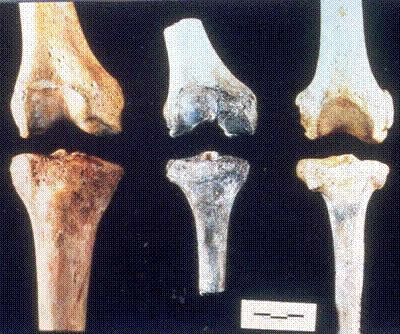
As for fossil hominins, the knees of more derived types like Homo erectus (which are either “fully human” or “just apes” depending on what anti-evolutionist you talk to) seem to be virtually identical to those of H. sapiens. As for the knees of the more basal species of Homo (H. habilis) and the australopithecines these become increasingly like those of living non-human apes the farther back in time one goes. Exactly the sort of thing one would predict if humans evolved from an “ape-like” ancestor. The knee of Australopithecus afarensis (which most anti-evolutionists say is “just an ape”) retains a number of “ape-like” features but also has characteristics like those of later hominins including H. sapiens. In other words it is an intermediate form in this regard.
The knee bones of a modern human, an australopithecine and a chimpanzee.
Burgess does mention living apes briefly but only to dismiss them as being poor bipedal walkers. However this is a problem for his argument for irreducible complexity (IC), at least as I understand Michael Behe‘s (the person responsible for the recent popularity of this term) definition of the term, in that while the knees of living non-human apes are slightly different in form, and are not as efficient for use in bipedal walking as those of humans, they do work, and they can walk bipedally.
Note: please remember that evolutionary theory does not postulate that humans are descended from other living apes, like chimps or bonobos, rather we share a common (ape) ancestor with those species.
So, assuming that knee joints of the ancestor of later hominins was essentially the same as those of the living non-human apes and could, like them, walk in a bipedal manner at all, then it would be possible for there to be a selective advantage for any slight modifications in their descendants which lead towards an increase in efficiency of bipedalism.
The human knee seems to me to be a poor example of an IC structure.
Some of Burgess’ other arguments just seem nonsensical to me. For example he states:
The knee joint presents a major challenge to the evolutionist because it is unique, and because there are no intermediate forms of joint between a condylar joint and the other two limb joints found in animals and humans – the ball and socket joint and the pivot joint. (Burgess, 1999)
I fail to understand Mr. Burgess’ challenge here. Knee joints did not evolve from elbow, shoulder, or hip joints. Rather knee joints have been knee joints since their origin in the first tetrapods. The same applies to the other types of joints. So why would we expect to find “intermediate forms” between them? That Burgess even poses this as a supposed problem for evolution demonstrates a significant lack of understanding about evolutionary theory and the fossil record.
Ichthyostega; an early tetrapod and its hind leg bones. Its “knee” was the joint between the femur and the tibia and fibula.
It is a curious thing that Behe’s principle of IC as an argument for design turns the traditional argument from design on its head. It used to be argued that those features of organisms that seem perfectly sculpted to suit their needs, or seem well designed from an engineering point was evidence for design. Now, under Behe’s IC principle of design, it doesn’t matter how clunky, ungainly, and poorly designed from an engineering point of view something is, it only matters that it is supposedly irreducibly complex.
Apparently the “Designer” under this new design “theory” is a (supernatural) cosmic Rube Goldberg.







 Playing Chess with Pigeons