Epic Horse Exhaust

OK, it took me a while to get to it but I am, as promised, responding to creationist Arthur Biele’s lengthy comments left in response to my criticisms of his writings on horse evolution. For those interested I suggest you go back and read Mr. Biele’s article and my original critique first. Those that do I think will find that his response didn’t really answer any of my original criticisms. Instead what he did was dump a new load of barely coherent nonsense on me.

A warning though, this goes on for quite a bit (it sure felt like it while I wrote it), which is of course due to the well known fact that accurately and substantially responding to horseshit takes considerably more time and effort than it does to spewing it.

Biele: With regard to Eohippus, If you knew anything about the actual fossil record, Eohippus finds are many and that category has been a dumping ground for certain archaic partial skulls that defy any specific classification, nor are they known to be ancestors of any known ‘evolved’ descendants, and they are mostly from Europe.

While apparently attempting to impugn my knowledge of the “the actual fossil record” Mr. Biele clearly demonstrates his own ignorance of the subject at hand. Let’s break this down in order:

Read on»

Wilkins on Darwin and race

John Wilkins, philosopher from down under, has written a nice blog post on Darwin and race, “Myth 7: Darwin thought that Australian aborigines were closer to apes than to Europeans“:

Actually, this one is better called “Darwin was a racist”, but as the text concerned is from the same source as those claims, I thought it might be easier to evaluate a single claim and generalise from that.

Our gospel for today is chapters V and VI of The Descent of Man, published in 1871.

If you read Darwin sloppily, or to find evidence that he really was a Very Bad Man for rhetorical – usually religious – purposes, you soon come across this statement. In fact, you can find paraphrases of it in literally hundreds of creationist documents and sites. Here is the offending passage, from towards the end of chapter VI of the Descent:

At some future period, not very distant as measured by centuries, the civilised races of man will almost certainly exterminate and replace throughout the world the savage races. At the same time the anthropomorphous apes, as Professor Schaaffhausen has remarked, will no doubt be exterminated. The break will then be rendered wider, for it will intervene between man in a more civilised state, as we may hope, than the Caucasian, and some ape as low as a baboon, instead of as at present between the negro or Australian and the gorilla. [p201]

Many folk read this to be making the following claims:

1. It is right that civilised races should exterminate the savage races

2. It is right that the great apes (which Darwin calls “anthropomorphous” or “humanlike”) will be made extinct.

3. When this happens the gap between humans and apes will be wider because the intermediates, apes and negroes or Australian aborigines, will be gone.

Hence: Aborigines and negroes are more apelike than Caucasians.

Let’s look at a bit of context here. I do not propose to defend Darwin from his biases, but let’s be quite clear on what they are first (and note, if Darwin turned out to be a baby eating white supremacist, it no more makes evolution false than the fact that most baby eating white supremacists are Christians discredits Christianity).

Check out the rest over on Evolving Thoughts.

A little pictorial sleight of hand

This is something of a followup on my previous post on bird hips and the place of the sauropods in the dinosaur family tree.

In that post I linked to an image of the dinosaur family tree I had found on the creationwiki web site:

After a commenter (Moth Eyes) noted, in so many words, how it was odd that a creationist might label this illustration a “family tree” given that they don’t believe there is such a thing. This led me to look at where creationwiki might have gotten this illustration.

Read on»

Four and twenty sauropods baked in a pie…

We find still more creationist ignorance about basic zoological facts, this time from Dr. David Menton of Answers in Genesis.

AiG recently republished on their website a Menton piece from last year attacking the evolutionary relationship between dinosaurs and birds.

Often my first instinct when I run across these things is to launch onto a point by point refutation but I am going to restrain myself this time and simply highlight one rather obvious error in Dr. Menton’s article that in my opinion should cast doubt on anything else he has to say on the subject (especially since he claims to be an anatomist).

Read on»

Intermediate fossils and the pre-Darwin (creationist) geologists

RBH left a comment to a previous posting that inspired me to put some material together to address his (or anyone’s) reservations on the subject of intermediate fossil forms and the pre-Darwin (creationist) geologists.

Another really helpful post, Troy. Thanks!

Thanks RB!


Addendum

I realized during my discussions with RBH in the comments to this post that my main point behind writing about this subject might not be transparent to the average reader who doesn’t eat, sleep, and breath the creation/evolution debate. So I add this preface to give the reader a context for why I am going on at length about early 19th century geologists.

My point in all this is less about understanding the often vague and sometimes even contradictory views of the pre-Darwin scientists (as worthy as that subject of study is) and more about countering the arguments from modern antievolutionists that intermediate fossils do not exist and that those paleontologists who claim that they do, do so only because they are reading their “evolutionary beliefs” into the evidence.

If the pre-Darwin creationist geologists saw intermediates this tends, strongly I think, to falsify that argument. The same applies to the overall pattern of the fossil record and the geologic column that illustrates it (which is also frequently claimed by antievolutionists to be a evolutionary invention).


RBH: I do have one reservation. You wrote

The changing pattern of the fossil record and the existence of intermediate fossil forms was recognized by scientists (who were creationists) long before Darwin brought evolutionary theory into the scientific mainstream.

The changing pattern in the fossil record was surely observed; Cuvier in France and Owen in England — both eminent comparative anatomists in the first half of the 19th century — were very clear on that.

Indeed, Cuvier, Owen and just about every other geologist/paleontologist in the world at the time.

RBH: But Owen opposed Darwin’s hypothesis of species transmutation and common ancestry specifically because he did not see transitional/intermediate forms in the fossil record to which he had access.

I can’t speak much about Cuvier, but Owen is a little difficult to pigeon-hole into modern categories (perhaps a theistic evolutionist of sorts). He did oppose Darwin, particularly Darwin’s mechanism of natural selection but seemed to have been open to the idea of some sort of secondary causation for living things (as opposed to their direct creation by God).

Read on»

‘O Oysters, come and walk with us!

Dr. John Morris, president of the Institute for Creation Research, just can’t seem to stop himself from saying ignorant things. And saying them about things for which there is no reason to be ignorant about even for a young earth creationist.

In the October issue of Acts & Facts, in yet another of a seemingly endless  parade of snarks about the Cambrian radiation (Morris 2008a) he throws out this little nugget about the famous mid-Cambrian Burgess Shale fossil locality:

Morris: In 1940, fossils of amazing clarity and diversity were found in Canada’s Burgess Shale. The extremely fine-grained shale preserved intricate details of previously unknown invertebrates.

The problem is the Burgess Shale was discovered by Charles Walcott in 1909 and quarried for fossils for decades before 1940. And as far as I know nothing significant regarding the Burgess Shale happened in 1940 either. But why get this wrong? Never mind bothering to crack a book on the subject, if Morris had bothered to Google the Burgess Shale the very first thing to pop up would have been the Wikipedia entry on the fossil locality which in a matter of seconds would have given him the correct date for its discovery.

It’s like he’s not even pretending to care about getting even the most basic and noncontroversial facts straight.

Read on»

More scientific ignorance from Dr. John Morris

Dr. John Morris, president of the Institute for Creation Research is at it again. Apparently not content with advertising his abject ignorance of zoology as he did a few months ago when he listed tunicates (phylum chordata) along with sea stars as members of the phylum echinodermata, he is now letting everyone know that he is equally incompetent to comment intelligently on the subject of paleontology (I know, I am as shocked as you are).

More specifically he has come out attacking the classic fossil evidence for the evolution of the horse in the September (2008) issue of ICR’s Acts & Facts.

Morris: Horse evolution prominently appears in textbooks as a supreme example of the evolution of one body style into another. All students remember the “horse series” sketches, tracing the development of a small browser named Hyracotherium (formerly known as Eohippus) with four toes on the front feet and three on the rear, into the large one-toed horse of today. Intermediate steps included the three-toed Mesohippus, a modified horse with one toe touching the ground [Emphasis mine]

Mesohippus_toes_arrows

Wrong right off the bat. The fact is that with Mesohippus all three toes touch the ground as can be seen in the above photo of a mounted fossil at the Chicago Field Museum. This is especially true when it is taken into account that Mesohippus probably would have had pads on its feet similar to those found in tapirs.

Tapir hooves

Tapir hooves

Read on»

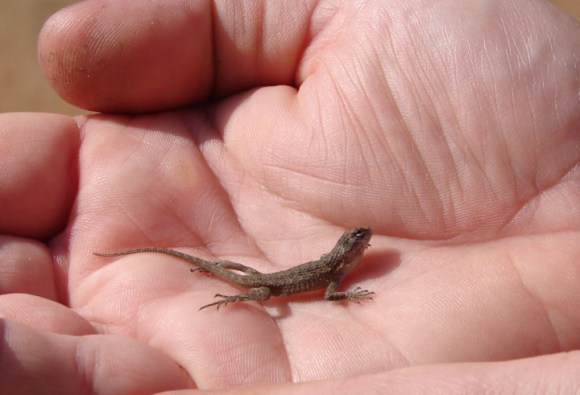
A tiny intruder

My wife (Kathy) woke me up this morning telling me there was a “baby in the bathroom”. Naturally enough I asked “baby what?”. “A lizard” she said.

Now we generally have only two types of lizards around where I live (in Southern California), the Southern Alligator Lizard (Elgaria multicarinata) and the Western Fence Lizard (Sceloporus occidentalis). Usually when I find a lizard in the house it’s an alligator lizard. They’re nasty little buggers who bite (the larger ones can draw blood), wipe feces on you and drop their tails if you breath on them too hard.

Elgaria multicarinata

So I asked my wife which kind it was. She said, rather insistently, that she didn’t know and that I should get out of bed and look for myself. Here is what I found in all its cuteness:

baby_liz

After briefly toying with the idea of keeping it (because it was so damn adorable) we decided to let it go in an area beside the house where we frequently see its relatives. We wished it best of luck and sent our tiny intruder on its way.

You can tune a piano but you can’t tunicate…

The May (2008) issue of the Institute for Creation Research‘s monthly newsletter Acts & Facts contains an article by the current President of ICR, Dr. John Morris, titled “Evolution’s Biggest Hurdles“. The article is ostensibly about enumerating unsolved questions in evolutionary theory but instead what it does is highlight a deeply rooted set of character flaws in the “creation science” movement and its leaders: intellectual laziness (and/or dishonesty) combined with a lack of basic scientific literacy and colossal hubris.

While I understand that this article is a relatively short, non-technical piece, this does not in my opinion excuse the glaring omissions of relevant evidence about its supposed subject. Nor does the fact that Dr. Morris has a background in geological engineering forgive the zoological ignorance it displays. I am not a zoologist. I don’t have any degrees, but still I was able to immediately spot some of the rather glaring zoological errors and omissions in what Dr. Morris wrote. For someone who has been involved in the creation/evolution debate as long as Dr. Morris has it is difficult to fathom how he could not be better informed on such basic issues.

Read on»

A horse is a horse, unless of course…

…the horse is of course the famous Eohippus.

One of my favorite corners of the alternate universe that is creationism is where creationists get to talking about (denying) horse evolution. The fossil record for horses and their relatives (rhinos, tapirs and some extinct groups) is so well documented it is amusing seeing how creationists rationalize their way around the evidence and when I find something about horses on a creationist site I often take a look to see what sort of silliness they’ve gotten up to.

Case in point: Answers in Genesis put up a short piece on their site recently titled “Not Just Horsin’ Around” which directs their readers to a site called “eQuest 4 Truth.com”. They report that the owner of the website (Rebekah Holt) started it to “… steer young people away from the incorrect information that they receive in many public school textbooks and encyclopedias” and that the site “…helps refute the claim that the modern horse evolved from a much smaller, non-horse ancestor.”

On the site is a page titled “Horse Evolution – Fact or Horse Manure?” written by creationist Arthur Biele, who, judging by a Google search on his name, has been pestering people with nonsense in various internet discussion forums for years. His article here attacking the evidence for horse evolution is a barely readable hodgepodge of unsupported assertions, factual errors and standard quotes from “The Creationist Joke Book™”.

Given that there is so much creationist nonsense out there on the web I normally wouldn’t have taken as much time as I did to dissect it but since Answers in Genesis put their seal of approval on it I figured it would be worth the time.

OK, we’re off to the Eohippus races…

Read on»