The Rush to ignorance tour continues

Oh boy, Limbaugh was talking about biology again on his show yesterday (Oct. 6th 2010,  audio available here):

RUSH: You know, ladies and gentlemen, just as the elitists, the wannabe ruling class people on our side are a little full of it, so are scientists.  Many scientists don’t know diddly-squat.  In fact, these next two stories are from the “scientists don’t know excrement and God is amazing file.”  Two stories, one from Bangkok: “Dracula fish, a bald songbird and a seven-meter (23 feet) tall carnivorous plant are among several unusual new species found in the Greater Mekong region last year, researchers said Wednesday.  Other new finds among the 145 new species include a frog that sounds like a cricket and a ‘sucker fish’, which uses its body to stick to rocks in fast flowing waters to move upstream, according to conservation group WWF.  With fangs at the front of each jaw, the ‘dracula minnow’ is one of the more bizarre new species found in 2009 in the Mekong River region, which comprises Cambodia, Laos, Myanmar, Thailand, Vietnam and China’s Yunnan Province.”

Second story: “Scientists Find 200 New Species in Papua New Guinea — Scientists on Wednesday unveiled a spectacular array of more than 200 new species discovered in the Pacific islands of Papua New Guinea, including a white-tailed mouse and a tiny, long-snouted frog.”  How many of you remember, along with me, the horror stories of how many species we are wiping out every year because of global warming.  I always said, “How do we know we’re wiping them out?  Do we really know there aren’t any more X’s left?  Have we scoured every acre of the earth, there really aren’t any more of those?”  And how do we know that these are actually new?  Were they just created yesterday, the day we found them? How long have these new species been around?  And how can they be new if we’re destroying them? And yet, ladies and gentlemen, we will tell a farmer he can’t use his land because a snail darter is threatened. We’re being governed by a bunch of stupid idiot jackasses. [Emphasis mine]

Wait, what..? Did he actually just say…?  Arrrrgh!

These newly discovered species are new to science Rush, not the planet. Anyone with an IQ higher than that of a stock of broccoli should have understood this.

Of course the real hilarity here is that he is making such mind bogglingly stupid statements in in the context of claiming that it is really scientists who “don’t know excrement”.

Ah, the arrogance of ignorance.
What’s in our kitchen now?

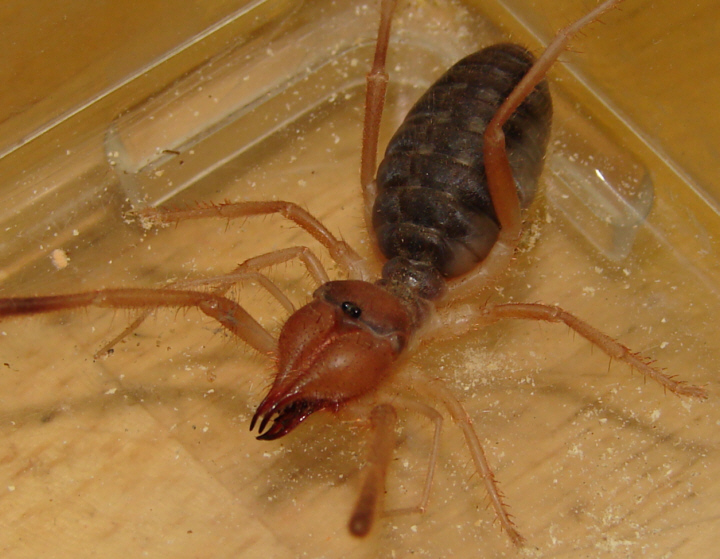
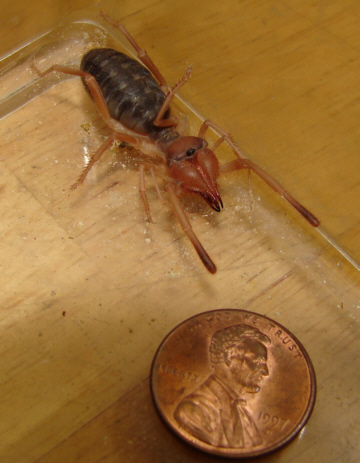
We had a visit this evening from a rather healthy looking Solifugid (aka camel spider, wind scorpion, sun spider, though I always knew them as a “sun scorpions”) which I caught after seeing it scurrying across our kitchen floor.

Solifugids are arachnids related to spiders and true scorpions and like scorpions seem to be largely nocturnal. We get them in the house not too infrequently (much to my wife’s dismay) but this was a larger specimen than usual. In fact it is probably one of the larger I’ve seen in this area of So. Cal..

Penny for scale

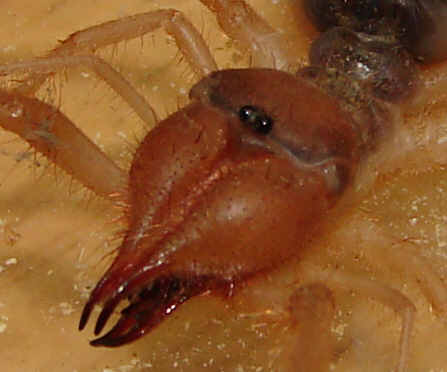
Close up

Despite their fearsome appearance they’re relatively harmless as they lack venom of any kind. However I imagine that they could inflict a rather nasty bite in self defense with those chelicerae (mouth parts).

Look into my eyes!

However impressive this individual might be for around here it is still relatively small compared to some pictures I’ve seen of some old world species encountered by U.S. troops stationed in the middle east.

Just another night in the Britain household…

Some web sites on Solifugids:

Inside Natures Giants

I recently stumbled upon (on YouTube) a BAFTA award winning British TV series titled Inside Natures Giants and I’ve fallen in love. What we have here is a television show in which various large animals, all vertebrates so far, are dissected on camera (and often in front of a live audience of students)  by a team of biologists in order to show the details of their anatomy while presenting elements of their physiology, natural history and evolution (including commentary by evolutionary biologist Richard Dawkins).

So far the show has dissected an Asian elephant, a fin whale, a Nile crocodile, a Rothschild giraffe, a great white shark, a Burmese python, and most recently (unfortunately not yet available on YouTube) a two for one, lion and tiger combination.

I’m hoping they work in a ostrich or emu in there sometime soon and maybe a giant squid or octopus to show some invertebrate anatomy as well.

These programs deal with the dissection of actual animals in graphic detail so if you’re squeamish at all you might find them difficult to watch, however this show is an absolute must see for anyone interested in zoology and evolution.

Of particular interest was the dissection of the giraffe. Among the various interesting adaptations towards tree top browsing is a classic example of one of the cloven hoofprints of evolutionary history, the recurrent laryngeal nerve; the dissection of which has apparently not been done (according to one of the scientists in the show) in a giraffe since the 1830’s.

Here is the first episode of the first series on the Asian elephant:

A play list of all the videos available on YouTube can be found here, and I really cannot recommend them more highly.

Go watch them… NOW!

but there is a whole series of videos showing several different large animals being dissected while their anatomy, physiology, and how these evolved are discussed. A must see for those interested in zoology and evolution.

An example of “intelligent design”?

Ah yes, surely if there ever was a perfect example of the handy work of a benevolent intelligent designer it must be parasitic wasps.

Warning: You may not want to watch this prior to eating if you are squeamish at all.

All things bright and beautiful,
All creatures great and small,
All things wise and wonderful,
The Lintelligent designerd made them all.

[Via Pharyngula]

An exciting day

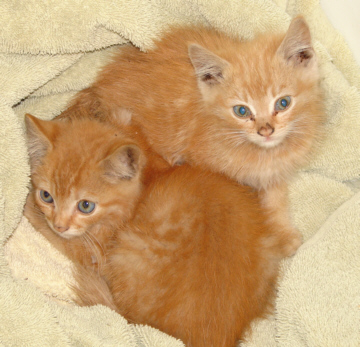
I had something of an exciting day today. First, after some running back and forth (which hurt, a lot, due to the gout attack I am currently suffering from) I managed to capture two of three feral kittens that have been living behind  my workplace. The third, a dark haired and slightly older kitten belonging to a different mother cat managed to elude capture, for now.

Unlike the raccoon and electrical sparks pictured below, these are the actual kittens in question, who are, as of this writing, residing in our bathtub.

Kathy (the wife) doesn’t seem inclined to keep them (despite her love of kitties), so they’re probably destined for the animal shelter. This gives them a better chance at a decent life than living on the streets eating out of dumpsters.

Second while trying to locate one of the kittens I looked between the building I work in and the bank next door (which is a space about a foot and a half wide) only to find myself being looked back at by a large mother raccoon with her kits (cubs?). This had the whole office and a few customers out peering between the buildings, which no doubt had the momma raccoon wondering why all the big hairless monkeys were staring at her.

This was the first wild raccoon I have seen in this part of Southern California (after 30 some odd years of living here). I’ve seen possums, skunks, and coyotes before but despite having heard they were around I had never run across a raccoon before until today.

Finally in the afternoon while I was working on my press, I noticed that the lights flickered and went out. This was followed very shortly by a loud buzzing coming from the circuit breaker panels in the back of the shop and then a series of extremely loud bangs from outside the back of the building (right above where I had caught the kittens in the morning).

I ran outside to see one of the electrical wires that feed our shop sparking, exploding, and burning a few feet past a transformer on a telephone pole in our back parking lot. This was followed shortly by a visit from the fire dept. and the electric company guys who informed us that the power would be out for the rest of the day.

What’s next?

Night of the Tenebrionids!

My back yard is overrun with tenebrionid beetles (genus Eleodes), aka stink beetles. This is in Southern California, early May 2010. My wife Kathy is behind the camera making comments from the peanut gallery.

Here is a picture of a larger version I took a couple years ago:

This was a good sized female who was a little worse for wear (note the dent in her elytron/back). She was ovipositing in a dirt road.

The not so itsy bitsy spider climbed out of the cactus

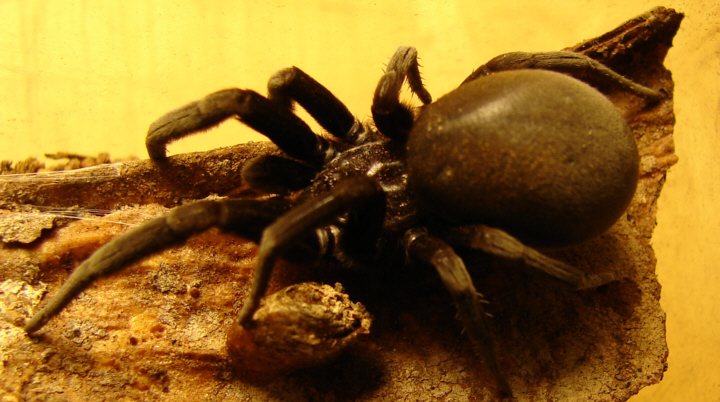
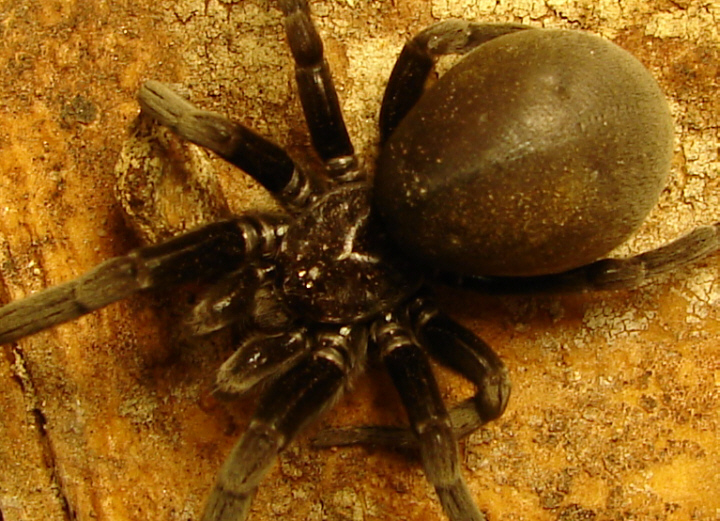
I was doing some long neglected yard work today and while pulling out some weeds around a dying bit of prickly pear cactus in the back yard I came upon this “little” beauty:

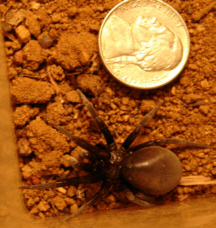
And here is one for scale:

OK, so it’s not a bird eating spider, the size of a dinner plate, but outside of a full blown tarantula it is the biggest spider I’ve seen in the wild around these parts (Southern California) since I was a kid. My first attempt at an identification would be a California trapdoor spider (Bothriocyrtum californicum), though it looks a little different from the pics I can find on the web and I didn’t find it associated with a trapdoor setup. It was just clinging to a bit of old prickly pear skin (an environment it was sharing with literally hundreds and hundreds of Eleodes).

Any spider guys out there that can confirm or correct my I.D.?

Smithsonian Magazine Editor Responds

Someone named Laura, who identifies herself as being an editor at the Smithsonian Magazine, left a comment on my post about their mix-up of hominid pictures in a paleoanthropology time line published in the March edition of the magazine and I figured I’d move it up to post level where more people would likely see it:

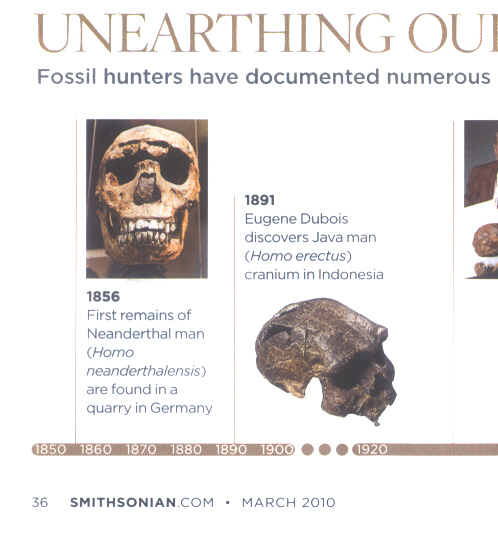
Troy, thanks for your post about Ann Gibbons’ story on Hominid Evolution in Smithsonian. I’m an editor there who worked on the story. We decided whenever possible to use images that would be easy for readers to understand. The timeline, especially, had to show many small images of specimens that some of our readers are reluctant to consider their ancestors. For Java Man, we did go with the more complete skull from the same place and species. We’re trying to figure out what happened with the Neanderthal image–the source we used labeled it as Neanderthal, but your comparison with Turkana Boy makes a good case. We’ll let you know if we figure out where the photo was taken and which specimen it shows.

First let me say thank you Laura for responding on this.

Regarding the Java Man thing, as I admitted in my post, I was perhaps being a bit nit-picky, and I don’t consider the switch from one Indonesian Homo erectus skull to another to be too much of a problem. However swapping out a H. ergaster (from Africa) for a H. neanderthalensis (mostly European) is obviously a different matter.  And while I am not a paleoanthropologist  and while I don’t even play one on the interwebs, I’ll bet you a years subscription to your magazine that you’ll find that the picture that was used to show a Neanderthal is instead a photo of the Turkana Boy.

Funny how I don’t get this sort of response from the antievolutionists who I catch making much larger mistakes than this (and I know some of them read this blog). Ah well…

Hominid Confusion

Just to show that I am an equal opportunity critic (proponents of mainstream science as well as pseudoscientists) I am going to give a wag of the finger to the Smithsonian Magazine.

The March 2010 issue has a feature article on human evolution that celebrates the opening of the Smithsonian Institutes new Hall of Human Origins titled “Our Earliest Ancestors” (Here is an online version) by Ann Gibbons. The problem, however, is not with the article per se but rather with some of the illustrations given in a timeline titled “Unearthing Our Roots” (Gibbons 2010, pp.36-37) which is found within the article.

The timeline gives the readers a brief outline of the history of paleoanthropology from the Neanderthal (Homo neanderthalensis) fossils discovered in German in 1856, to the more recent finds like those of Sahelanthropus tchadensis found at Chad in 2001. The first refers, as I said, to the 1856 Neanderthal find and includes what is supposed to be a picture of a Neanderthal. The second is the 1891 discovery of “Java Man” (Homo erectus) with a picture of a fairly compete skull of a H. erectus.

Read on»

We need creationists lecturing us on evolution like we need another fenestra in the head

The Institute for Creation Research has presented the world with another taxonomic turd from the cat box of creationist wisdom. This time it comes from ICR’s “Senior Science Lecturer” Frank Sherwin. However before I get to the main event, I want to take a closer look at the litter in which Mr. Sherwin’s little jewel is nestled.

In the February (2010) issue of ICR’s monthly Acts & Facts Mr. Sherwin (whose background is in parasitology) graced us with an article titled “Darwinism’s Rubber Ruler” in which he argues that descent with modification is untestable and that “any and all scientific evidence” can be “stretched to fit” the theory.

The first thing that comes to my mind when reading this is to ask: if this is so, then how is it that I could have in my personal collection literally hundreds of books and pamphlets, many of them originating from Mr. Sherwin’s organization, that purport to contain absolutely scads of evidence that contradict evolutionary theory?

How about Dr. Duane Gish’s (the emeritus vice president of ICR) books Evolution the Fossils Say NO! (1978) and the update Evolution: the fossils STILL say NO! (1995)? How can the fossils say “no” to evolution if any scientific evidence (in this case fossils) can be “stretched to fit” the theory?

Read on»