And now a little poorly concealed bragging

bragging

hopwood_haeckel_book

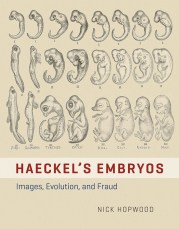
Last weekend while I was awaiting delivery of my copy of Cambridge University historian of science Nick Hopwood‘s new book Haeckel’s Embryos: Images, Evolution, and Fraud (2015) on 19th century biologist Ernst Haeckel and his (in)famous embryo illustrations, (which I have written about a few times here an PCWP and elsewhere), I got a Facebook notification that I had been “tagged” in a post by my friend (in real life, not just Facebook) and colleague Dr. Nick Matzke. The somewhat cryptic post said the following:

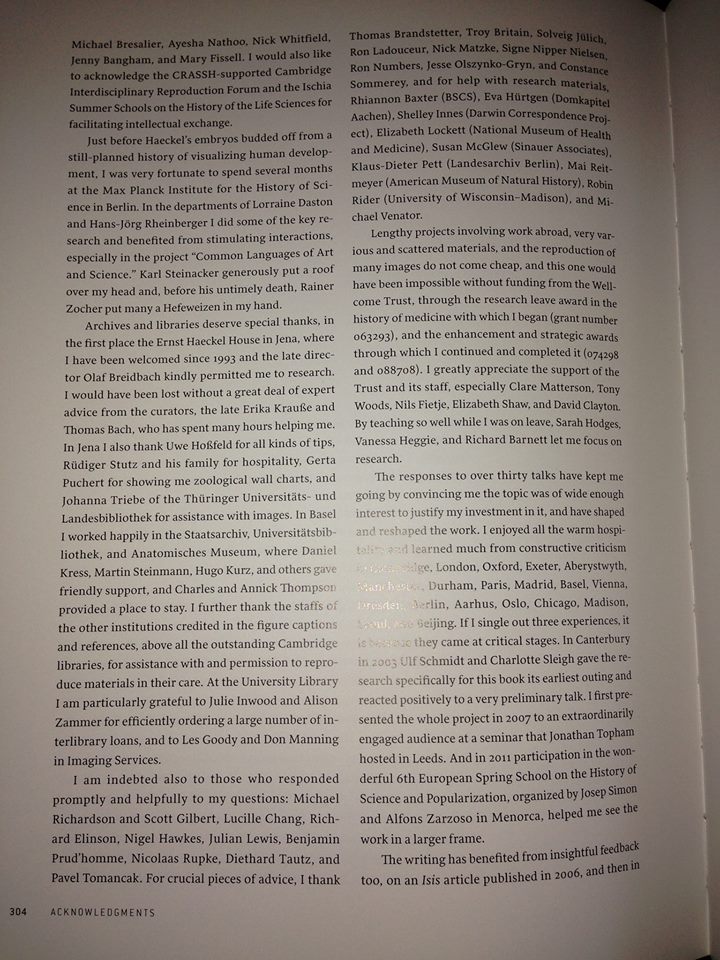
Hey look who’s in the acknowledgements – Troy Britain

Attached to this comment was the following picture:

hopwood_page

Thereafter the comments conversation between Nick M. and I went like this:

Me: Wait, wait, wait, this isn’t Hopwood’s new book is it (my copy is in route)?!

NickYep it is!!

Me: Holy crap!

Nick: Immortality!

Apparently Professor Hopwood was kind enough to mention me (and Nick Matzke as well) in the acknowledgements section of his new book (page 304).

 The relevant section reads as follows:

For crucial pieces of advice, I thank Thomas Brandstetter, Troy Britain, Solveig Jülich, Ron Ladouceur, Nick Matzke, Signe Nipper Nielsen, Ron Numbers, Jesse Olszynko-Gryn, and Constance Sommerey…

Quite an honor! All the more given the company of people like Nick Matzke, Ron Numbers and the rest.

Thank you Prof. Hopwood, you are too kind! And thank you for writing this book! It needed to be done and I look forward to reading it (or rather the rest of it, I’m up to chap. 3 already)!

BraggingAPhysicalInterpretation-27984

What I have been up to lately

I have been a bit neglectful of my blog of late and I feel I owe my readers (who are not Facebook friends, and thus know already), an explanation. In part  it has been due to my usual procrastination but it has also been due to a change in career. For over twenty five years I have been in the small press printing industry (“quick printing” of letterheads, business cards etc.), however this business has taken a turn towards extinction so I have been looking for some sort of escape hatch into something else. Something preferably somewhat more in line with my interests in natural history.cdfa_logo_v_300

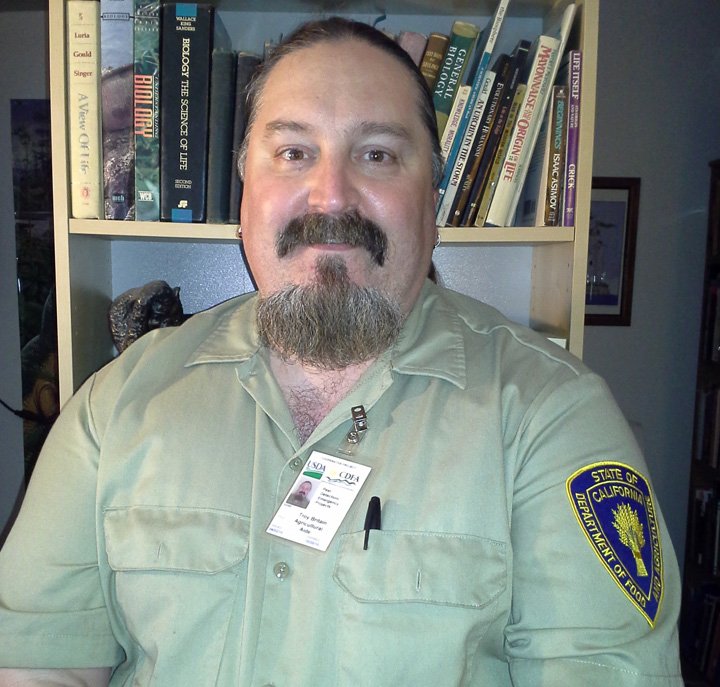
As a result of my search I recently lucked into a job with the California Department of Food and Agriculture (CDFA) as an “Agricultural Aide”, or more descriptively an insect trapper.

troy_in_cdfa_uniform

Yours truly in my CDFA uniform.

Basically I catch flies for a living now.

The initial job is temporary (with a one year duration) but I hope to maneuver myself into a permanent position, with a bit higher pay and additional benefits.

Time will tell whether I will be successful in this endeavor. In the meantime this new job has at least broken the shackles that bound me to a printing press and given me something different to add to my resume if a future employment search becomes necessary.

Before, in my last printing job, I was mostly working part time. Now with the state I work four ten hour days (Mon.-Thurs.) and I feel every minute of it. Basically I have been coming home, eating dinner and falling asleep. This leaves less time and energy for blogging. Though hopefully I will start to adapt and get some of the projects I have been working on finished and published. In the meantime here is a quick pictorial view of my day to day life in the CDFA.

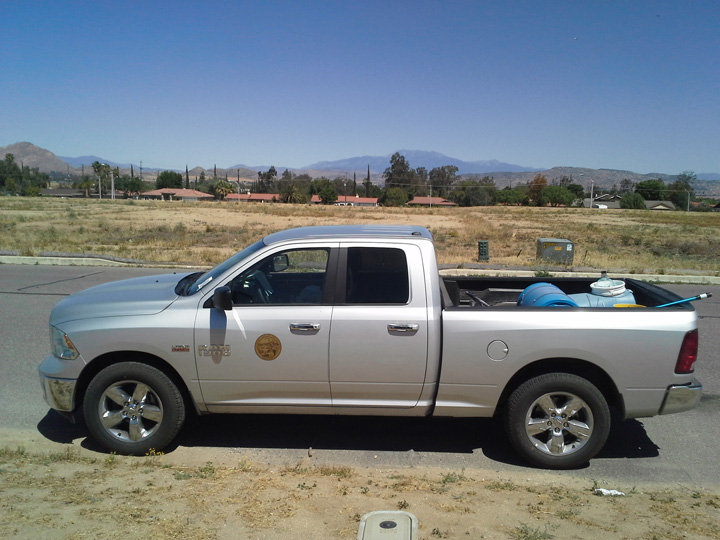
I drive a large truck with a State seal on the door around a particular part of Southern California…

truck

…servicing two different types of fly traps typically hung in various types of fruit trees. The McPhail (the interesting old fashioned glass type, baited with yeast pellets)…

mcphail

…and plastic, two part, Multilure traps (baited with a pheromone soaked sponge, the green thing inside).

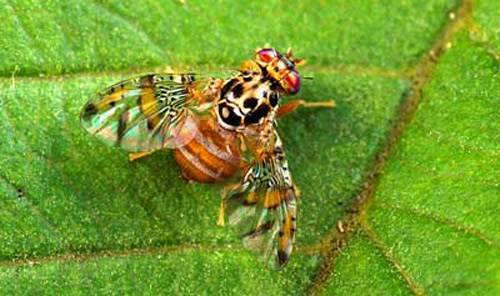
mltOnce a week I visit every trap (30 or so a day), replace the bait when needed (every week for the McPhails and every six weeks for the MLTs) and gather up any Mediterranean Fruit Flies (Ceratitis capitata) that I might find in the traps.

mediterranean_fruit_fly17

Image source, The University of Florida website.

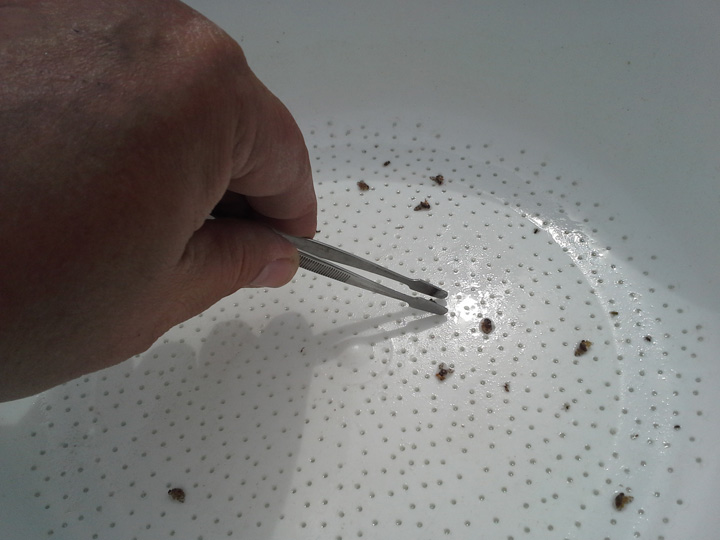
Sometimes there are only a few and sometimes there are literally hundreds in a trap. Further, they are often not alone in the traps. There are frequently a variety of other species of flies as well as lace wings, bees, wasps and moths. More so in the McPhail traps (which are less species specific) but even in the MLTs.

picking_flies

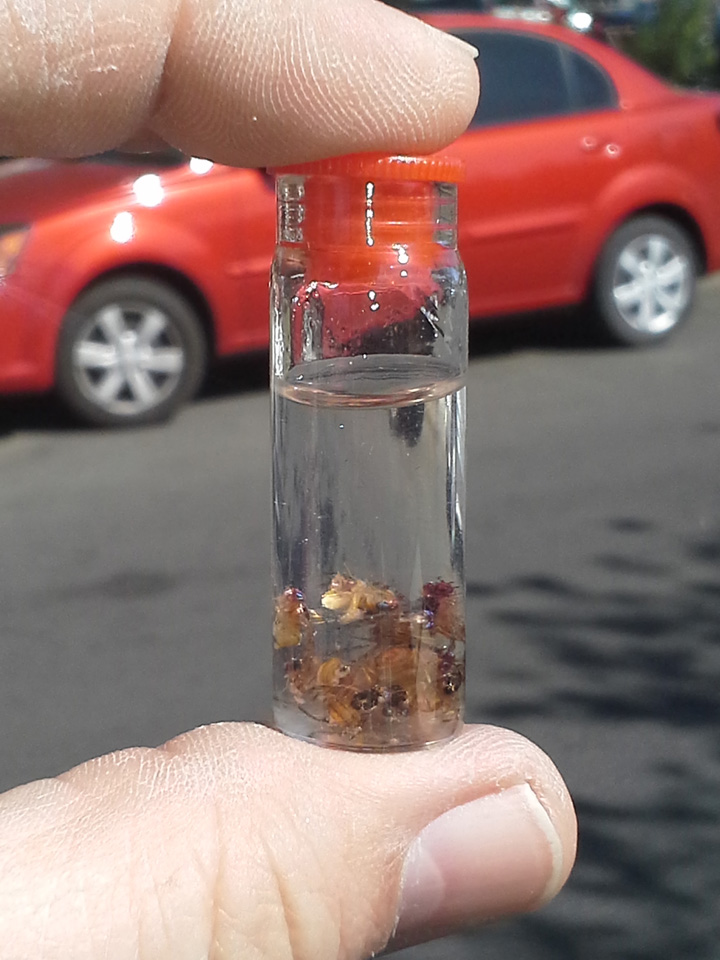
Most, if not all, of these Med Flies are sterile files released by the CDFA as a biological control. However some might be wild flies and that is what I am really looking for, though I don’t make that determination. I simply gather the captured flies up and place them in vials of alcohol:

medflys

They are then turned over to someone else who goes through them looking for wild specimens (sterile flies are marked with ultraviolet dye prior to release); the presence of which might indicate a new infestation that would require further action on the part of the CDFA.

So that is basically what I have been up to as of late and which has been partly responsible for my lack of blogging. Fear not however, I have not given up the struggle against ignorance and unreason. I may just be a bit slower than usual at it.

mad_troy

Yours truly on the hunt.

Creationism Nit: Archaeocete legs

This will be a departure from my typical novel length dissection of a creationist article and will instead be a short look at a single creationist gaffe. Perhaps I will make this into a series, we’ll see. Anyway, today’s nit will be picked with young Earth creationist Dr Carl Werner (a medical doctor).

I recently acquired a copy, of what I believe is the 1st edition, of his book Evolution: The grand experiment (2007, 2nd printing 2009, coauthored with his wife Debbie Werner) and while skimming through it I noticed a little error on page 57, which is chapter 5 of the book and is apparently meant as a refutation of the evidence for evolution from comparative anatomy. In this particular case he is discussing the homology of various tetrapod forelimbs (yellow highlighting mine):Werner_whale

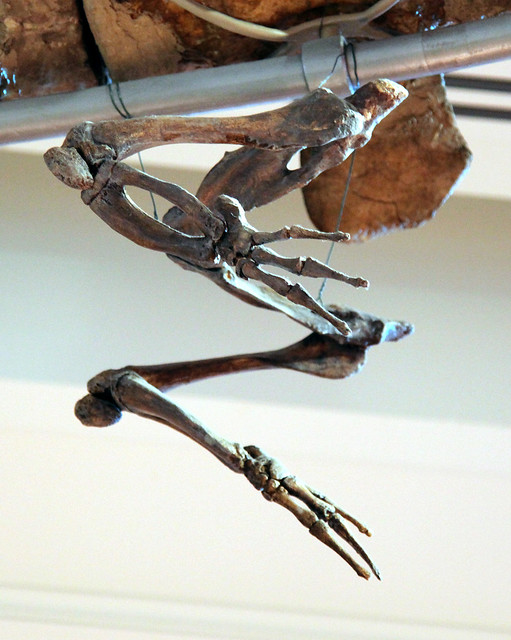
The “nit” in this case is his illustration of the forelimbs of a whale in the dark blue circle above. When I saw it I immediately  recognized that it was not in fact the forelimbs of a whale but rather the hind limbs of one. In this case those of an extinct archaeocete, most likely those of Dorudon (image source).

The skeleton of Dorudon.

And these are the hind legs of Dorudon (image source):

Dorudon hind legs at the Smithsonian Museum

For comparison here are a couple modern whale forelimbs:

Blue whale (Balaenoptera musculus).

Pacific white-sided dolphin (Lagenorhynchus obliquidens).

Clearly what Dr. Werner has pictured are not the forelimbs of a modern whale, rather my money is on them being the hind limbs of Dorudon. Is it a huge deal? No. It is just another example of sloppy creationist research (I mean if a printing press operator recognizes archaeocete legs when he sees them, come on).

Nit. Picked.

Relevant Links

Missing footage from the Nye v. Ham debate!

Wow, OK… One like, no comments, I guess it was just me (and one other person).

22 Answers to 22 messages from creationists

File this under: better late than never.

In the wake of the Bill Nye/Ken Ham creation/evolution debate BuzzFeed writer Matt Stopera had some of the people who attending the debate, and who were creationists, write down questions or comments to those of us who accept evolution.

 The following are the questions they wrote down and my quick and dirty responses.

 1) Bill Nye, are you influencing the minds of children in a positive way?

Obviously I cannot answer for Bill Nye but I would say yes he is, by helping to popularize science.

2) Are you scared of a Divine Creator?

No. If one exists and is worthy of admiration, let alone worship, it would not want its creations to fear it.

3) Is it completely illogical that the Earth was created mature? i.e. trees created with rings… Adam created as an adult.

Illogical based on everything we think we know about existence via science. However, if an all powerful being existed it is certainly possible it could have done this. Likewise under that scenario the entire universe, including all our memories of the past could have been created last Thursday and there would be no way to know. The evidence all points towards the Earth being 4.5 billion years old (and the rest of the universe more than double that) remains the same, so if it is not actually that old then that would seem to make the creator a cosmic liar.

4) Does not the second law of thermodynamics disprove evolution?

No, in fact life as we know it, which includes the ability to evolve, could not exist without the 2nd Law. You see the 2nd Law is essentially about energy flow from more coherent, usable states, to less coherent, unusable states. The obvious and most relevant example being the flow of energy from the Sun into space, where a tiny fraction of its energy is intercepted by the Earth. Life on Earth is only possible because of this energy flow (with the exception of life that lives off the energy flowing from the interior of the Earth itself at hydrothermal vents).

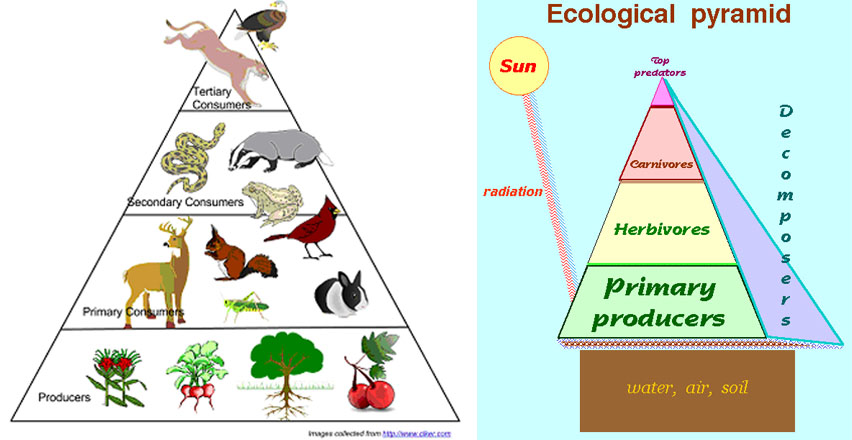
The effects of the 2nd Law can be seen reflected in the so called ecological pyramid, with each level able to extract less and less usable energy from the environment (and this is simplified of course). At the base we find plants are the most abundant and they absorb energy from the sun (“producers”). Next up there are herbivores that live off the plants (“primary consumers”). Then there are the omnivorous and/or small carnivorous animals (“secondary consumers”). Finally the apex predators (“tertiary consumers”), which are found in the fewest numbers of any ecosystem. Underlying all of these are the decomposers that make a living on the energy left over in dead plants, animals, and animal waste. energy pyramidSee: Ecology/Energy in ecosystems

I cannot even imagine what living things or ecosystems would look like without the 2nd Law in operation.

5) How do you explain a sunset if their [sic] is no God?

Seriously? This is a “the tides go in, the tides go out, with never a miscommunication” sort of question. The Earth rotates on its axis every 24 hrs. creating the illusion (from the POV of an Earthbound observer) of the Sun moving across the sky from sunrise to sunset.

6) If the Big Bang Theory is true and taught as science along with evolution, who do the laws of thermodynamics debunk said theories?

No, see answer #4.

7) What about Noetics?

What about it?

8) Where do you derive objective meaning in life?

I don’t know that there is such a thing or that it is even possible. We do have subjective and inter-subjective meaning however and that is good enough for me.

9) If God did not create everything, how did the first single-celled organism originate? By Chance?

It likely did not occur by chance, in the sense of purely random actions of matter, rather it would have happened in accordance with the laws of physics and chemistry.

10) I believe in the Big Bang Theory… God said it and BANG in happened!

Cute, however “god did it” is not a scientific explanation.

11) Why do evolutionists/secularists/humanists/non-God believing people reject the idea of their [sic] being a creator God but embrace the concept of intelligent design from aliens or other extra-terestrial [sic] sources?

First “evolutionist”, i.e. one who accepts evolution, does not equate to being an atheist (“non-God believer”). There are plenty of Christians and other types of theists who accept evolution.

As for evolutionists in general I would say they do not “embrace” any such thing. I can only guess this comes from the disingenuous questions put to Richard Dawkins in the intelligent design creationism propaganda film “Expelled”.  Here is a video where Dawkins discusses this and says exactly what his views are on the likelihood of intelligent design by ETs.

12) There is no in between… The only one found has been Lucy and there are only a few pieces of the hundreds neccssary [sic] for an “official proof”.

hominids2_bigYou were saying?

13) Does metamorphosis help support evolution?

I am not entirely sure what is meant by this question or even what sort of metamorphosis is being asked about. Insect metamorphosis? Amphibian metamorphosis? There is a creationist meme out there that insect metamorphosis (usually in reference to monarch butterflies) is somehow a problem for evolution, however as with most creationist memes, it is based on misinformation.

14) If Evolution is a Theory (like creationism or the Bible) why then is Evolution taught as fact.

It is, or should be, taught as an extremely well substantiated theory, i.e. a rigorously tested, fact-based explanation. Neither creationism nor the Biblical creation account it is based on, even begins to qualify as such.

15) Because science by definition is a “theory” – not testable, observable, nor repeatable why do you object to creationism or intelligent design being taught in school?

Science is not a theory; the development of testable—by observation and experiment—theories are part of doing science. In fact, one could say it is the very aim of science to develop such theories. Creationism—of which intelligent design is a subset—is made up of components which are either untestable or which have already been tested and falsified.

16) What mechanism has science discovered that evidences an increase of genetic information seen in any genetic mutation or evolutionary process?

Part of the answer was in the question; mutation and especially gene duplication.

17) What purpose do you think you are here for if you do not believe in salvation?

Our purpose is whatever purpose we choose for ourselves and frankly, I do not see the how the idea of some supposed purpose imposed from on high is somehow more attractive or fulfilling.

18) Why have we found only 1 “Lucy”, when we have found more than 1 of everything else?

Actually, there are fossil remains representing over 300 individuals of Australopithecus afarensis. “Lucy” is just the most famous specimen of this species. As for more than one of anything else, there is for example Homo erectus, the remains of which have been found in Africa all across Eurasia and into islands in the Pacific (Indonesia). The fun thing about H. erectus is that creationists used to (some may still) argue about whether they were “just apes” or “fully human”.

19) Can you believe in “the big bang” without “faith”?

Yes, as the theory is based on repeatable observations and is testable against further observations.

20) How can you look at the world and not believe someone Created/thought of it? It’s Amazing!!!

You are absolutely right, it is amazing, however there is no compelling evidence that “someone” created it.

21) Relating to the big bang theory… Where did the exploding star come from?

The Big Bang has nothing to do with a star exploding. Strictly speaking, it doesn’t have to do with anything “exploding” in the normal sense of the word. Rather it is about space expanding.

22) If we came from monkeys then why are there still monkeys?

For the same reason that both you and your cousin can exist when you both descend from your grandparents. Humans and the other living apes descend from a common ancestor with the living monkeys. That ancestor was probably more monkey-like than ape-like, but was not one of the current species of monkeys living today.

These questions, at least the ones regarding science—and which were coherent—were not particularly difficult and these people could easily have found the answers with a few Google searches. However, that would require actual curiosity and a willingness to learn. Sadly, these traits are often absent in creationists.

The rest of the questions (philosophical or theological) were simply irrelevant to the accuracy of evolutionary theory (or Big Bang theory) and a unwillingness to grasp this fact is yet another character flaw common amongst creationist.

Answers in Genesis memory holes a glaring error but fails to notice others

While doing some research for a potential post, I was going back and reviewing some of the obvious and indisputably false statements made by creationists that I have documented here on PCwP and in doing so discovered that Answers in Genesis has relegated one of these blunders to the memory hole.  In this case, it seems that AiG would rather we forget that their in house “anatomist”, Dr. David Menton, apparently cannot keep his saurischian (“lizard hipped”) dinosaurs and his ornithischian (“bird hipped”) dinosaurs straight—a basic distinction that any child interested in dinosaurs knows.

This by itself would be reason enough to revisit Dr. Menton’s article however an even better reason might be the fact that the interwebs is currently abuzz with the news that Bill Nye (The Science Guy) has agreed, perhaps unwisely, to debate creationist preacher Ken Ham—Dr. Menton’s boss at AiG—this coming February 4th (2014). I believe what follows should give the reader some insight into both the commitment to principled scholarship and the scientific caliber of the people behind Answers in Genesis.

Now You See It, Now You Don’t

As I noted in back in my February 2009 post,Four and twenty sauropods baked in a pie“, Menton erroneously identified sauropod dinosaurs—long necked giants like Apatosaurus, a.k.a brontosaurus—as being “bird-hipped”, or ornithischian, dinosaurs, making a point of how un-birdlike these massive dinosaurs were, in an article titled “Did Dinosaurs Turn Into Birds?“.

Here is how this section of the article read at the time:

Menton: All dinosaurs are divided into two major groups based on the structure of their hips (pelvic bones): the lizard-hipped dinosaurs (saurischians) and the bird-hipped dinosaurs (ornithiscians)[sic]. The main difference between the two hip structures is that the pubic bone of the bird-hipped dinosaurs is directed toward the rear (as it is in birds) rather than entirely to the front (as it is in mammals and reptiles).

But in most other respects, the bird-hipped dinosaurs, including such huge quadrupedal sauropods as Brachiosaurus and Diplodocus, are even less bird-like than the lizard-hipped, bipedal dinosaurs such as the theropods. This point is rarely emphasized in popular accounts of dinosaur/bird evolution. [Emphasis mine]

This conspicuous blunder, of both taxonomy and comparative anatomy, remained on the AiG site for about five years, then somewhere between April 19th and May 22nd 2013—going by the snap-shots the Internet Archive Wayback Machine takes of websites—they quietly changed this part of the article to read thusly (changes in bold):

Menton: All dinosaurs are divided into two major groups based on the structure of their hips (pelvic bones): the lizard-hipped dinosaurs (saurischians) and the bird-hipped dinosaurs (ornithiscians)[sic]. The main difference between the two hip structures is that the pubic bone of the bird-hipped dinosaurs is directed toward the rear (as it is in birds) rather than entirely to the front (as it is in mammals and reptiles).

But in most other respects, the bird-hipped dinosaurs, including such bizarre creatures as the armor-plated ankylosaurs and the horned ceratopsian dinosaurs, are even less bird-like than the lizard-hipped, bipedal dinosaurs such as the theropods. This point is rarely emphasized in popular accounts of dinosaur/bird evolution. [Emphasis mine]

As you can see, the inaccurate listing of saurischian sauropods, as ornithischians, has become an accurate listing of some actual ornithischians. Which is all well and good, however there is no asterisk, no editor’s note, no update, nothing to let their readers know about this rather spectacular error or the changes made to correct it. It is just gone as if it never happened.

Way to be intellectually honest Answers in Genesis!

Innuendo Ad Nauseam

I will not rehash all the information about the similarities between the hipbones of theropod dinosaurs and various birds, both fossil and living, you can go back and look at my previous post on Menton’s mistake for that. However I am going to take a run at his attempted insinuation (in the last sentence quoted above) that paleontologists are somehow embarrassed by the fact that ornithischian dinosaurs, with their bird-like hips, were otherwise not particularly bird-like and therefore don’t like to bring them up when talking about bird origins.

This makes sense only if you A) have a low very opinion of scientists and think they are involved in a conspiracy to hide things from the general public (which creationists do). And B) are wed to the idea that the superficial resemblance of one feature must imply a close evolutionary relationship; but who does this (aside from creationists that is)?

These two paragraphs of Menton’s article are essentially an irrelevancy, which exists solely for making this innuendo. There may have been some 19th century paleontologists who were impressed by the superficial resemblance of the pelvic bones of ornithischians to those of birds but with very few exceptions (Galton 1970), this idea has been long abandon. If this is “rarely emphasized” in popular discussions of bird evolution it is because it is only of historical interest and not relevant to the current best science on the subject.

That said, some popular works on the subject do in fact discuss it, even including discussions of the armored dinosaurs that Dr. Menton is so keen for us to consider.  For example, pulling something of my bookshelf, there is a section of Lowell Dingus & Timothy Rowe’s book The Mistaken Extinction (1998, pp.170-177) where they go on for several pages discussing the different types of ornithischians and how they are, or rather are not, similar to birds.

On the web, there is The University of California, Berkeley Museum of Paleontology’s website that talks about this on their page about ornithischians and hidden in the deep recesses of Wikipedia, where no one is likely to find them, there are multiple references to ornithischians in relation to birds. For example, both the Origins” section of Wikipedia’s entry on the evolution of birds and the entry for ornithischia talk about ornithischians and birds.

Finally, returning to the printed page, there is every creationist’s most favorite expert on bird evolution* Alan Feduccia (Professor Emeritus at the University of North Carolina), who discussed this in his book The Origin and Evolution of Birds (1999):

Very early on …dinosaurs branched into two major groups delineated by the structure of their hips: the reptile-hipped saurischians and the bird-hipped ornithischians. There has long been a strong temptation to try to derive birds from ornithischians because of this amazing but anatomically superficial resemblance of the hips. Gerard Hellmann in 1926 wrote that “the mere fact that [the pubis] was directed backward, like that of the birds, has evidentially hypnotized several scientists that they have overlooked, or tried to set aside, the many conspicuous differences between the birds and the Predentates [Ornithischia]” (148). …Ornithischians were highly specialized herbivores, too far removed from the main line of dinosaurian evolution to have given rise to any major group. Their line dead-ended with such forms as the duckbills, armored ankylosaurs, plated stegosaurs, and horned ceratopsians like Triceratops.  [Feduccia 1999, pp.51-52, Emphasis mine]

As you can see, it is all a big dark secret that evolutionists do not want getting around, so please, please, dear reader, do keep it to yourself.

This Little Piggy Went To Market…

Of course here I have once again been picking the fly poop out of the pepper, taking time to quibble over something nuanced when I should be telling you about how Dr. Menton, has dropped another huge coprolite into our collective cornflakes.

You see while I was revisiting Dr. Menton’s article I decided to take a little more time with it and in doing so I noted a few more amusing anatomical errors. The most glaring having to do with the dromaeosaurid dinosaur called Deinonychus:

Menton: While evolutionists now agree that birds are related in some way to dinosaurs, they are divided over whether birds evolved from some early shared ancestor of the dinosaurs within the archosauria (which includes alligators, pterosaurs, plesiosaurs, ichthyosaurs, and thecodonts) or directly from advanced theropod dinosaurs (bipedal meat-eating dinosaurs, such as the wellknown [sic] Tyrannosaurus rex). The latter view has gained in popularity since 1970, when John Ostrom discovered a rather “bird-like” early Cretaceous theropod dinosaur called Deinonychus.

An adult Deinonychus measured about 12 feet (3.5 m) long, weighed over 150 pounds (68 kg), and was about 5 feet (1.5 m) tall standing on its two hind legs. Like other theropods (which means “beast foot”), Deinonychus had forelimbs much smaller than its hind limbs, with hands bearing three fingers and feet bearing three toes. The most distinctive feature of Deinonychus (which means “terrible claw”) is a large curved talon on its middle toe. [Emphasis mine]

Without getting distracted with the false equivalency Dr. Menton makes between the minority, “(unknown) archosaur origin” camp and the majority “theropod origin” camp*, his description here of the feet of Deinonychus is wrong on at least two counts.

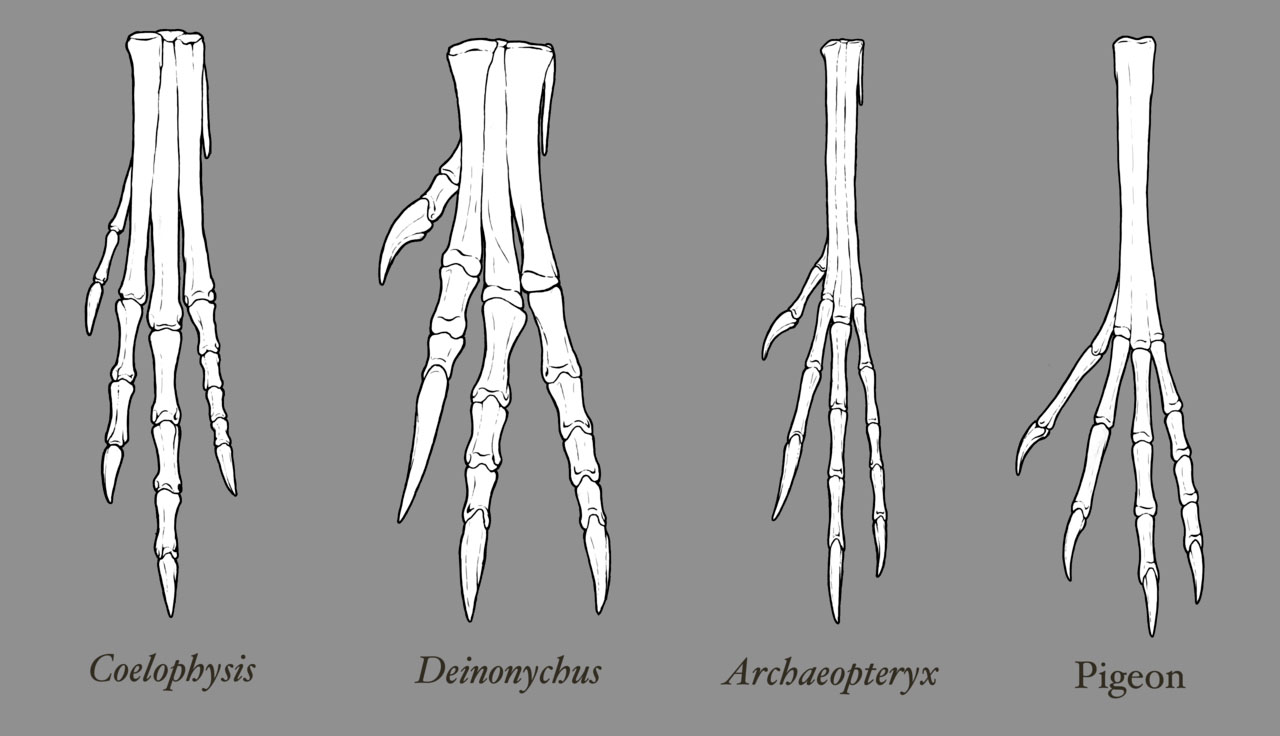
First, Deinonychus like most theropods (and birds) had four toes, not three as Dr. Menton states. In Deinonychus‘ case, three robust forward facing toes and one somewhat reduced backward facing toe—the fifth digit is reduced to a splint bone (Ostrom 1969, p.124).


dino-bird-feet-compComparative illustration composed by Emily Willoughby (used with permission).


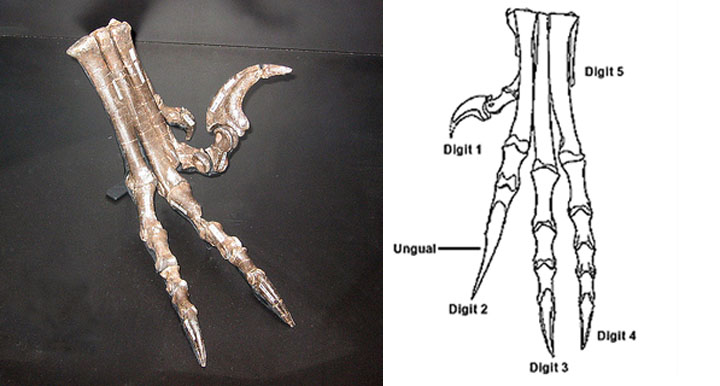
Second, the large curved claw that gives Deinonychus its name is on the anatomically second toe, not the third, which is the “middle” toe in tetrapods. Nor is it on the “middle toe” if we ignore the existence of Deinonychus‘ reduced first toe (hallux) and pretend it only had three forward facing toes. Even in this case the enlarged toe claws of Deinonychus are on the inside toes of its feet, not the middle toes.


Deinonychus feetThe photograph on the left is by Denver W. Fowler and was taken of a specimen on display at Museum or the Rockies, Bozeman, Montana (used with permission, for more on Deinonychus see Fowler et al., 2011). The drawing on the right is from the Yale Peabody Museum website.


So no matter how you count these little piggies, whether from a technical anatomical perspective, or just informally, Dr. Menton, creationist anatomist extraordinaire, is mistaken once again.     

This leads to a couple of questions. If Dr. Menton does not know such basic facts as, what types of dinosaurs are ornithischians or saurischians, how many toes theropod dinosaurs had, or which toes are which, why should anyone take his opinions on the more complex question of the evolutionary relationship between theropods and birds seriously?  

And why would anyone put their trust in Answers in Genesis as a reliable source of information if they apparently willing to cover up this sort of ignorance, which had been on their site, misinforming their readers for years, by quietly changing things without any sort of notice or acknowledgement?

I leave the answers to the reader.

It Is Thus Because It Pleased God To Make It Thus

There is much more in Menton’s article that needs to be addressed and I am going to separate those into a second post. However, there is one last statement by Menton to attend to here. You see just about right in the middle of his article Menton dropped an anti-science bomb that seems to render the rest of his arguments effectively meaningless.   

Menton: What would it prove if features common to one type of animal were found on another? Nothing. Simply put, God uses various designs with various creatures. Take the platypus, for example—a mosaic. It has several design features that are shared with other animals, and yet it is completely distinct. So if a dinosaur (or mammal) is ever found with feathers, it would call into question our human criteria for classification, not biblical veracity. What’s needed to support evolution is not an unusual mosaic of complete traits, but a trait in transition, such as a “scale-feather,” what creationist biologists would call a “sceather.” [Emphasis mine]

I’ll save my barbs about the platypus, feathered mammals and “sceathers”, for part two, because the main point here (which makes those things and pretty much everything else in his article irrelevant) is Menton’s offhanded dismissal of the significance such things as feathered dinosaurs. His statement essentially boils down to an argument that such things as feathered dinosaurs, fish with feet or “ape-men”—you know, transitional or intermediate forms—are merely the creations of a whimsical deity who chose to arbitrarily to mix and match characteristics of different groups of organisms and are therefore irrelevant. After all God can make anything, in anyway he chooses and for any reason he see fit to do so.

This is also known as “using the miracle card” or an appeal to magic. Dr. Menton is of course free to do this; however, in doing so he abandons all pretence of doing science, or even attempting to make rational arguments.   

Why does he bother arguing about different anatomical or physiological features of dinosaurs and birds? Why does he bother to fold, spindle, or mutilate the facts about these things and to misquote scientists regarding them (more on this in part two), if in the end you just going to say, “regardless of the facts, it is the way it is because God did it that way, period”?

It would save everyone a lot of time if he just said this sort of thing up front, so that rational people, who actually accept science and who care about the facts, will know that his claims can be dismissed without further consideration.

So, those are the major things I wanted to address first—and where some of you might want to stop and get off—however, for those of you who are gluttons for punishment, there is, as I said, much more in Dr. Menton’s article that is of false and or misleading nature to be addressed. I will examine those in a separate post.

Fairly warned ye be!

Footnote

*Alan Feduccia is part of a shrinking minority of scientists who deny the evidence that birds evolved from theropod dinosaurs in favor of an older hypothesis that birds evolved from an earlier unknown group of archosaurs (a group that includes crocodilians, pterosaurs, dinosaurs and smattering of other extinct types). Their frequent and often strident attacks on the evidence that birds evolved from theropod dinosaurs make Feduccia, and others like him (the late Larry Martin for example), the go to scientists for creationists to quote on the subject of bird evolution. Creationists use their attacks on the mainstream view of bird evolution to try to cast doubt on whether birds evolved at all.

See:

References

Dingus, Lowell & Rowe, Timothy (1998) The Mistaken Extinction, W. H. Freeman and Company, New York, NY

Fedducia, Alan (1999) The Origin and Evolution of Birds (2nd Edition), Yale University Press, New Haven, CT  

Fowler DW, Freedman EA, Scannella JB, Kambic RE (2011) “The Predatory Ecology of Deinonychus and the Origin of Flapping in Birds“, PLoS ONE 6(12): e28964

Galton, Peter M. (1970) “Ornithischian Dinosaurs and the Origin of Birds”, Evolution, 24(2): 448-462

Ostrom, John H. (1969) “Osteology of Deinonychus antirrhopus, an Unusual Theropod from the Lower Cretaceous of Montana”, Peabody Museum of Natural History Bulletin, 30:1-165

A “Darwin fish” of a different sort

A little in-joke…

The Carnival of Evolution #66 is up!

Or rather it has been up since the 1st of December… [sigh] Yes, I am that pathetic. However, I couldn’t let another month go by with my failing to fulfill my CoE obligation especially given that this edition of the Carnival is being hosted by my friend and colleague the inestimable John Wilkins over at Evolving Thoughts (which you should be reading regularly anyway).

Another selling point for this CoE is, as the presence of the TARDIS (over there on the left of this post) indicates, the Carnival of Evolution is yet again going under a Doctor Who theme. This time it is The Day of the Doctor..of Evolution! Lots of evolutionary goodness, so go and check it out!

Besides, if you don’t the Cybermen will win!

Though I have been neglectful of my participation in the Carnival of Evolution you can still find all the previous installments at this link.  Go and read!

All in the family

Credit: M.F. Bonnan via "I f***ing love science (on Facebook).

Credit: M.F. Bonnan via “I f***ing love science (on Facebook).

Yes, exactly! A significant percentage of the population (cough, creationists, cough) doesn’t understand that the evolutionary relationships between species is a lot like that between extended family members; just over a much longer time scale. Phylogeny is primarily a branching (family) tree-like pattern, not a single file, ladder-like, progression (cladogenesis vs. anagenesis).


Addendum: It has been pointed out to me that the cartoons depiction of a family “tree” superimposed on a cladogram is somewhat inapt and I absolutely agree that the cartoon is by no means a perfect analogy (comparing speciation, species giving rise to new species, with two parents coming together and bearing children). However, I think it gets the idea across much better than the linear iconography that has become so entrenched in peoples minds. Especially, I think, concerning the relationships between fairly closely related species like between chimps and humans. People incorrectly tend to think of humans as somehow being directly descended from chimps rather than our being “cousins” descended from a common “grandparent” (that was probably somewhat chimp-like in appearance).


Once you grok this fact you will understand what is fundamentally wrongheaded about questions like: “If humans evolved from [share a common ancestor with] apes why are there still apes?”

This sort of question is, except for the timescale involved, just like asking: “If you and your cousin share a common ancestor (grandmother), how can you both exist at the same time?”

Understanding this also answers the common creationist objection against many transitional fossil series based on species overlapping in time. For example:

“Early” horses have been preserved in strata from the same evolutionary age as several ‘”later” horses

Hyracotherium/Eohippus and Orohippus do for instance appear in the fossil record at the same time as Epihippus. Mesohippus and Miohippus appear together with Merychippus and Parahippus. Almost all other horses (with a possible exception of one or two)—Parahippus, Merychippus, Pliohippus, Equus and possibly also Miohippus—are represented at the same time during much of the period when they have been found as fossils.16 (But especially in the newer evolutionary schemes, different names have been given to very similar animals, giving the appearence of evolution as well as providing fame to their discoverers; see examples in Froehlich 20029 and MacFadden 20054). Fossils of Hyracotherium (sic) have also been found very high up in the strata (Pliocene), but these findings have been rejected as reworked (i.e. eroded and deposited at a later strata) in spite of the fact that the geological observations do not show any signs of disturbance.17 Thus, the fact that most of the horses lived almost at the same time undermines their proposed evolution. (Molén, 2009, emphasis mine)

Buzzzt, sorry but that is incorrect, thank you for playing, here is a home version of our game as a consolation prize.*

The coexistence of two genera of horses does nothing to undermine their evolutionary relationship any more than your grandparent or cousin coexisting with you undermines your familial relationship.

Evolution does not require that a parent species become extinct after a speciation event (after it gives “birth” to a new daughter species) nor does it require that once two lineages split apart that both will change at the same rate or in the same direction.

Fossil species A could be directly ancestral to species B, persisting relatively unchanged after the two lineages have split. Or species A could be a cousin to species B that only strongly resembles an as yet undiscovered common grandparent species. Such distinction are very difficult to make in fossil organisms.

[* Note: This is not even close to a comprehensive dissection of the problems with quoted article or even this paragraph.]

Reference

Molén, Mats (2009) “The evolution of the horse“, Journal of Creation 23(2):59–63 (downloaded on 9-14-2013)

The evolution of feathers in about 3 and a half minutes

By Carl Zimmer:

[Hat tip to Brian Switek.]