Does intelligent design “theory” lack a mechanism?

No, says the Discovery Institute’s Center for the Renewal of Science and Culture’s resident attack Chihuahua Casey Luskin (and, yes, I’m stealing that John), who reports that he was recently confronted with this question at a talk he had given:

Last month I spoke at the University of Arkansas, and during the Q&A, a skeptic complained that ID theory lacks a “mechanism.” I explained that intelligent agency itself functions in that role, serving as a known cause / mechanism which produces high levels of complex and specified information (CSI).

[Snip a bunch of slides with various quotes from Luskin’s fellow Discoveroid (stealing that too) Stephen Meyer that don’t add anything to this discussion.]

[…] Intelligent agency, therefore, is a mechanism which we can observe and understand in the world around us, and from those observations we know it alone is capable of producing high CSI. But the skeptic wasn’t satisfied with this argument. He insisted what ID lacks is a mechanism that, at the direction of an intelligent agent, could be capable of instantiating information, or design, in the real world.

And this unnamed skeptic was correct. Intelligent design creationists prattle on endlessly about “complex specified information” in nature and how they think that “an intelligence” is required to explain it but they never explain how this “CSI” gets from the mind of their “designer” (wink, wink) to the features of the natural world it is supposedly intended to explain. In other words, even if we were to grant their source of “CSI” they’ve got nothing to offer on where the rubber actually hits the road.

As we spoke after the talk, I asked him, “Why should it be so hard to believe that intelligent agents can implement their designs in the real world? After all, we see intelligent agents manipulating the information in DNA all the time.”

Yes we do Casey. Intelligent agents who are physical beings with physical brains, physically manipulating physical DNA with physical tools.

As the skeptic was a philosopher, he was apparently unaware of the burgeoning field of genetic engineering, where biologists manipulate the information in DNA to produce new biological functions. Unfortunately, this hardened ID critic was probably still not convinced after I explained that it’s easy to believe intelligent agents might have ways of implementing their designs in the natural world — since we see it happening, reported in the scientific literature on a regular basis. This new research discussed in Nature News shows exactly how intelligent agents can manipulate information in DNA to create new structures and functions. There is no reason, in principle, why an intelligent agency must lack a mechanism for implementing designs in the natural world.

And if we ask these physical genetic engineers what mechanisms they use to manipulate physical DNA they won’t respond by merely pointing out that they are intelligent agents and that that fact should tell you all you need to know about the process.

This is the same fallacy that ID creationists engage in when they liken their ideas to the SETI (Search of Extra Terrestrial Intelligence) program. “SETI is looking for signs of intelligence” they say, “we’re doing the same thing.”. But just as with the genetic engineers we are talking about physical ET’s, ostensibly with physical transmitters, sending out signals propagated via some part of physical electromagnetic spectrum.

The reason for all this obtuse deflection about genetic engineers (and aliens) and tedious repetition about “CSI” is that the actual answer to the question of what the mechanism for intelligent design is that it is magic.

Their “intelligent designer” is God (everyone knows this); and God implemented his designs through unknowable miraculous means, end of story.
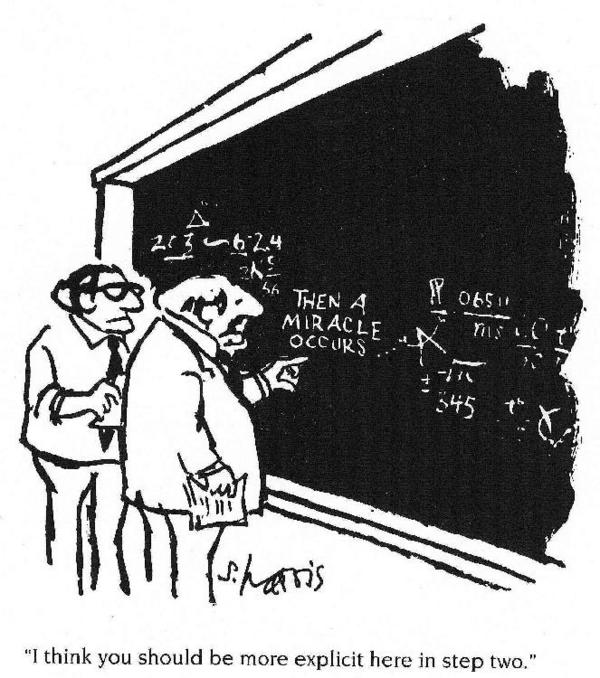
However, if they were to divulge this they know would lose their pretense of doing science and would be admitting to the fact that what they are actually engaging in is apologetics.

Reference

Luskin, Casey (1012) “Responding to the Challenge that Intelligent Design Lacks a “Mechanism”“, evolutionnews.org (blog) downloaded on 5-27-2012

[Hat tip to The Sensuous Curmudgeon.]

Is the human knee joint “irreducibly complex”?

This is a re-post, in slightly modified from, of one of my Talk Origins Archive feedback responses (from back when the Archive had a feedback section, specifically March of 2002)


Luke asked:

Please email me your response if possible. I don’t want to categorize myself as a evolutionist or creationist. I was visiting the other website I think it was creationist or similar, your guys arch enemies; anyways I was trying to find proof to support modern man evolving from ape, and they had an extensive article written about the human knee and how it has sixteen parts and minus just one and its useless. Apes have non locking knees and because of their makeup you aparently can’t evolve it into a locking one you have to start from scratch. Evolution and mutations from what I’ve read only allow for small changes no mutation can allow for the formation of a complex organism with sixteen moving parts? The knee would have to be built all at once it couldn’t evolve or it would have no use. How do you suggest that apes dumped their knees and immediately mutated new ones with sixteen brand new parts? I would like to believe it could happen just seems far fetched?

This argument originates from an article (Critical Characteristics and the Irreducible Knee Joint) published in the Creation Ex Nihilo Technical Journal (Vol. 13, No. 2, 1999) by a British engineer named Stuart Burgess.

From my reading of the article it seems to be highly flawed, especially in its almost total lack of discussion on the comparative anatomies of living non-human apes (gorillas & chimps etc.), extinct hominins (australopithecines, early Homo) and modern humans. This lack of attention to comparative anatomy (and physiology) is typical of anti-evolutionists and it leads them to continually talk about the anatomy/physiology of various organisms as if they exist in a vacuum (examples: The woodpecker or The bombardier beetle). They focus on some extreme example of organ or system in a particular species as if it is totally unique to that species. The fact is that when one looks at other closely related species one usually finds that there are variations on the extreme example that the anti-evolutionists have focused upon.

For instance the bombardier beetle that anti-evolutionists often cite is just one species of a whole group of beetles (“Ground beetles”, Family Carabidae) many of which have some variation on a chemical defense mechanism, using the same basic chemicals (which exist in many beetles in varying amounts), but used in differing ways. The specific example that anti-evolutionists cite sprays an explosive mixture out of its abdomen in a fairly well aimed stream at its attackers, however there are other Carabid beetles that spray with less accurate aim, and others that merely excrete bad tasting chemicals out of their abdomens when attacked. There is a whole spectrum from fairly simple to fairly complex defense mechanisms. Anti-evolutionists only talk about the more complex variant.

This discussion of the human knee is another example of this sort of argument in a vacuum.

While I am not an expert in the comparative anatomies of the living non-human apes and humans, as far as I am aware there is no material difference between them. That is, every bone, muscle, ligament, tendon, and cartilage in the human knee has its corresponding representative in the knee of chimpanzees and the other great apes (and presumably in the knee of their concestor). Yes they are shaped somewhat differently. Yes they are proportioned differently. But as far as I know all the same parts are there (if there are any primatologists or physical anthropologists out there, please correct me if I am wrong). [Note: see the 2nd Lovejoy quote provided by Adam Benton in the comments section below.]

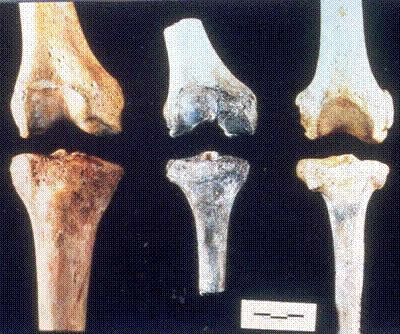
As for fossil hominins, the knees of more derived types like Homo erectus (which are either “fully human” or “just apes” depending on what anti-evolutionist you talk to) seem to be virtually identical to those of H. sapiens. As for the knees of the more basal species of Homo (H. habilis) and the australopithecines these become increasingly like those of living non-human apes the farther back in time one goes. Exactly the sort of thing one would predict if humans evolved from an “ape-like” ancestor. The knee of Australopithecus afarensis (which most anti-evolutionists say is “just an ape”) retains a number of “ape-like” features but also has characteristics like those of later hominins including H. sapiens. In other words it is an intermediate form in this regard.

The knee bones of a modern human, an australopithecine and a chimpanzee.

See The ICR and Lucy: Bearing False Witness Against Thy Neighbor for more comparative photos, or refer to any good text on human evolution for comparative illustrations.

Burgess does mention living apes briefly but only to dismiss them as being poor bipedal walkers. However this is a problem for his argument for irreducible complexity (IC), at least as I understand Michael Behe‘s (the person responsible for the recent popularity of this term) definition of the term, in that while the knees of living non-human apes are slightly different in form, and are not as efficient for use in bipedal walking as those of humans, they do work, and they can walk bipedally.

Note: please remember that evolutionary theory does not postulate that humans are descended from other living apes, like chimps or bonobos, rather we share a common (ape) ancestor with those species.

So, assuming that knee joints of the ancestor of later hominins was essentially the same as those of the living non-human apes and could, like them, walk in a bipedal manner at all, then it would be possible for there to be a selective advantage for any slight modifications in their descendants which lead towards an increase in efficiency of bipedalism.

The human knee seems to me to be a poor example of an IC structure.

Some of Burgess’ other arguments just seem nonsensical to me. For example he states:

The knee joint presents a major challenge to the evolutionist because it is unique, and because there are no intermediate forms of joint between a condylar joint and the other two limb joints found in animals and humans – the ball and socket joint and the pivot joint. (Burgess, 1999)

I fail to understand Mr. Burgess’ challenge here. Knee joints did not evolve from elbow, shoulder, or hip joints. Rather knee joints have been knee joints since their origin in the first tetrapods. The same applies to the other types of joints. So why would we expect to find “intermediate forms” between them? That Burgess even poses this as a supposed problem for evolution demonstrates a significant lack of understanding about evolutionary theory and the fossil record.

Ichthyostega; an early tetrapod and its hind leg bones. Its “knee” was the joint between the femur and the tibia and fibula.

It is a curious thing that Behe’s principle of IC as an argument for design turns the traditional argument from design on its head. It used to be argued that those features of organisms that seem perfectly sculpted to suit their needs, or seem well designed from an engineering point was evidence for design. Now, under Behe’s IC principle of design, it doesn’t matter how clunky, ungainly, and poorly designed from an engineering point of view something is, it only matters that it is supposedly irreducibly complex.

Apparently the “Designer” under this new design “theory” is a (supernatural) cosmic Rube Goldberg.

Related Links

Pay no attention to the creationists behind the ID curtain!

Dr. Barbara Forrest of Southeastern Louisiana University (AKA “Evil, evil woman“), who testified to devastating effect during the 2005 intelligent design trial, Kitzmiller v. Dover (Pennsylvania), has written a scathing expose of the recent shenanigans that intelligent design proponents have been up to in Louisiana (and Tennessee) which I highly recommend you read.  It seems that once again the ID proponents are having difficulty keeping their creationist petticoats from showing.

I’m shocked! Shocked, I tell you!

See: Discovery Institute to LA Family Forum: “Repeat after me: ‘The LA Science Education Act is *NOT* a creationism law.’”

Brilliant!

Stolen from Facebook.

Open mouth, insert hoof

Ken Ham, president/CEO of Answers in Genesis (USA), which is headquartered in Kentucky has attacked an exhibit at the Kentucky Horse Park on horse evolution in a recent post to his blog “Around the World with Ken Ham” and it is yet another glittering example of creationist scholarship.

Reading it immediately brought to mind the words supposedly* whispered by Thomas Huxley as he rose to respond to Samuel Wilberforce in their exchange at the 1860 Oxford evolution debate:

“The Lord hath delivered him into mine hands”.

The reason this came to mind was that it is clear from his comments that he has not bothered to educate himself on the subject and is just mindlessly repeating tired, long refuted creationist clichés on the subject of horse evolution.  In other words, he’s lobbing softballs at defenders of science like me.

Alright, without further ado let’s saddle up and ride forth into the mind of Ham:

Read on»

Is that what it takes?

Now I have no illusions about my blog being another Pharyngula or anything but with at least a couple hundred views a day, from around the world, you’d think I’d be getting few more comments.

Where are all the would-be “creation scientists” eager to show me the error of my ways? Here I am writing post after post spanking the heck out of their intellectual leaders and rather than reasoned defenses or even primal screams of rage I get:

Fine, let’s try Chuck & Beans advice:

inteligent design ain’t science!

Now I know this might seem like little more than a blatant cry for attention (which of course it is) but I am honestly curious about the seeming lack of comments around here. Is there a ‘visits per day’ threshold that one has to cross in order to overcome some sort of comment inertia? Has there been any research on this?

Oh, and hat tip to Scott Weitzenhoffer for the cartoon.

Something creationists wish existed

[Hat tip to Larry Moran at Sandwalk.]

A funny, from Saturday Morning Breakfast Cereal

[Hat tip to James McGrath at Exploring Our Matrix.]

Creationists are just buggy about bugs

A few months back Frank Sherwin,  “Senior Science Lecturer” at the Institute for Creation Research, launched an amusing attack on evolution that is nigh on word-salad; this time focusing on insects, and how they are supposedly problematic for evolutionary theory.

As usual it is stated with the confidence and the faux authority that is typical of “creation science” practitioners but when you actually look at it and try to make sense of what is being said it quickly becomes apparent that much of it is really unintelligible nonsense.

Read on»

Help the TalkOrigins Archive’s bid to buy “Expelled”

Premise Media, the production company that produced the creationist pseudo-documentary “Expelled“, has gone bankrupt and is putting the film up for auction. The opportunity having presented itself, the TalkOrigins Archive Foundation is making a run at acquiring it.

Getting the rights to the film and related production material (unedited interviews of scientists etc.)  could be an invaluable source of ammunition in the defense of science education against the attacks of intelligent design creationists, so if you’re able please consider making a donation to the Foundation (if the bid is unsuccessful your money still goes to a worthy cause) .


Update: TalkOrigins lost the biding war. Oh well, it would have been interesting.