Responding to a comment on my article: “Gill slits” by any other name…

I have decided to move this up from the comments section (cuz why not?) of my article “Gill slits by any other name…

Andy: Hi Troy, I read your post, and it is very well argued.

Thanks. [He said knowing that a “but” was coming.]

Andy: At the moment, I am a biology student at a local university, and one of my personal headaches is the promotion of either creation-ism or evolution-ism. To be honest with you and with all due respect, I really don’t care for either explanation.

Andy, with all due respect, you should know that for someone like me who has been in the “trenches” debating people pushing pseudoscience for years, the fact that you would refer to evolutionary theory as “evolutionism” is a large red flag that would strongly lead me to suspect that your understanding of evolutionary theory and science itself is likely wanting.

Unfortunately, your next sentence does little to disabuse me of my suspicion. Creationism is set of theological beliefs regarding a creation story written down in the 6th or 5th century B.C.E., accepted on faith and in the face of contravening facts by a tiny minority of people with any scientific background. Its mechanisms (God did it) are untestable and to the extent that it makes claims testable against the empirical world it has been falsified a thousand times over.

On the other hand evolutionary theory is a scientific explanation for a vast number of facts that is testable against further observations of the empirical world and used by the vast majority of the relevant scientific community as a guide to further research…whether you “care” for it or not.

That you would casually place them on the same level is yet another huge red flag.

Andy: As a student, the only thing that I am concerned about is true scientific facts that have been tested at a laboratory to the molecular level.

We are only three sentences in and we have three red flags. In my experience people who use terms such as “true scientific facts” (as opposed to what, “false scientific facts”?) tend to not to be particularly familiar with either the facts or what counts as scientific.

However, that is a nit compared to the philosophical problems with your above statement. Why on Earth would you limit yourself to what is testable in a laboratory at a molecular level? Better yet, why should anyone else take your narrow limits as to what to be concerned with seriously? Using your bizarre limitations, we would be throwing out vast swaths of empirical data, and not just in biology.

Molecules are great but they are not a perfect path to knowledge nor are they the only path.

Furthermore, the point of science is not simply collecting random facts, rather it is about explaining the facts that we observe [insert Darwin quote about collecting pebbles here]. In this case, we have detailed anatomical, physiological and genetic similarities between the pharyngeal structures of terrestrial vertebrate (hereafter “amniotes“) embryos and non-amniote vertebrates (amphibians and “fish”), set against a particular paleontological backdrop that needs a coherent explanation.

You do not like creationism, great. That should be a given and I am with you. However if you do not like evolutionary theory, then what is your better explanation for the gill-like appearance of the pharyngeal structures of amniote embryos (and everything else evolution explains)?

You cannot just sit back and say, “I don’t buy any of it” and expect to be taken seriously, especially in face of the apparent success of evolutionary theory.

Andy: My teacher presented this same example about the gill slits during a microbial genetics lecture.

I am not sure how the “gill slits” of vertebrate embryos are relevant to the genetics of microbes but OK…

AndyI was just exhausted of listening, so, I raised my hand and said that the information was outdated and more up-to-date data has been collected explaining that they are no longer gill slits, and they are pharyngeal pouches.

Huh, did you read my article to which you are supposedly responding? You are literally arguing semantics here. Regardless of what we call these structures in the embryos of amniotes, they exist, they resemble—in detail—the developing gills of non-terrestrial vertebrates, and we want to understand why this would be so.

AndyHe asked what was my source, and my reply was, with all due respect, professor, but your source is 150 years old and newer information was out that did not concentrate on a belief based teaching. He stopped and said he will do some more research and get back to us. He continued with the lecture as it was intended.

I am sorry but “your source is 150 years old”, even if true, is not an argument; old ≠ incorrect. FA = -FB (for every action there is an equal and opposite reaction) gets robotic probes to Mars despite the fact that Newton came up with the formula over three hundred years ago.

Furthermore, what is this “belief based teaching” to which you refer? Once again, if you read my article you would know that referring to these structures as “gill-slits” is not dependant on a belief in either creation or evolution as is evidenced by the fact that pre-Darwin creationists called them this.

Oh, and what is your source Andy?

AndyI agree; they look like gills until you dissect it, and then they look like pouches. I know in biology we name a lot of things base on morphological characteristics, and that is a great easy way to remember things.

No, no, no, again did you even read my article? Here, look at this diagram again:
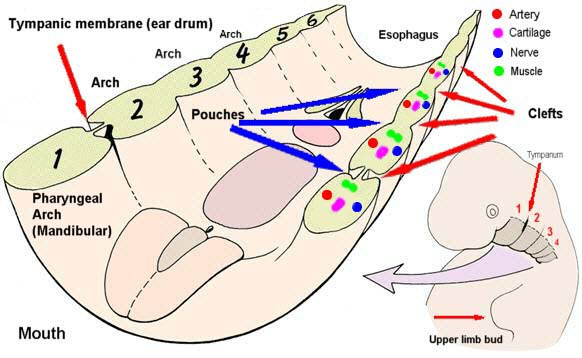
Source bionalogy.com, with modifications.

Source bionalogy.com, with modifications.

There are clefts (or grooves) on the outside of the pharynx (red arrows) with corresponding pouches on the inside (blue arrows). These clefts and pouches are each separated by membranes that, in mammals, normally remain unperforated with the first (tympanic) membrane forming the so-called eardrum. Some of the post tympanic membranes do normally perforate and then reclose in some birds and reptiles embryos. They also temporarily perforate in the gill-bearing larvae of some amphibians and, of course, in fish they stay perforated and become gills.

Since I know some people are queasy about diagrams here are a few photographs of coronal sections done on various mammal embryos. First, an electron microscope picture of what I think is a stage 13 human embryo (Etchevers, 2008)(blue arrow points to the pharyngeal pouch and red to the corresponding cleft).
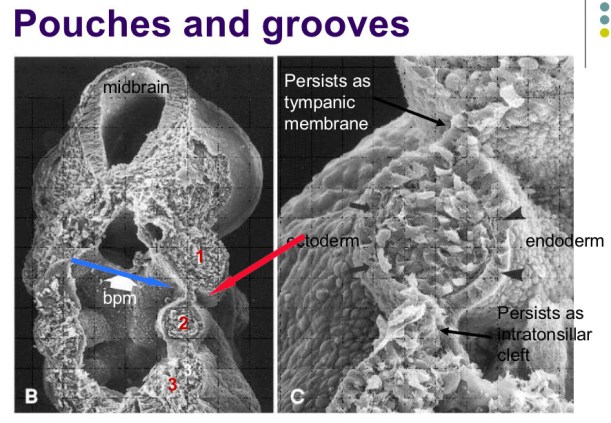
(Etchevers, 2008)

For comparison, here are some stained sections from a mouse (left, Zhang et al. 2005) and a pig (right, Shone & Graham 2014) at a similar point of development; once again blue arrows for pouches and red for clefts. Also, note in these photos that the aortic arches—the blood vessels—are visible within the pharyngeal arches (green arrows).
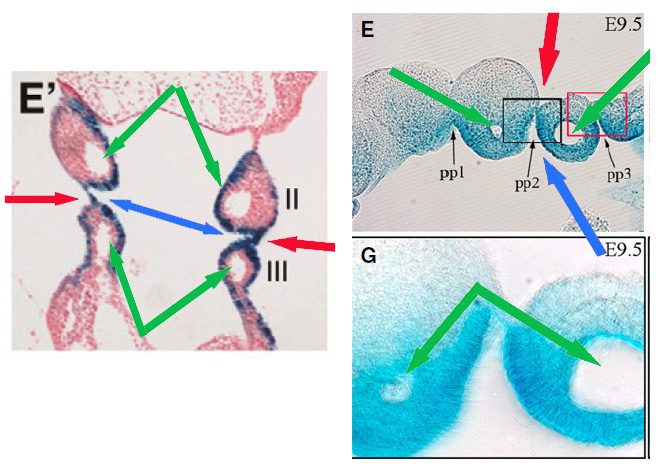
(Left, Zhang et al. 2005 – right, Shone & Graham 2014)

These are not just “pouches”! There are arteries (the blood vessels shown above), muscles, nerves and cartilaginous structures found on either side of the cleft/pouch pairs in the embryonic gills of “fish” and the corresponding pharyngeal arches of amniote embryos.

How do you get from this to, “they look like gills until you dissect it, and then they look like pouches” without ignoring all of these observable facts? These things exist and you need to explain them Andy.

AndyThe only thing that really gets to me is that either creationist or evolutionist keeps trying to push the subject in school.

The reason a competent science teacher (i.e. one who teaches evolutionary theory) would bring them up is because they are structures that have interested biologists since they were first discovered and whose existence is elegantly explained by descent from a common ancestor (evolution).

AndyHonestly, I paid for one of my books close to $300. I feel that my book should be filled with up-to-date information that has been tested, and that is going to help me in the future and not filled with propaganda of any kind.

The pharyngeal structures of amniote embryos are not propaganda. They exist and are observable by anyone with eyes to see. For example, please note that the photographs of the pharyngeal sections of mouse and pig embryos I reproduced above were both taken from papers published within the twenty-first century. Any modern textbook on vertebrate developmental biology is likely to have similar photos or diagrams of these structures.

AndyI guess it is easier to print the old stuff than to update the books to what they are intended to do, and that is to provide useful information that can help us treat diseases and give our patients a fighting chance.

Sorry Andy regardless of whether it comes from an older source or a current one, pharyngeal clefts, or “gill slits” exist in amniote embryos whether or not you want to accept the facts or the current best explanation for them, so please spare us the overwrought “won’t someone think of the ill people?!” shtick.

AndyTo this day, I haven’t seen a mermaid or an angel either in nature or in a lab, so, I will have to dismiss both claims as pending research and proper laboratory testing.
53435573

Yeah so at this point, I am starting to have doubts that you are for real Andy and not just a troll looking for attention. What the hell does a mermaid have to do with anything Andy? Please tell me you are not seriously suggesting that evolutionary theory somehow supports the existence of mermaids [Hint: the exact opposite is the case]. Because if you think it does, you may want to rethink your career path—perhaps something in the arts?

AndyPlease don’t take this the wrong way. I am a paying student who is discordant with the never-ending stories.

As I said, after the mermaid comment I am no longer sure how to take you Andy. Perhaps your response or lack thereof will clarify that question.

Regardless I want to thank you Andy. Formulating my response to you has made me consider adding a few things to my “gill-slit” article that I think could use some expansion or clarification. So anyway, Poe, troll or sincere, something positive has come from your comment, thanks.

References

Etchevers, Heather (2008) Development of the branchial arches (slide presentation downloaded on 10-29-16)

Shone, Victoria & Graham, Anthony (2014) Endodermal/ectodermal interfaces during pharyngeal segmentation in vertebrates, Journal of Anatomy, 225(5):479-91

Zhang, Zhen et al. (2005) Tbx1 expression in pharyngeal epithelia is necessary for pharyngeal arch artery development, Development, 132:5307-5315
Playing Chess with Pigeons on Facebook

pigeonchess_sm

While I have had a link to my personal Facebook page in the sidebar for some time, I don’t know if I have ever mentioned here that Playing Chess with Pigeons has its own Facebook page… Well, now I have.

I generally post cartoons and news stories directly related to CvE as well as links to science news stories that I think are interesting and/or obliquely related to the CvE debate.

Anyway, have a look, like, subscribe, share…

Secular Museum Blunder

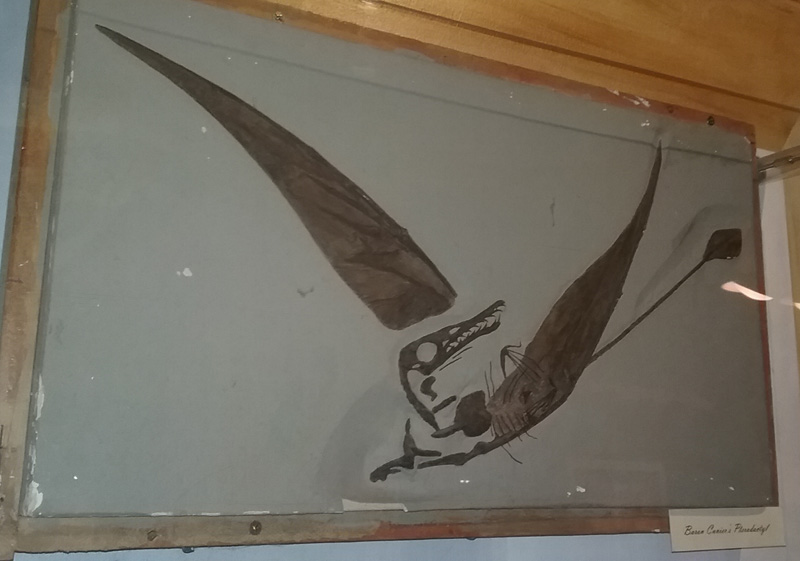
To demonstrate once again that I am an equal opportunity critic, here is a nit I have to pick with a secular museum, namely the Riverside Metropolitan Museum located in downtown Riverside, CA. It is a small museum and most of its limited public floorspace is taken up by displays dealing with Native American culture and artifacts. However it also has a number of displays on natural history, primarily that of the mountains & deserts in Riverside County. It is near some of these displays I found the following stuck to a wall:

Rhamphorhynchus_at_RMM

And here is the lone label seen in the bottom right-hand corner:

Cuviers_pterodactyl

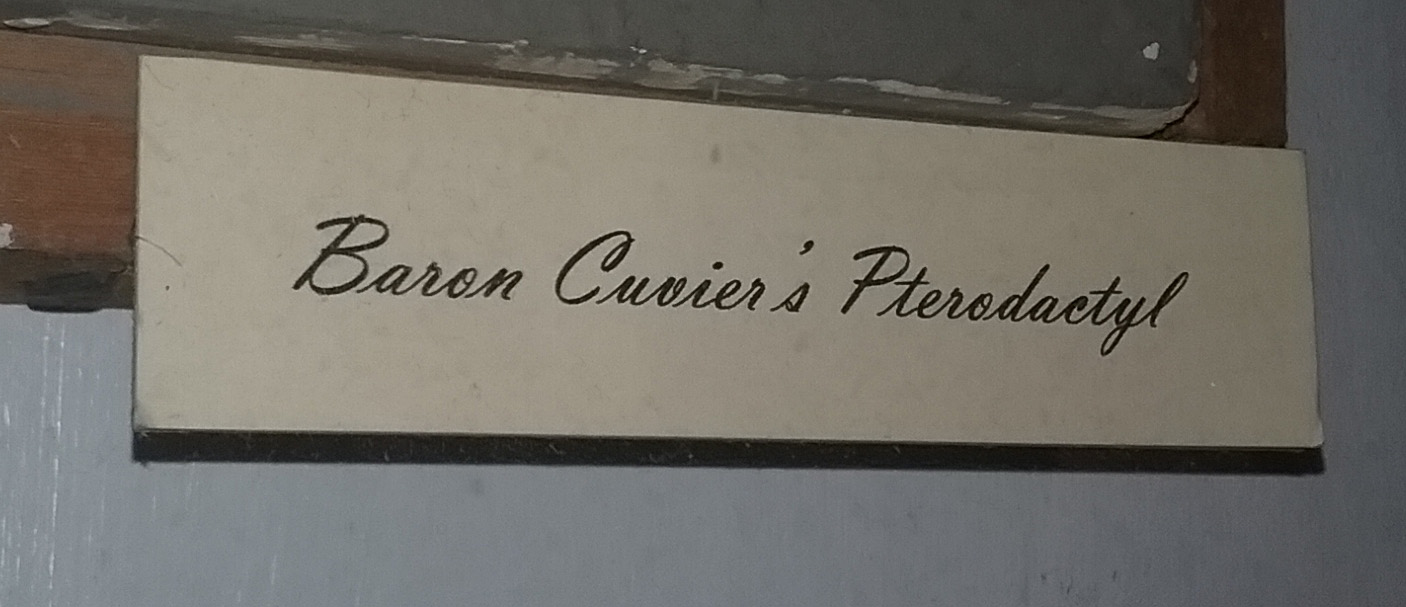
It reads, “Baron Cuvier’s Pterodactyl“, apparently a reference to the fact that it was the “father of paleontology” Georges Cuvier who dubbed one of the earliest discovered pterosaur fossils “Ptéro-Dactyle”.

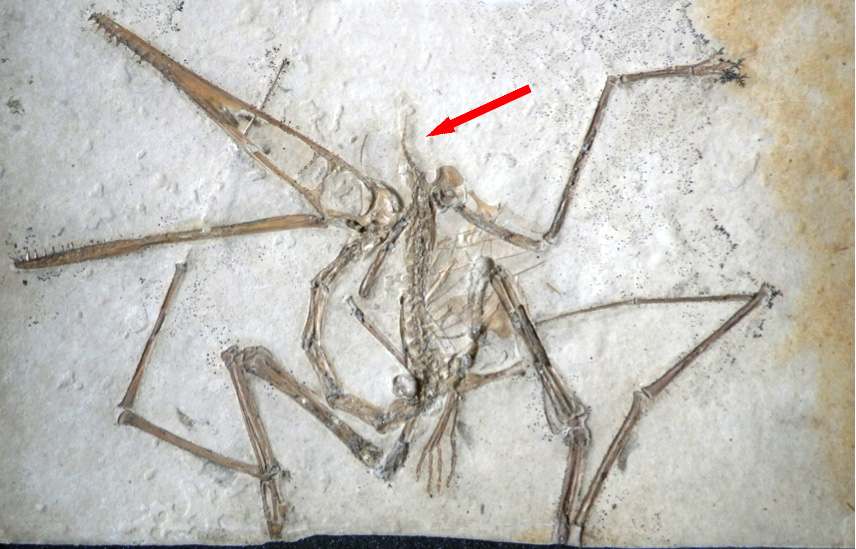
Yeah, the problem is though the cast of the fossil accompanying the label is very clearly not of the genus Pterodactylus named by Cuvier. Rather it is a cast of a RhamphorhynchusHere for comparison is the holotype specimen of Pterodactylus:

Pterodactylus_holotype_w-arrow

The red arrow points to Pterodactylus’ rather diminutive tail, which stands in rather stark contrast to Rhamphorhynchus’ long kite-like tail which ends in a diamond shaped vane (see above). 

Amusingly this is not the first time that these two genera have been confused. Apparently Rhamphorhynchus was originally misidentified as a species of Pterodactylus but after a few rounds of reclassification finally ended up as its own genus by the hand of Richard Owen 1861.

So a wag of my finger to the Riverside Metropolitan Museum; you need to fact check your displays.

Consilience and whale evolution

Way, waaay back in December of 2005 (ye gods has been ten years already?!) I wrote a Feedback response on the Talk Origins Archive to a question about the vestigial pelvic bones found in modern whales. In this case the questioner did not believe them to be truly vestigial, no doubt due to holding erroneous beliefs regarding the subject. In my response I of course took the time to correct their faulty views, however I also used the opportunity to talk about the concept of consilience wherein multiple independent lines of evidence converge on a single explanation, giving us greatly increased confidence that those explanations (hypothesis/theories) are likely to be accurate reflections of reality, i.e. “true”. 

I have now and again thought of going back and using that post as a spring-board for a more detailed examination of this subject and who knows, I may still do so someday. In the meantime however, here is a great video from Stated Clearly that I ran across on Facebook recently that uses the same topic—whales—to essentially do the same thing I did all those years ago; make a point about the consilience of evidence pointing to a pretty definite conclusion with regards to not just the ancestry of cetaceans but the evolution of life in general. Better they include more details than I did and it has animations.

Check it out:

I miss answering the feedback question on Talk Origins…

Beware the Coursera bait and switch!

anti_coursera

On July 30 I signed up on Coursera to take their “verified certificate” version of the course Evolution: A Course for Educators, taught by Joel Cracraft and David Randle of the American Museum of Natural History. I figured it would be fairly easy given my background and the certificate would add a little something to my resume. So, as I said, I signed up, paid the $29 fee for the certificate got an email receipt back from Coursera and waited for the class to start on Aug. 3rd.

Aug. 3rd quickly rolls around and I get another email, ostensibly from Cracraft & Randle, welcoming me to the course.

Great!

Then I tried to log in and start the course only to get a 404 error message telling me that the page for the course isn’t there.

I contact Coursera and they send back the usual “use X browser & clear your cache” troubleshooting message. I was already using browser X and I cleared my cache but this has no effect and I inform Coursera of this.

Next I get an email telling me that the course I signed up for has “changed format” (apparently in a matter of days) and that I needed to “un-enroll” from the old course, get my money back and then re-enroll in the new version.

One problem though, the new “format” is $20 more than the old one!

I suggest to them that since I already paid the price they had asked for (and got a receipt & welcoming email etc.) that they should allow me access to the course.

They responded by refunding my money and telling me (in corporate happy talk) that it was too damn bad and that if I wanted to take the course I would have to cough up $49 dollars, going so far as to suggest that I look into their financial aide services if I thought that would help.

Well, instead of paying more money I am telling everyone I know about their bait and switch and asking that you pass this on on Facebook and Twitter and the like. Thanks!

By the way, does anyone out there know Cracraft or Randle? I wonder what they would think of how Coursera treats their would-be students. 

[And I was so looking forward to the Dinosaur Paleobiology course they offer as well…]

A happy Pi day to one and all!

3.1415…

I knew I had become part of a meme but holy crap…

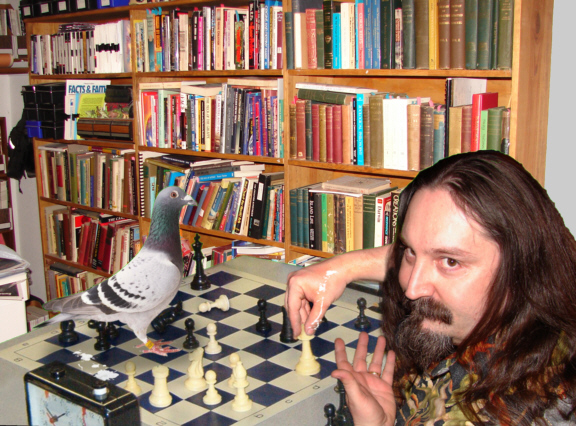
A new Facebook friend asked me if it was me in the meme picturing a bearded guy looking over his shoulder with a pigeon and chessboard in front of him. I told him that I am indeed that guy.

It can get messy

It can get messy

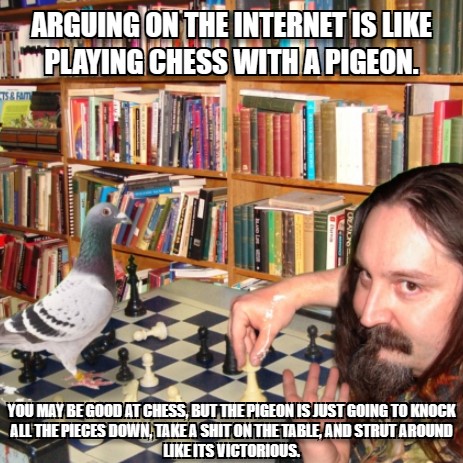
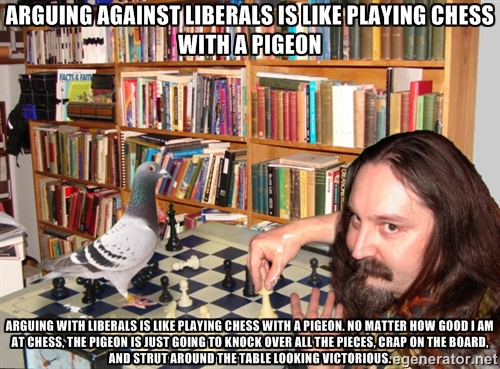
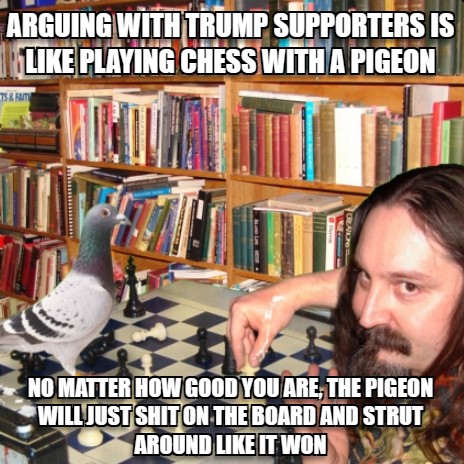
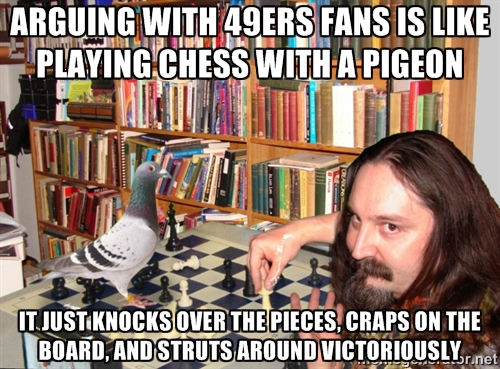
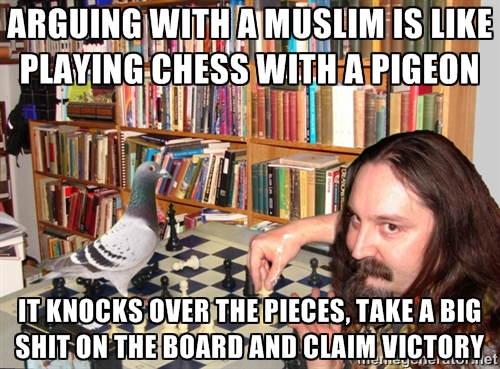
He then asked if it felt weird when I started seeing such things on the internet and in the process of composing my response to his question I did a Google image search based on my original picture and discovered that my likeness had been added to a meme generator. Now, I knew that my picture was “out there” and even blogged about the fact my mug had been stuck into a “demotivation” style meme but it is still a rather odd thing to find a picture of yourself repeated over and over dozens of times with all sorts of different words plastered over top of them.

Most are variations of the original quote, though they often substitute “creationists” with “liberals”, “Republicans”, or whatever political point of view the various meme authors find objectionable. Some replace “creationists” with Christians in general and at least one changes it to Muslims. Others exchange “creationists” for the names of specific people—no doubt the result of dimly remembered arguments taking place forgotten discussion boards—and some take shots at the fans of disfavored sports teams:

Some stray from the original form but seem to be improvising based on the general theme:

A few were taking shots at President Obama’s handling of the war in Iraq:

At least one seemed to take issue with the premise:

Still others are indecipherable by me:

So, yes, as I told my FB friend, it is kind of weird. Especially when I see it used in ways I am either ambivalent about or in ways I would probably rather it not be used. For example, some used homophobic slurs, or rude terms for the mentally disabled and a few even attacked political or philosophical views that I have sympathies with.

Still, I am “Zen” about it. The internet is the modern day Wild West, and once you put a picture of yourself out there you have lost control. It is just something you have to get used to if you want to play in the game.

Though, with all these bits of me (get it?) floating around the net, there aught to be a way for me to get my beak wet (get it?) on the deal…

Answering Creationist Questions

Someone named Stephen has asked some questions on my “creationist questions” page and I am moving my response up to the main page.

Hello Stephen!

Just to get a couple points of order out of the way I want to note that you asked three questions at once and only one (#3) touches on evolutionary biology, violating my question guidelines in multiple ways right off the bat. However, I said might grant some leeway and I will in this case.

Stephen: First, to clarify, I am a college student, almost through with my history degree (as a major), I have a minor in geology, and I have taken enough courses to almost have minors in philosophy and anthropology (just establishing that I am not an uneducated internet troll…. at least not completely). This does not make me an authority on the debate between evolution and creationism, but I have studied enough to be fairly well versed in the arguments that each side uses.

OK, good to know; as it would mean that there is no reason you should be making any glaring errors in those areas, yes?

Stephen: I was home-schooled by choice and was taught evolution and creation equally…

You were taught about a mature and productive scientific field and the relatively brief creation story from the Hebrew scriptures (backed up, no doubt, with the pseudoscience, misrepresentations and misinformation of “creation science”), “equally”?

You should understand that from my perspective that doesn’t make a lot of sense.

Stephen: I studied the sides and decided to pick the side that, I believe, has the least number of holes in its arguments. I decided to become a creationist, but I still see both sides and am willing to keep my mind open to all possibilities.

Well then, my question would be what are some of the supposed “holes” in evolutionary theory? Please do not tell me they are of the sort usually put forward by “creation scientists”, I have a library full of those bogus arguments.

Again, from my perspective creationism is collection of long refuted empirical claims (young Earth, Flood geology) backed by a premise (“God did it”) that is fundamentally untestable and therefore scientifically useless.  

Stephen: Question 1: How do you define science (yes, I am talking about the AIG argument between “testable/repeatable science” and “historical/perceived science”)? I do mean you specifically, as different words mean different things to different people, and “standard definitions” do not always fully encapsulate this idea.

In the context you seem to be asking (that of Answers in Genesis’ idiosyncratic redefinition of science), I would say that science is a process wherein people derive coherent explanations about the state of the natural world which are testable by further, intersubjective, observations of the natural world. This holds regardless of whether the particular phenomenon under examination is something that occurred in the past or is currently ongoing.

In science, one does not have to be able to repeat the occurrence of something in order to explain it. What is necessary is that the observations that are made to test the explanation be repeatable by anyone who makes the effort, i.e. not subjective revelations knowable only to an individual or an elect few.

As with forensic science used against criminals, one need not repeat the crime in order to make observations (of finger prints, DNA, etc.) to build a case as to who the most likely perpetrator is.

The same is true when one is trying to explain the current state of nature be it biological, geological or astronomical. We do not need to repeat, in full, the processes that lead to the current state of affairs in order to piece together a case against the most likely “perpetrator”.

Of course, in practice, there is more to it than that but I am not writing a book on the philosophy of science.

Professional creationists want to muddy the waters on this because their explanations either have failed to hold up against observations of the natural world, or are simply not testable by such observations. In other words, their ideas are either failed science or non-science and so they try to tear down good science in an attempt to mislead people into believing that their ideas have merit.    

Stephen: Question 2: Why do scientific laws exist: gravity, thermodynamics, etc. if no one created them (yes it does seem like a silly question, but believe it or not, I have found this question to be helpful)?

This is a question about cosmology and is essentially asking why the universe is the way it is. My answer is, I do not know. Cosmologist are working on such questions and they may or may not be able to answer some or all of them someday, however I see no reason to assume that if they do find answers to them that they will include the idea that the universe was “created” by a conscious being of some sort.

Any explanations that cosmologists do come up with will have to be testable by observations of the natural world in order to be scientific. “God did it” does not meet that criterion.

Stephen: Question 3: How do you believe that things such as a conscience, idea of self-awareness, and the ability to fully reason came to be? Yes, this is a philosophical question, because philosophy is the first “science” and was the root of all the other disciplines.

I don’t know if the ability to “fully reason” actually exists and I would quibble with you that these are necessarily philosophical questions. I would say that the evidence suggests that these things are evolved characteristics as we see them in a continuum in the animal world with humans merely being at one end of the spectrum.

Stephen: In addition, evolution influences much more than biology, geology, and physics (to name a few of the traditional sciences) in its scope, and all aspects of the theory need to be considered.

I disagree. Biology, geology and (to a lesser degree) physics influence evolutionary theory but not the other way round. Evolutionary theory had to be consistent with the facts of biology (obviously) but also geology and physics in order to be considered successful. Theories of geology (plate tectonics etc.) or physics (relativity etc.) do not need to factor in evolutionary theory but rather stand or fall based on observations from those fields.

If inconsistencies between evolutionary theory and say, plate tectonics, were discovered, then those would have to be worked out, but physical geologists who are trying to solve geological problems do not sit around worrying about how their findings might affect those of biologists. They find what they find and it is up to the biologists to figure out whether their own theories can be made to fit with the new data or must to be scrapped in favor of new ones.

What you are talking about reflects the conspiracy theory thinking of creationists, wherein all of modern science is some sort of evolutionist plot to discredit the Biblical account of creation, it isn’t.

The actual problem is that the facts of nature, biological, geological and physical, simply are not consistent with creationism and creationists have adopted this conspiracy idea as a way to avoid facing that fact.

Stephen: Especially since the idea of “origins” is one of the three fundamental questions of philosophy (IE: Where did I come from? Why am I here? Where am I going?).

“Where did I come from?” is an empirical question answered by science; proximally by reproductive biology and evolutionary theory more distally by astronomical and cosmological theories. You would have to be more specific to get answers that are more specific.

“Why am I here?”—assuming it is not merely a rephrasing of the previous question—is a question that assumes something not in evidence, that there is some externally imposed purpose to our existence. It could be that there is no “why” and therefore the question is incoherent.

“Where am I going?”, again this assumes that you are going anywhere. Barring evidence that anyone is going anywhere this question is also incoherent.

Stephen: By the way, I have heard your comparison of “playing chess with pigeons” before (in relation to evolutionists). Is that saying original (to you) or did you get it from elsewhere? If so, where?

The answer to that may be found in the tab at the top of my blog titled “Playing Chess with Pigeons?“. It is taken from something first written by Scott Weitzenhoffer in reference to creationists; so if you have seen it being used in any other way it was pilfered directly or indirectly from him.


New page for creationist questions!

I have just added a whole new page to the blog just for creationists to ask questions. Just click on the tab above to take a look. Please DO NOT post your questions in the comments thread of THIS post, rather enter them into the comments of the creationist questions page. Thank you.sm_question-mark

22 Answers to 22 messages from creationists

File this under: better late than never.

In the wake of the Bill Nye/Ken Ham creation/evolution debate BuzzFeed writer Matt Stopera had some of the people who attending the debate, and who were creationists, write down questions or comments to those of us who accept evolution.

 The following are the questions they wrote down and my quick and dirty responses.

 1) Bill Nye, are you influencing the minds of children in a positive way?

Obviously I cannot answer for Bill Nye but I would say yes he is, by helping to popularize science.

2) Are you scared of a Divine Creator?

No. If one exists and is worthy of admiration, let alone worship, it would not want its creations to fear it.

3) Is it completely illogical that the Earth was created mature? i.e. trees created with rings… Adam created as an adult.

Illogical based on everything we think we know about existence via science. However, if an all powerful being existed it is certainly possible it could have done this. Likewise under that scenario the entire universe, including all our memories of the past could have been created last Thursday and there would be no way to know. The evidence all points towards the Earth being 4.5 billion years old (and the rest of the universe more than double that) remains the same, so if it is not actually that old then that would seem to make the creator a cosmic liar.

4) Does not the second law of thermodynamics disprove evolution?

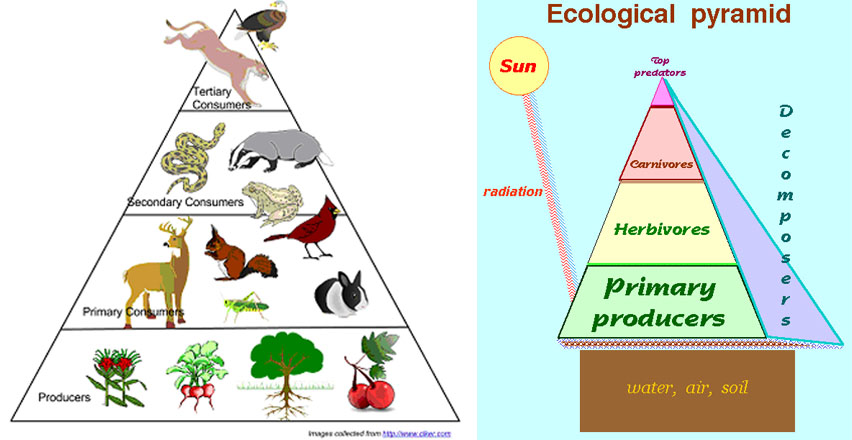
No, in fact life as we know it, which includes the ability to evolve, could not exist without the 2nd Law. You see the 2nd Law is essentially about energy flow from more coherent, usable states, to less coherent, unusable states. The obvious and most relevant example being the flow of energy from the Sun into space, where a tiny fraction of its energy is intercepted by the Earth. Life on Earth is only possible because of this energy flow (with the exception of life that lives off the energy flowing from the interior of the Earth itself at hydrothermal vents).

The effects of the 2nd Law can be seen reflected in the so called ecological pyramid, with each level able to extract less and less usable energy from the environment (and this is simplified of course). At the base we find plants are the most abundant and they absorb energy from the sun (“producers”). Next up there are herbivores that live off the plants (“primary consumers”). Then there are the omnivorous and/or small carnivorous animals (“secondary consumers”). Finally the apex predators (“tertiary consumers”), which are found in the fewest numbers of any ecosystem. Underlying all of these are the decomposers that make a living on the energy left over in dead plants, animals, and animal waste. energy pyramidSee: Ecology/Energy in ecosystems

I cannot even imagine what living things or ecosystems would look like without the 2nd Law in operation.

5) How do you explain a sunset if their [sic] is no God?

Seriously? This is a “the tides go in, the tides go out, with never a miscommunication” sort of question. The Earth rotates on its axis every 24 hrs. creating the illusion (from the POV of an Earthbound observer) of the Sun moving across the sky from sunrise to sunset.

6) If the Big Bang Theory is true and taught as science along with evolution, who do the laws of thermodynamics debunk said theories?

No, see answer #4.

7) What about Noetics?

What about it?

8) Where do you derive objective meaning in life?

I don’t know that there is such a thing or that it is even possible. We do have subjective and inter-subjective meaning however and that is good enough for me.

9) If God did not create everything, how did the first single-celled organism originate? By Chance?

It likely did not occur by chance, in the sense of purely random actions of matter, rather it would have happened in accordance with the laws of physics and chemistry.

10) I believe in the Big Bang Theory… God said it and BANG in happened!

Cute, however “god did it” is not a scientific explanation.

11) Why do evolutionists/secularists/humanists/non-God believing people reject the idea of their [sic] being a creator God but embrace the concept of intelligent design from aliens or other extra-terestrial [sic] sources?

First “evolutionist”, i.e. one who accepts evolution, does not equate to being an atheist (“non-God believer”). There are plenty of Christians and other types of theists who accept evolution.

As for evolutionists in general I would say they do not “embrace” any such thing. I can only guess this comes from the disingenuous questions put to Richard Dawkins in the intelligent design creationism propaganda film “Expelled”.  Here is a video where Dawkins discusses this and says exactly what his views are on the likelihood of intelligent design by ETs.

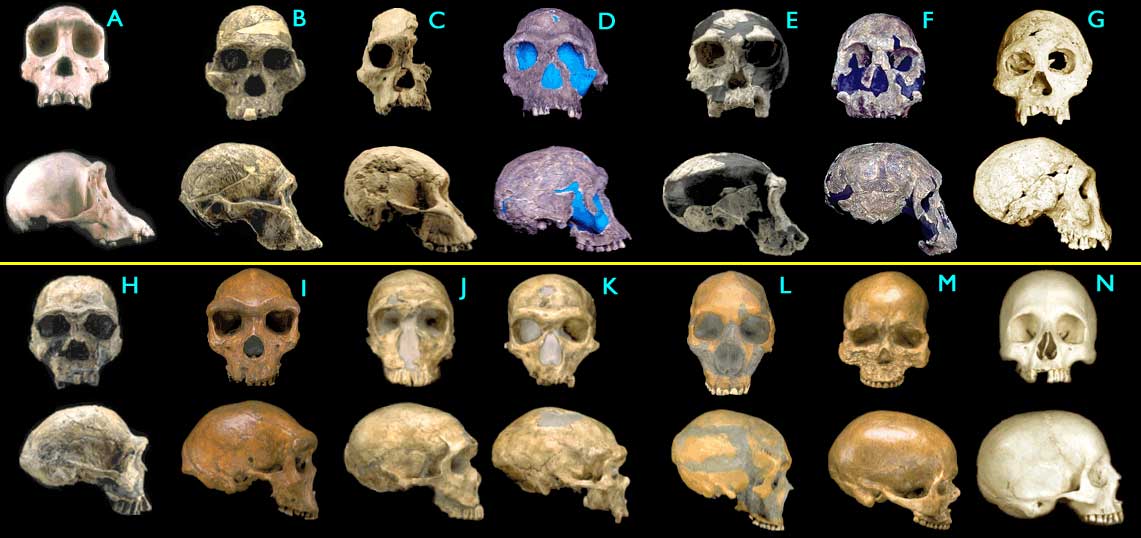
12) There is no in between… The only one found has been Lucy and there are only a few pieces of the hundreds neccssary [sic] for an “official proof”.

hominids2_bigYou were saying?

13) Does metamorphosis help support evolution?

I am not entirely sure what is meant by this question or even what sort of metamorphosis is being asked about. Insect metamorphosis? Amphibian metamorphosis? There is a creationist meme out there that insect metamorphosis (usually in reference to monarch butterflies) is somehow a problem for evolution, however as with most creationist memes, it is based on misinformation.

14) If Evolution is a Theory (like creationism or the Bible) why then is Evolution taught as fact.

It is, or should be, taught as an extremely well substantiated theory, i.e. a rigorously tested, fact-based explanation. Neither creationism nor the Biblical creation account it is based on, even begins to qualify as such.

15) Because science by definition is a “theory” – not testable, observable, nor repeatable why do you object to creationism or intelligent design being taught in school?

Science is not a theory; the development of testable—by observation and experiment—theories are part of doing science. In fact, one could say it is the very aim of science to develop such theories. Creationism—of which intelligent design is a subset—is made up of components which are either untestable or which have already been tested and falsified.

16) What mechanism has science discovered that evidences an increase of genetic information seen in any genetic mutation or evolutionary process?

Part of the answer was in the question; mutation and especially gene duplication.

17) What purpose do you think you are here for if you do not believe in salvation?

Our purpose is whatever purpose we choose for ourselves and frankly, I do not see the how the idea of some supposed purpose imposed from on high is somehow more attractive or fulfilling.

18) Why have we found only 1 “Lucy”, when we have found more than 1 of everything else?

Actually, there are fossil remains representing over 300 individuals of Australopithecus afarensis. “Lucy” is just the most famous specimen of this species. As for more than one of anything else, there is for example Homo erectus, the remains of which have been found in Africa all across Eurasia and into islands in the Pacific (Indonesia). The fun thing about H. erectus is that creationists used to (some may still) argue about whether they were “just apes” or “fully human”.

19) Can you believe in “the big bang” without “faith”?

Yes, as the theory is based on repeatable observations and is testable against further observations.

20) How can you look at the world and not believe someone Created/thought of it? It’s Amazing!!!

You are absolutely right, it is amazing, however there is no compelling evidence that “someone” created it.

21) Relating to the big bang theory… Where did the exploding star come from?

The Big Bang has nothing to do with a star exploding. Strictly speaking, it doesn’t have to do with anything “exploding” in the normal sense of the word. Rather it is about space expanding.

22) If we came from monkeys then why are there still monkeys?

For the same reason that both you and your cousin can exist when you both descend from your grandparents. Humans and the other living apes descend from a common ancestor with the living monkeys. That ancestor was probably more monkey-like than ape-like, but was not one of the current species of monkeys living today.

These questions, at least the ones regarding science—and which were coherent—were not particularly difficult and these people could easily have found the answers with a few Google searches. However, that would require actual curiosity and a willingness to learn. Sadly, these traits are often absent in creationists.

The rest of the questions (philosophical or theological) were simply irrelevant to the accuracy of evolutionary theory (or Big Bang theory) and a unwillingness to grasp this fact is yet another character flaw common amongst creationist.