Divinely Designed’s X avatar as of 2/20/26
The following is adapted from an August 2025 response I wrote to a creationist on X who goes by the handle “@DivinelyDesined“, henceforth “DD”. I put a fair amount of work into it and don’t think it got a sufficient hearing then/there, so I repost it here with some editing and additions for a hopefully wider audience. My apologies if some of this gets a bit technical, I had to read up a bit on this subject myself to formulate my response, so wherever technical terms pop up I have tried to link to relevant explanatory resources. Also, DD’s writing is a little scattered and repetitious. I tried to organize the primary issues into the same piles, but it is sometimes difficult, hopefully things aren’t too hard to follow.
DD, sadly, has over 12k followers on X and frequently posts “long” (for X) and very self-assured, dismissive attacks on evolutionary theory, largely made up of misinformation and strawman caricatures of what evolution. For example, DD once complained about an illustration showing an example of macroevolution, in this case a species of butterfly giving rise to a new species of butterfly, by suggesting that a better example of macroevolution would be “…a butterfly transforming into a dragonfly.” Anyone with an even basic understanding of evolutionary theory knows that it does not postulate that species from one existing clade will somehow morph into species of a completely different clade (see monophyly). This is not how evolution works; this is not what the basis of macroevolution (speciation) looks like. And in the case of butterflies and dragonflies, neither group is descended from the other, rather they share a common ancestor that while it was an insect was neither a butterfly nor a dragonfly.
In another DD posts with apparent approval a page out of an antievolution cartoon tract by the late Jack Chick titled “Bid Daddy” (pp.12-13) This alone is enough to discredit DD as a serious person, but never mind.
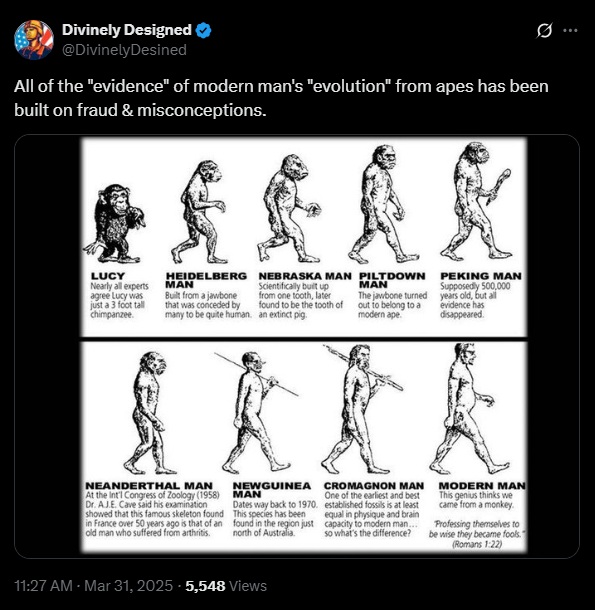
This particular engagement started with one of DD’s responses to an evolution defender on X who goes by the handle “Creationist Translationist” [@JustinCPorter], henceforth “CT”:
DD: The argument is not that there is a mechanism which stops genetic variation or change from accruing — the argument is that the change which accrues cannot ever build novel biological structures necessary for macroevolutionary innovation. [Link to source, 06/20/2025]
After which DD gave the following link to another thread where DD had stated the following:
DD: There is no evidence that random changes in DNA will ever add up over time to construct novel genes & cellular structures. [Link to source, 03/07/2025] …The evolutionist believes that mutations will add up over time and engineer novel genes, which leads to novel proteins, cells, organs, and body plans – despite the fact that we have ZERO evidence of this ever occurring, nor even being possible. [Link to source, 03/07/2025]
CT responded with a reiteration of one of his earlier responses:
CT: Without a mechanism to stop variation from accruing iver [sic, “every” -TB] generations, you have nothing to prevent speciation from continuing over millions — even billions — of generations. You are a fake skeptic. [C.T. on X 06/20/2025]
And I jumped in and added to the thread an admittedly lazy, throw away response, of the following:
Me: That and: [Google Scholar link to papers on de novo genes coding for proteins.]
DD responded to me with the following:
DD: Let’s see if you understand what you’re reading, and not just forming opinions based on misunderstanding hyped up headlines. Pick a paper from that list – any paper – and summarize why it provides evidence for Evolutionism. [From DD’s response to my throw away.]
To which I replied:
Me: LOL! This is not my first rodeo. I am not going to fall for the beach bum creationist routine where I do a bunch of work presenting evidence that the claims you make are nonsense, only to have you, based on willful ignorance and an existential dread of actually understanding the thing you’re sure isn’t so (evolution), dismiss whatever I show you as insufficient. For example, you have in the past said that macroevolution would be something like a “butterfly transforming into a dragonfly”, something which is impossible according to evolutionary theory. So, I could show you legit evidence of macroevolution, as the term is defined by scientists, and you would simply reject it out of hand based on it not matching your twisted creationist definition of the term. How about this instead? You’re claiming that the vast literature on the genetics of evolution is fundamentally flawed, and that the overwhelming majority of geneticists don’t know what they’re talking about, how about YOU pick a (recent, say from the last 10 years) paper and walk us through where they are factually incorrect or logically incoherent.
“Evolutionism.” 🙄 [Link to source, 06/21/25]
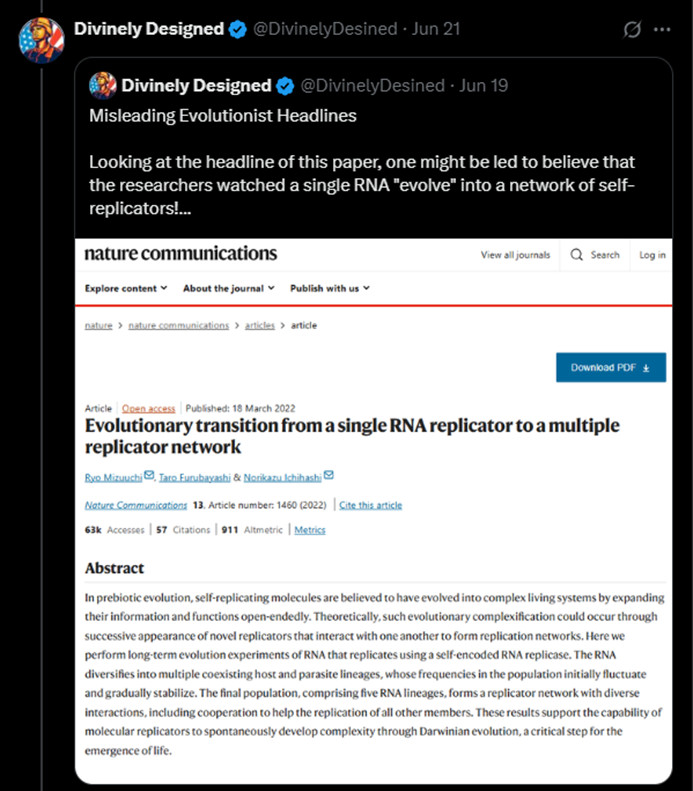
DD responded not by addressing any of the papers I had linked from Google Scholar, or even any similar paper dealing with the subjects DD laid out in his earlier comments about “novel genes & cellular structures” or “novel proteins, cells, organs, and body plans” but rather with a repost of something DD had written earlier attacking a paper on an RNA replication experiment, which is related to prebiotic evolution (abiogenesis/RNA world hypotheses) rather than biological evolution proper which was, as I understood it, what DD’s bluster regarding “novel genes” etc. was about.
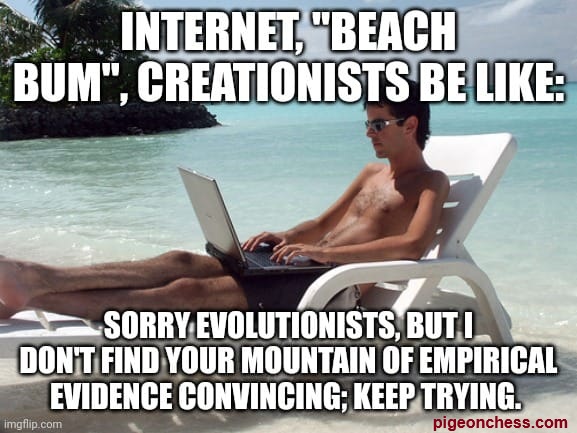







 Playing Chess with Pigeons