
Ken Ham posts dishonestly edited and out of context quotation

I know, “Dog Bites Man”, but I still feel whenever creationist are caught dishonestly misrepresenting the words of others it should be pointed out and documented.

In this case Ken Ham, founder CEO of the young Earth creationist (YEC) organization Answers in Genesis posted to his X account the following:

Is this high school biology textbook definition of science a scientific one?

“Restrict science to a search for natural causes for natural phenomena. Supernatural explanations of natural events are simply outside the bounds of science.”

In other words, “science” (which really means “knowledge”) cannot allow the supernatural. Thus, by this definition, God and his Word are eliminated.

But that’s not a scientific statement—it’s a religious one. Yes, religion is in every single classroom. There’s no avoiding it, and parents must be aware of this and work hard to combat it with truth.
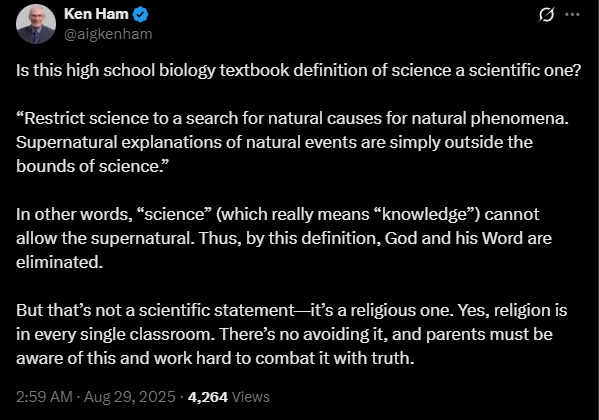
He gives no citation other than a vague reference to a “high school biology textbook”. I was immediately suspicious about the context of this quote, wondering if the original would explain why science was limited to natural explanations for natural phenomena, something that Ham and other creationists avoid like the plague (more on this below).

So I started searching the web for the quote as Ham presented it and initially couldn’t find anything, deepening my suspicions. So I broke the quote down into individual sentences and low and behold a link popped up to the quote coming from an online biology textbook Meridian Technical Charter High School in Meridian, Idaho. And shocker of all shocks my suspicion about the context turned out to be warranted.

So I hopped on to X and replied to Mr. Ham with the following (red text not in original reply):

Oh, look Ken using dishonestly edited and out of context quotations… I am shocked, shocked I tell you.

Here is the full quote, Ken’s quoted parts bracketed ***thusly*** (red text not in original response):

>>The Limitations of Science
Science is powerful, but limited in the kinds of questions it can help answer. Science requires repeatable observations and testable hypotheses. These standards ***restrict science to a search for natural causes for natural phenomena.*** For example, science can neither prove nor disprove that unobservable or supernatural forces cause storms, rainbows, illnesses, or cures of disease. ***Supernatural explanations of natural events are simply outside the bounds of science.*** There is no way to show that such hypotheses are false.<<

Just leave out the parts that tell us why supernatural claims like “God did it” are not scientific, *because they are not testable*. And Ken has the audacity to talk about “truth”.

Source of the quote: bodell.mtchs.org/OnlineBio/BIOC    
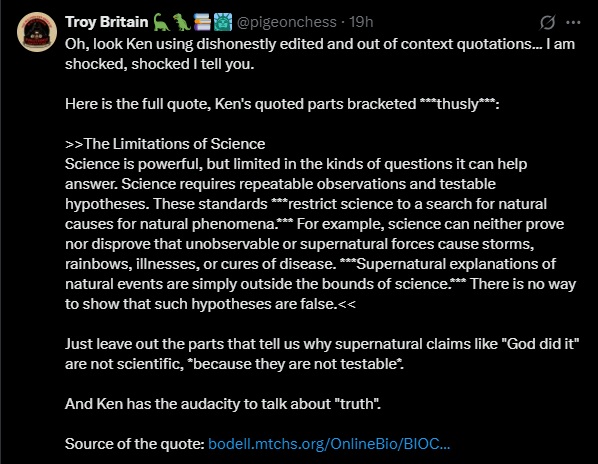
So he provides no citation, no context, and not even any ellipses (…) indicating that the sentences were not contiguous in the original source. As I indicated in my response to him, he has a lot of gall to speak of “truth” when pulling these sorts of shenanigans.  

Here is some more relevant context from the textbook, specifically regarding theories like evolution(Ham’s cherry picked quote again in bold red):

The Limitations of Science
Science is powerful, but limited in the kinds of questions it can help answer. Science requires repeatable observations and testable hypotheses. These standards restrict science to a search for natural causes for natural phenomena. For example, science can neither prove nor disprove that unobservable or supernatural forces cause storms, rainbows, illnesses, or cures of disease. Supernatural explanations of natural events are simply outside the bounds of science. There is no way to show that such hypotheses are false.

Although science is “a way of knowing,” keep in mind that it is not the only way. Not everything you “know” is based on science. For example, you know what kind of music you like and what your favorite color is. These personal tastes are not the results of a careful testing of hypotheses. And you know right from wrong. This concept is an ethical value, not a scientific fact. Each human mind develops a unique database of knowledge of many different kinds. Science-based knowledge is the type built from confirmed observations and testable hypotheses.

Theories in Science
Many people think of science mainly as a collection of facts. But collecting facts is not what really defines science. A telephone book is an impressive catalog of factual information, yet it has little to do with science. It is true that factual data provide the raw material for science. But scientists are mostly interested in finding patterns in the data and explaining these patterns. What really advances science is some new theory that ties together a variety of facts that previously seemed unrelated. People like Isaac Newton, Charles Darwin, and Albert Einstein stand out in the history of science because their theories connected so many observations and experimental results.

How is a theory different from a hypothesis? In science, a theory is a well-tested explanation that makes sense of a great variety of scientific observations. It gives rise to many hypotheses that can be tested. This definition contrasts with the everyday use of theory to mean a speculation, as in “It’s only a theory.” Compared to a hypothesis, a theory is much broader in scope. This is a hypothesis: “Mimicking poisonous snakes is an adaptation that protects nonpoisonous snakes from predators.” But this is a theory: “Adaptations such as mimicry evolve by natural selection.” The theory of natural selection explains the evolution of the many cases of mimicry, as well as a variety of other adaptations of organisms to their environments.

Theories, such as the theory of natural selection, only become widely accepted in science when they are supported by an extensive body of evidence. That evidence also provides a framework for further research and predictions. If new evidence that contradicts a theory is uncovered, scientists first verify the evidence many times. They then modify or discard the theory accordingly.

Of course Ken left out all of this which explains why scientific explanations exclude supernatural explanations (their lack of testability) and how scientific theories, like evolution are “well-tested”. This isn’t dogmatic atheistic limitation on science, as Ken would have his readers believe, rather testability is a practical limitation of science because it is the only way to demark fanciful speculations and religious myths from potentially valid explanations.

But Ken and other creationists can’t have this because their particular theology demands a particular interpretation of their scripture that is incomputable with not only evolutionary biology but with the findings of much of the rest of science (which they falsely label as “evolutionist science” or similar). For YEC, whose beliefs require the Earth and universe to be young (6000 to 10,000 years old), whenever they posit a testable hypothesis, such as the fossil record being explainable as the actions of a single event, in this case the Noachian Flood described in the book of Genesis, these hypotheses have been falsified. In the case of Flood geology in innumerable ways, something known to late 18th and early 19th century creationist geologists long before evolutionary theory was accepted.

This, by the way, is what led to the development of so called “Intelligent Design theory” (ID). ID creationists wanted to rid themselves of having to defend already falsified hypotheses, and of making direct references to Genesis, so as to avoid both scientific and First Amendment objections to their ideas being taught in public school science classrooms.  

Once Flood geology and a few other potentially testable creationist hypotheses have been ruled out by science (or deliberately left out by ID proponents) all they have is “God did it” (or the “Intelligent Designer did it”) which is not testable against the empirical evidence. An omnipotent creator could create anything, in any way, making any possible observation of the facts potentially compatible with God having done it.

So, anyway, more evidence (as if it were needed) that Ken Ham is not an honest interlocutor.  

Answering Creationist Questions

Someone named Stephen has asked some questions on my “creationist questions” page and I am moving my response up to the main page.

Hello Stephen!

Just to get a couple points of order out of the way I want to note that you asked three questions at once and only one (#3) touches on evolutionary biology, violating my question guidelines in multiple ways right off the bat. However, I said might grant some leeway and I will in this case.

Stephen: First, to clarify, I am a college student, almost through with my history degree (as a major), I have a minor in geology, and I have taken enough courses to almost have minors in philosophy and anthropology (just establishing that I am not an uneducated internet troll…. at least not completely). This does not make me an authority on the debate between evolution and creationism, but I have studied enough to be fairly well versed in the arguments that each side uses.

OK, good to know; as it would mean that there is no reason you should be making any glaring errors in those areas, yes?

Stephen: I was home-schooled by choice and was taught evolution and creation equally…

You were taught about a mature and productive scientific field and the relatively brief creation story from the Hebrew scriptures (backed up, no doubt, with the pseudoscience, misrepresentations and misinformation of “creation science”), “equally”?

You should understand that from my perspective that doesn’t make a lot of sense.

Stephen: I studied the sides and decided to pick the side that, I believe, has the least number of holes in its arguments. I decided to become a creationist, but I still see both sides and am willing to keep my mind open to all possibilities.

Well then, my question would be what are some of the supposed “holes” in evolutionary theory? Please do not tell me they are of the sort usually put forward by “creation scientists”, I have a library full of those bogus arguments.

Again, from my perspective creationism is collection of long refuted empirical claims (young Earth, Flood geology) backed by a premise (“God did it”) that is fundamentally untestable and therefore scientifically useless.  

Stephen: Question 1: How do you define science (yes, I am talking about the AIG argument between “testable/repeatable science” and “historical/perceived science”)? I do mean you specifically, as different words mean different things to different people, and “standard definitions” do not always fully encapsulate this idea.

In the context you seem to be asking (that of Answers in Genesis’ idiosyncratic redefinition of science), I would say that science is a process wherein people derive coherent explanations about the state of the natural world which are testable by further, intersubjective, observations of the natural world. This holds regardless of whether the particular phenomenon under examination is something that occurred in the past or is currently ongoing.

In science, one does not have to be able to repeat the occurrence of something in order to explain it. What is necessary is that the observations that are made to test the explanation be repeatable by anyone who makes the effort, i.e. not subjective revelations knowable only to an individual or an elect few.

As with forensic science used against criminals, one need not repeat the crime in order to make observations (of finger prints, DNA, etc.) to build a case as to who the most likely perpetrator is.

The same is true when one is trying to explain the current state of nature be it biological, geological or astronomical. We do not need to repeat, in full, the processes that lead to the current state of affairs in order to piece together a case against the most likely “perpetrator”.

Of course, in practice, there is more to it than that but I am not writing a book on the philosophy of science.

Professional creationists want to muddy the waters on this because their explanations either have failed to hold up against observations of the natural world, or are simply not testable by such observations. In other words, their ideas are either failed science or non-science and so they try to tear down good science in an attempt to mislead people into believing that their ideas have merit.    

Stephen: Question 2: Why do scientific laws exist: gravity, thermodynamics, etc. if no one created them (yes it does seem like a silly question, but believe it or not, I have found this question to be helpful)?

This is a question about cosmology and is essentially asking why the universe is the way it is. My answer is, I do not know. Cosmologist are working on such questions and they may or may not be able to answer some or all of them someday, however I see no reason to assume that if they do find answers to them that they will include the idea that the universe was “created” by a conscious being of some sort.

Any explanations that cosmologists do come up with will have to be testable by observations of the natural world in order to be scientific. “God did it” does not meet that criterion.

Stephen: Question 3: How do you believe that things such as a conscience, idea of self-awareness, and the ability to fully reason came to be? Yes, this is a philosophical question, because philosophy is the first “science” and was the root of all the other disciplines.

I don’t know if the ability to “fully reason” actually exists and I would quibble with you that these are necessarily philosophical questions. I would say that the evidence suggests that these things are evolved characteristics as we see them in a continuum in the animal world with humans merely being at one end of the spectrum.

Stephen: In addition, evolution influences much more than biology, geology, and physics (to name a few of the traditional sciences) in its scope, and all aspects of the theory need to be considered.

I disagree. Biology, geology and (to a lesser degree) physics influence evolutionary theory but not the other way round. Evolutionary theory had to be consistent with the facts of biology (obviously) but also geology and physics in order to be considered successful. Theories of geology (plate tectonics etc.) or physics (relativity etc.) do not need to factor in evolutionary theory but rather stand or fall based on observations from those fields.

If inconsistencies between evolutionary theory and say, plate tectonics, were discovered, then those would have to be worked out, but physical geologists who are trying to solve geological problems do not sit around worrying about how their findings might affect those of biologists. They find what they find and it is up to the biologists to figure out whether their own theories can be made to fit with the new data or must to be scrapped in favor of new ones.

What you are talking about reflects the conspiracy theory thinking of creationists, wherein all of modern science is some sort of evolutionist plot to discredit the Biblical account of creation, it isn’t.

The actual problem is that the facts of nature, biological, geological and physical, simply are not consistent with creationism and creationists have adopted this conspiracy idea as a way to avoid facing that fact.

Stephen: Especially since the idea of “origins” is one of the three fundamental questions of philosophy (IE: Where did I come from? Why am I here? Where am I going?).

“Where did I come from?” is an empirical question answered by science; proximally by reproductive biology and evolutionary theory more distally by astronomical and cosmological theories. You would have to be more specific to get answers that are more specific.

“Why am I here?”—assuming it is not merely a rephrasing of the previous question—is a question that assumes something not in evidence, that there is some externally imposed purpose to our existence. It could be that there is no “why” and therefore the question is incoherent.

“Where am I going?”, again this assumes that you are going anywhere. Barring evidence that anyone is going anywhere this question is also incoherent.

Stephen: By the way, I have heard your comparison of “playing chess with pigeons” before (in relation to evolutionists). Is that saying original (to you) or did you get it from elsewhere? If so, where?

The answer to that may be found in the tab at the top of my blog titled “Playing Chess with Pigeons?“. It is taken from something first written by Scott Weitzenhoffer in reference to creationists; so if you have seen it being used in any other way it was pilfered directly or indirectly from him.


How could evolutionary theory be falsified?

cambrianrabbit

A rabbit fossil in Cambrian rock would be difficult to understand under current evolutionary theory.

Creationists often charge that evolutionary theory is unfalsifiable; that there is no way to potentially disprove it, if it were in fact incorrect. This is in essence an “I know you are but what am I” response to their critics who have rightfully pointed out that “God did it” as an explanation is not testable against the evidence from the natural world and therefore not a valid scientific explanation for anything.

This is because hypotheses, in order to qualify as scientific, must be testable against observable evidence in the natural world. In other words, in addition to there being potential observations that might support a given hypothesis, there should likewise be some potential observations that would tend to disprove a hypothesis.

Since God can do anything in any way, for any reason, here are no potential observations of the natural world that could disprove God’s involvement, which means the “God did it” hypothesis is unscientific in character.

In any event, is it true, as creationists charge, that there are no potential observations that would tend to disprove evolutionary theory?

The short answer is no, it is not true. However, for something more in depth you should head over to Why Evolution Is True where biologist Jerry Coyne provides several scenarios that would be highly problematic for current evolutionary theory.

In my general talk on the evidence for evolution, I give a list of seven observations that, if repeated and confirmed, would disprove parts of the theory of evolution described above. This shows that it is a scientific theory in the Popperian sense of being falsifiable.  Here are some of those conceivable observations:

  • Fossils in the wrong place (e.g., mammals in the Devonian). If the fossil record were all out of order like this (a single anomalous fossil might not overturn everything, of course, since it could be in the wrong place for other reasons), we’d have to seriously question the occurrence of evolution.

I recommend you hop over and check out the rest.

The last thing I want to say about this particular creationist claim, is that in addition to it being false, it is also stands in rather blatant contradiction to what creationists do on a regular basis, which is to argue that this or that bit of evidence somehow counts against evolutionary theory.

I mean what sense can we make of Duane Gish’s book Evolution, the Fossils Say No! (1978) if he was not arguing that the fossil evidence was disconfirming of the evolution hypothesis?

The mind boggles.

[And now John Wilkins, or some other philosopher of science, will yell at me about Popperian Falsificationism being passé with regards to the demarcation problem. Just to head that off somewhat I am not advocating naive falsificationism.]

“Reason and creationism”

My friend and colleague (frienlleague?) Dr. Eugenie Scott gave, yet another, excellent talk titled “Reason and creationism” at the Global Atheist Convention, Melbourne, Australia (4/15/2012). Have a watch:

NCSE Home Page

A Tale of Two Dinosaurs

The Institute for Creation Research has graced us once again with a brilliant display of their scientific prowess. This time the focus of their efforts revolves around the recently published description of a newly unearthed dinosaur species Eodromaeus murphi.

Eodromaeus is a small (slightly over a meter in length) South American dinosaur from the mid-Triassic (230 MYA). This date makes it one of the earliest dinosaurs and its describers, Ricardo Martinez et al., argue that it should be classified as a basal theropod ―the carnivorous branch of the “lizard-hipped” or saurischian dinosaurs (Martinez et al., 2011).

What has ICR’s, or more specifically ICR “science writer” Brian Thomas‘ knickers in a twist is that in the same paper in which they describe Eodromaeus the authors also argue for the reclassification of another dinosaur, Eoraptor (described back in the early 1990’s), which is from the same location and roughly the same time period as Eodromaeus.

Read on »

A good primer on skepticism and “open mindedness”

Learn it, know it, live it!

[Via Pharyngula]