
As I continue to try and adapt to having a significantly longer commute to work, settle into our rental house, and generally try to get my crap together, here are some pictures of some critters I’ve encountered over the last few months.
First a mollusk:
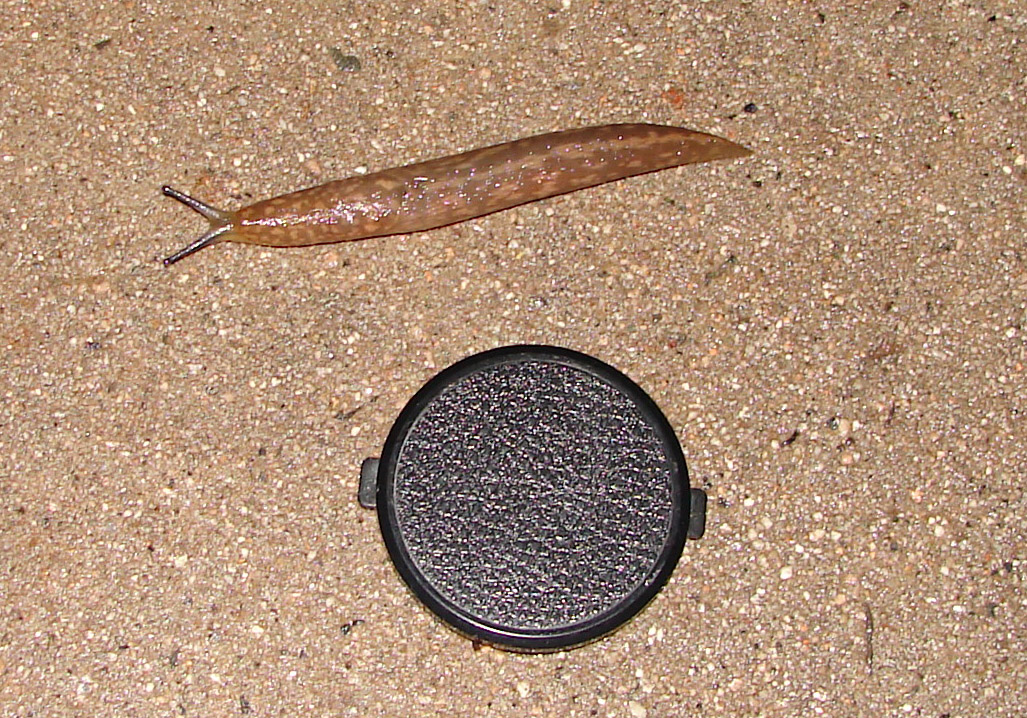
I discovered this rather large (approx. 10cm) slug making its way across my front walk. Not sure about my ID but I’d say it was possibly a Limacus flavus, which would make this an introduced ALIEN SLUG! [Scream!]
Secondly a couple different arthropods, one terrestrial and the other aquatic:
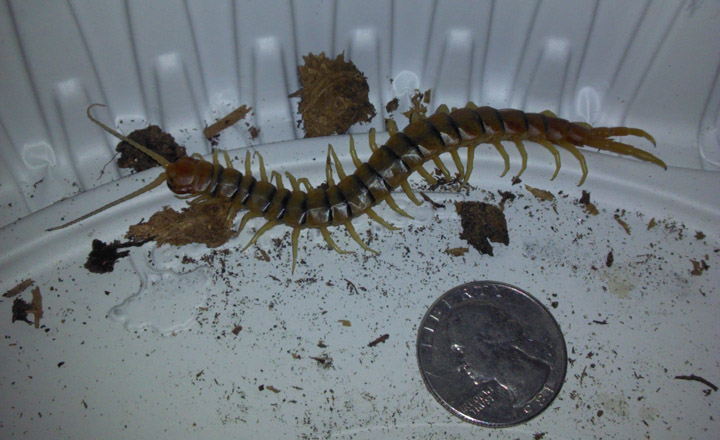
This dangerous little bugger was hitchhiking in a load of horse manure that my mother was unloading from the back of her pickup truck. A centipede, probably a Scolopendra polymorpha. After I told my mother that I wasn’t interested in adopting it she ended up feeding it to her chickens, which was probably a little spicier than their usual fare.
OK, there is a bit of a set up to our next crawly, or rather swimy critter. I was on my way to work one morning and while driving by a vacant lot around the corner from my house, I noticed three adults standing around a large puddle in middle of the lot that was left over from some recent rain. My brain noted that this was an unusual thing to see, so I slowed down a bit and saw that a couple of them were holding small fishnets, of the sort that an aquarist might keep handy. Quickly running through the possibilities of what three adults with fishnets standing around a small ephemeral body of water in a generally arid environment might be up to and my brain instantly hit upon what seemed to be the only logical conclusion…BIOLOGISTS!
Unfortunately I was already a little late for work and couldn’t stop and talk to them, however I immediately vowed to myself that I would visit the puddle ASAP to see what might have drawn a trio of probable biologists to this vacant lot. So on my way home from work I stopped at the lot and checked out the puddle.
At first I didn’t see anything but once my eyes adjusted to what I was looking at I noted some small (maybe 2cm) things swimming fairly vigorously around the puddle. At first I thought that they might be fish, perhaps Gambusia which are often stocked in our local waterways to control mosquitoes. This wasn’t totally crazy as there is a catchment basin immediately adjacent to the lot and I thought that, while it was unlikely, it might be possible for some Gambusia to have somehow made it into this puddle. However given that this was a very ephemeral body of water and that Gambusia would be considered “junk fish” by an ichthyologist I quickly dismissed this idea.
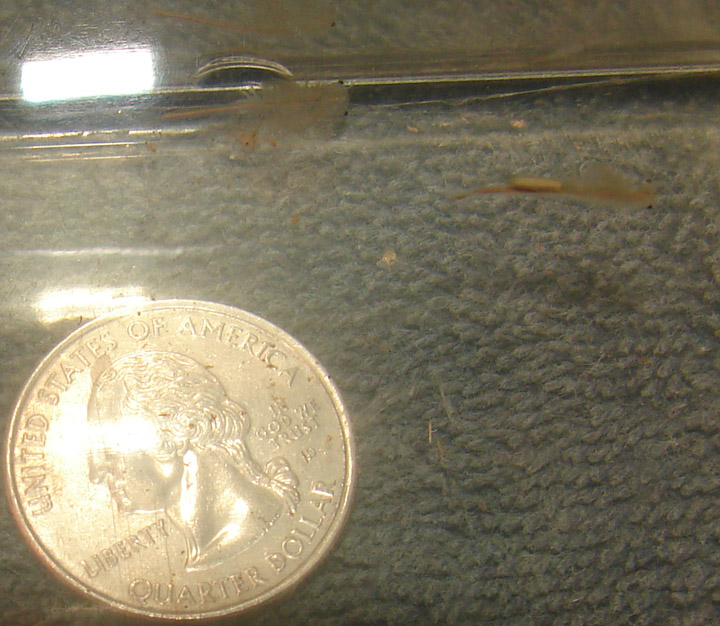
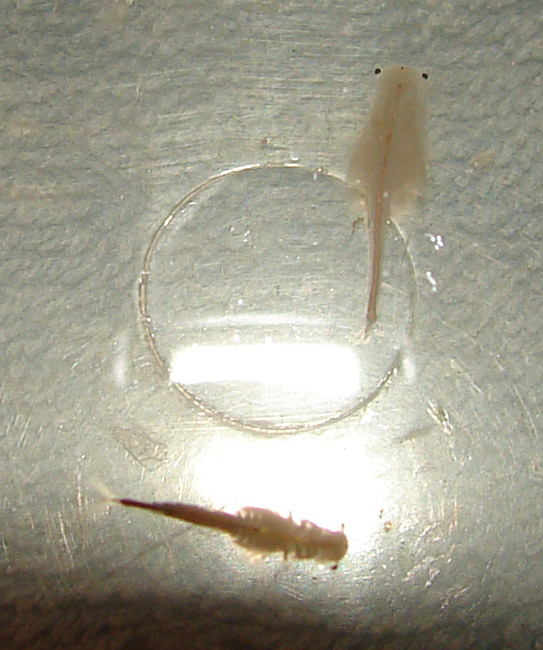
Looking a bit closer at the tiny swimming creatures I realized what their true nature was and why thy might be of interest to biologists became much less of a mystery. They were fairy shrimp, possibly of the Family Streptocephalidae, some members of which are very endangered. In this case possibly Streptocephalus woottoni A.K.A. the “Riverside fairy shrimp“, though this puddle was a little shallow (under 30mm) for the normal bodies of water that S. woottoni are supposed to inhabit.
Anyway, after seeing that they were indeed fairy shrimp I rushed home and got one of my critter keepers (a small plastic aquarium) and fashioned a small, pitiful, net out of a coat-hanger and one of my wife’s old nylon stockings. Pitiful as my jury-rigged net was, it allowed me to catch a few of the shrimp.
Fear not for the shrimp though, after I photographed them (which isn’t an easy thing!) I returned them to their puddle which remained habitable for three or four days longer.
Last but not least a couple different chordates, in this case both mammals:
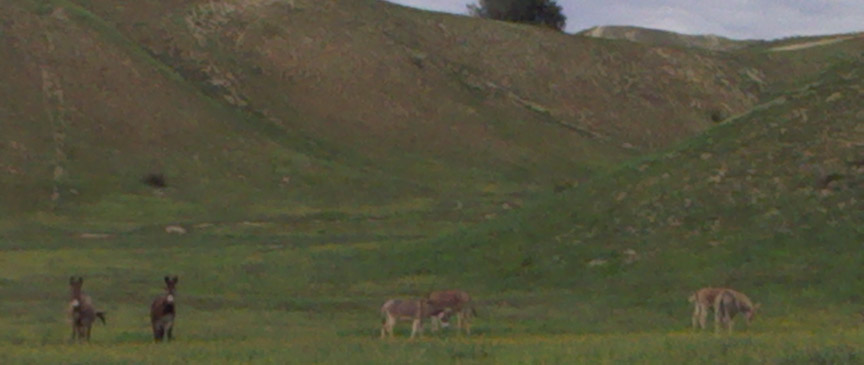
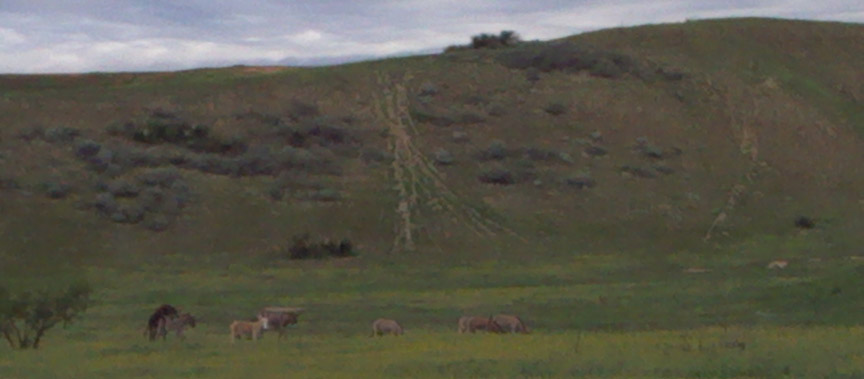
While driving through a local rural area (Reche Canyon) my wife and I spotted a herd of feral burros (Equus africanus asinus) that we had heard (get it?) lived in the area. I wasn’t able to get too close to them and only had my cell phone camera so these are not the best pictures. However if you look carefully at the second picture below you’ll get a glimpse of some “hot donkey action” going down (brown chicken, brown cow!).
Apparently there is something of a mystery involving these burros lately. It seems that several of the newborns have gone missing and it becoming a concern for the locals who watch over them.
Finally a rough pair of middle aged male apes (H. sapiens). Yours truly with Dr. Sean B. Carroll Professor of Molecular Biology, Genetics, and Medical Genetics at the University of Wisconsin–Madison at U.C. Riverside on 2-11-2013. Dr. Carroll had just given a very entertaining talk: Remarkable Creatures: Epic Adventures in the Search for the Origins of Species about the adventures and scientific contributions of Alfred Russel Wallace, Charles Darwin and Henry Walter Bates in honor of Darwin Day 2013 (Photo and my shirt by Lani Britain, a.k.a. Mom).

OK, so this wasn’t a scathing dissection of creationist silliness, but it was something…



 Playing Chess with Pigeons