More from Inside Nature’s Giants

Two more episodes from the excellent television series Inside Natures Giants are now available for viewing on YouTube. As I wrote in a previous post, this is a fascinating zoology program wherein the bodies of various large animals are dissected to demonstrate the details of their anatomy. This is combined with discussions of the living animals and their natural history with occasional incites from Richard Dawkins about evolutionary biology.

First of the newly available episodes is a two for one in which both a lion and tiger are examined, contrasted and compared. Here is part one of four:

A play list for the rest of the parts can be found here.

In my previous posting on this series I wished for them to focus an episode on something like a giant squid so as to show something on invertebrate anatomy and my wish has come true. Here is part one of five:

I couldn’t find a play list for this episode so here are individual links to the different segments: part 2, part 3, part 4, and part 5.

As before I really cannot speak more highly of this program. It is fascinating television for anyone with even the slightest curiosity about the natural world and a absolute must see for anyone interested in biology, zoology and evolution.

Gush, gush, gush!

[Thanks to P.Z. (squee) Myers over at Pharyngula for the heads up on the squid episode and to the WhyEvolutionisTrue YouTube channel for hosting the videos!]

Inside Natures Giants

I recently stumbled upon (on YouTube) a BAFTA award winning British TV series titled Inside Natures Giants and I’ve fallen in love. What we have here is a television show in which various large animals, all vertebrates so far, are dissected on camera (and often in front of a live audience of students)  by a team of biologists in order to show the details of their anatomy while presenting elements of their physiology, natural history and evolution (including commentary by evolutionary biologist Richard Dawkins).

So far the show has dissected an Asian elephant, a fin whale, a Nile crocodile, a Rothschild giraffe, a great white shark, a Burmese python, and most recently (unfortunately not yet available on YouTube) a two for one, lion and tiger combination.

I’m hoping they work in a ostrich or emu in there sometime soon and maybe a giant squid or octopus to show some invertebrate anatomy as well.

These programs deal with the dissection of actual animals in graphic detail so if you’re squeamish at all you might find them difficult to watch, however this show is an absolute must see for anyone interested in zoology and evolution.

Of particular interest was the dissection of the giraffe. Among the various interesting adaptations towards tree top browsing is a classic example of one of the cloven hoofprints of evolutionary history, the recurrent laryngeal nerve; the dissection of which has apparently not been done (according to one of the scientists in the show) in a giraffe since the 1830’s.

Here is the first episode of the first series on the Asian elephant:

A play list of all the videos available on YouTube can be found here, and I really cannot recommend them more highly.

Go watch them… NOW!

but there is a whole series of videos showing several different large animals being dissected while their anatomy, physiology, and how these evolved are discussed. A must see for those interested in zoology and evolution.

Smithsonian Magazine Editor Responds

Someone named Laura, who identifies herself as being an editor at the Smithsonian Magazine, left a comment on my post about their mix-up of hominid pictures in a paleoanthropology time line published in the March edition of the magazine and I figured I’d move it up to post level where more people would likely see it:

Troy, thanks for your post about Ann Gibbons’ story on Hominid Evolution in Smithsonian. I’m an editor there who worked on the story. We decided whenever possible to use images that would be easy for readers to understand. The timeline, especially, had to show many small images of specimens that some of our readers are reluctant to consider their ancestors. For Java Man, we did go with the more complete skull from the same place and species. We’re trying to figure out what happened with the Neanderthal image–the source we used labeled it as Neanderthal, but your comparison with Turkana Boy makes a good case. We’ll let you know if we figure out where the photo was taken and which specimen it shows.

First let me say thank you Laura for responding on this.

Regarding the Java Man thing, as I admitted in my post, I was perhaps being a bit nit-picky, and I don’t consider the switch from one Indonesian Homo erectus skull to another to be too much of a problem. However swapping out a H. ergaster (from Africa) for a H. neanderthalensis (mostly European) is obviously a different matter.  And while I am not a paleoanthropologist  and while I don’t even play one on the interwebs, I’ll bet you a years subscription to your magazine that you’ll find that the picture that was used to show a Neanderthal is instead a photo of the Turkana Boy.

Funny how I don’t get this sort of response from the antievolutionists who I catch making much larger mistakes than this (and I know some of them read this blog). Ah well…

Hominid Confusion

Just to show that I am an equal opportunity critic (proponents of mainstream science as well as pseudoscientists) I am going to give a wag of the finger to the Smithsonian Magazine.

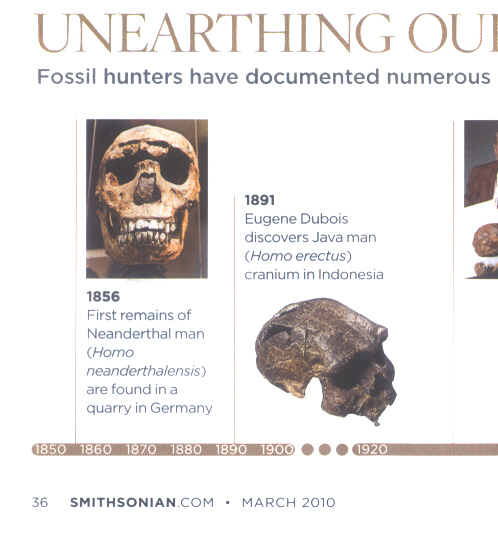
The March 2010 issue has a feature article on human evolution that celebrates the opening of the Smithsonian Institutes new Hall of Human Origins titled “Our Earliest Ancestors” (Here is an online version) by Ann Gibbons. The problem, however, is not with the article per se but rather with some of the illustrations given in a timeline titled “Unearthing Our Roots” (Gibbons 2010, pp.36-37) which is found within the article.

The timeline gives the readers a brief outline of the history of paleoanthropology from the Neanderthal (Homo neanderthalensis) fossils discovered in German in 1856, to the more recent finds like those of Sahelanthropus tchadensis found at Chad in 2001. The first refers, as I said, to the 1856 Neanderthal find and includes what is supposed to be a picture of a Neanderthal. The second is the 1891 discovery of “Java Man” (Homo erectus) with a picture of a fairly compete skull of a H. erectus.

Read on»

We need creationists lecturing us on evolution like we need another fenestra in the head

The Institute for Creation Research has presented the world with another taxonomic turd from the cat box of creationist wisdom. This time it comes from ICR’s “Senior Science Lecturer” Frank Sherwin. However before I get to the main event, I want to take a closer look at the litter in which Mr. Sherwin’s little jewel is nestled.

In the February (2010) issue of ICR’s monthly Acts & Facts Mr. Sherwin (whose background is in parasitology) graced us with an article titled “Darwinism’s Rubber Ruler” in which he argues that descent with modification is untestable and that “any and all scientific evidence” can be “stretched to fit” the theory.

The first thing that comes to my mind when reading this is to ask: if this is so, then how is it that I could have in my personal collection literally hundreds of books and pamphlets, many of them originating from Mr. Sherwin’s organization, that purport to contain absolutely scads of evidence that contradict evolutionary theory?

How about Dr. Duane Gish’s (the emeritus vice president of ICR) books Evolution the Fossils Say NO! (1978) and the update Evolution: the fossils STILL say NO! (1995)? How can the fossils say “no” to evolution if any scientific evidence (in this case fossils) can be “stretched to fit” the theory?

Read on»

Four and twenty sauropods baked in a pie…

We find still more creationist ignorance about basic zoological facts, this time from Dr. David Menton of Answers in Genesis.

AiG recently republished on their website a Menton piece from last year attacking the evolutionary relationship between dinosaurs and birds.

Often my first instinct when I run across these things is to launch onto a point by point refutation but I am going to restrain myself this time and simply highlight one rather obvious error in Dr. Menton’s article that in my opinion should cast doubt on anything else he has to say on the subject (especially since he claims to be an anatomist).

Read on»

Intermediate fossils and the pre-Darwin (creationist) geologists

RBH left a comment to a previous posting that inspired me to put some material together to address his (or anyone’s) reservations on the subject of intermediate fossil forms and the pre-Darwin (creationist) geologists.

Another really helpful post, Troy. Thanks!

Thanks RB!


Addendum

I realized during my discussions with RBH in the comments to this post that my main point behind writing about this subject might not be transparent to the average reader who doesn’t eat, sleep, and breath the creation/evolution debate. So I add this preface to give the reader a context for why I am going on at length about early 19th century geologists.

My point in all this is less about understanding the often vague and sometimes even contradictory views of the pre-Darwin scientists (as worthy as that subject of study is) and more about countering the arguments from modern antievolutionists that intermediate fossils do not exist and that those paleontologists who claim that they do, do so only because they are reading their “evolutionary beliefs” into the evidence.

If the pre-Darwin creationist geologists saw intermediates this tends, strongly I think, to falsify that argument. The same applies to the overall pattern of the fossil record and the geologic column that illustrates it (which is also frequently claimed by antievolutionists to be a evolutionary invention).


RBH: I do have one reservation. You wrote

The changing pattern of the fossil record and the existence of intermediate fossil forms was recognized by scientists (who were creationists) long before Darwin brought evolutionary theory into the scientific mainstream.

The changing pattern in the fossil record was surely observed; Cuvier in France and Owen in England — both eminent comparative anatomists in the first half of the 19th century — were very clear on that.

Indeed, Cuvier, Owen and just about every other geologist/paleontologist in the world at the time.

RBH: But Owen opposed Darwin’s hypothesis of species transmutation and common ancestry specifically because he did not see transitional/intermediate forms in the fossil record to which he had access.

I can’t speak much about Cuvier, but Owen is a little difficult to pigeon-hole into modern categories (perhaps a theistic evolutionist of sorts). He did oppose Darwin, particularly Darwin’s mechanism of natural selection but seemed to have been open to the idea of some sort of secondary causation for living things (as opposed to their direct creation by God).

Read on»

‘O Oysters, come and walk with us!

Dr. John Morris, president of the Institute for Creation Research, just can’t seem to stop himself from saying ignorant things. And saying them about things for which there is no reason to be ignorant about even for a young earth creationist.

In the October issue of Acts & Facts, in yet another of a seemingly endless  parade of snarks about the Cambrian radiation (Morris 2008a) he throws out this little nugget about the famous mid-Cambrian Burgess Shale fossil locality:

Morris: In 1940, fossils of amazing clarity and diversity were found in Canada’s Burgess Shale. The extremely fine-grained shale preserved intricate details of previously unknown invertebrates.

The problem is the Burgess Shale was discovered by Charles Walcott in 1909 and quarried for fossils for decades before 1940. And as far as I know nothing significant regarding the Burgess Shale happened in 1940 either. But why get this wrong? Never mind bothering to crack a book on the subject, if Morris had bothered to Google the Burgess Shale the very first thing to pop up would have been the Wikipedia entry on the fossil locality which in a matter of seconds would have given him the correct date for its discovery.

It’s like he’s not even pretending to care about getting even the most basic and noncontroversial facts straight.

Read on»

More scientific ignorance from Dr. John Morris

Dr. John Morris, president of the Institute for Creation Research is at it again. Apparently not content with advertising his abject ignorance of zoology as he did a few months ago when he listed tunicates (phylum chordata) along with sea stars as members of the phylum echinodermata, he is now letting everyone know that he is equally incompetent to comment intelligently on the subject of paleontology (I know, I am as shocked as you are).

More specifically he has come out attacking the classic fossil evidence for the evolution of the horse in the September (2008) issue of ICR’s Acts & Facts.

Morris: Horse evolution prominently appears in textbooks as a supreme example of the evolution of one body style into another. All students remember the “horse series” sketches, tracing the development of a small browser named Hyracotherium (formerly known as Eohippus) with four toes on the front feet and three on the rear, into the large one-toed horse of today. Intermediate steps included the three-toed Mesohippus, a modified horse with one toe touching the ground [Emphasis mine]

Mesohippus_toes_arrows

Wrong right off the bat. The fact is that with Mesohippus all three toes touch the ground as can be seen in the above photo of a mounted fossil at the Chicago Field Museum. This is especially true when it is taken into account that Mesohippus probably would have had pads on its feet similar to those found in tapirs.

Tapir hooves

Tapir hooves

Read on»

You can tune a piano but you can’t tunicate…

The May (2008) issue of the Institute for Creation Research‘s monthly newsletter Acts & Facts contains an article by the current President of ICR, Dr. John Morris, titled “Evolution’s Biggest Hurdles“. The article is ostensibly about enumerating unsolved questions in evolutionary theory but instead what it does is highlight a deeply rooted set of character flaws in the “creation science” movement and its leaders: intellectual laziness (and/or dishonesty) combined with a lack of basic scientific literacy and colossal hubris.

While I understand that this article is a relatively short, non-technical piece, this does not in my opinion excuse the glaring omissions of relevant evidence about its supposed subject. Nor does the fact that Dr. Morris has a background in geological engineering forgive the zoological ignorance it displays. I am not a zoologist. I don’t have any degrees, but still I was able to immediately spot some of the rather glaring zoological errors and omissions in what Dr. Morris wrote. For someone who has been involved in the creation/evolution debate as long as Dr. Morris has it is difficult to fathom how he could not be better informed on such basic issues.

Read on»