
I know, “Dog Bites Man”, but I still feel whenever creationist are caught dishonestly misrepresenting the words of others it should be pointed out and documented.
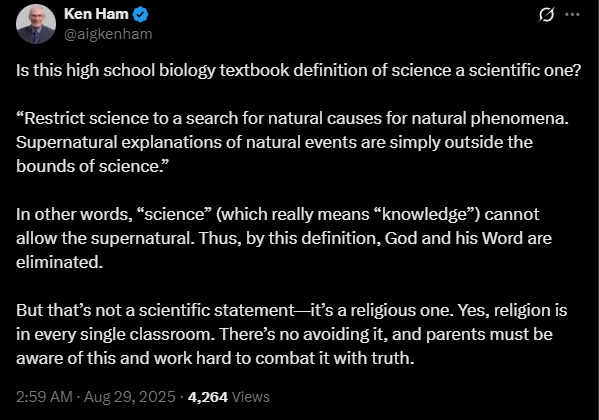
In this case Ken Ham, founder CEO of the young Earth creationist (YEC) organization Answers in Genesis posted to his X account the following:
Is this high school biology textbook definition of science a scientific one?
“Restrict science to a search for natural causes for natural phenomena. Supernatural explanations of natural events are simply outside the bounds of science.”
In other words, “science” (which really means “knowledge”) cannot allow the supernatural. Thus, by this definition, God and his Word are eliminated.
But that’s not a scientific statement—it’s a religious one. Yes, religion is in every single classroom. There’s no avoiding it, and parents must be aware of this and work hard to combat it with truth.
 He gives no citation other than a vague reference to a “high school biology textbook”. I was immediately suspicious about the context of this quote, wondering if the original would explain why science was limited to natural explanations for natural phenomena, something that Ham and other creationists avoid like the plague (more on this below).
So I started searching the web for the quote as Ham presented it and initially couldn’t find anything, deepening my suspicions. So I broke the quote down into individual sentences and low and behold a link popped up to the quote coming from an online biology textbook Meridian Technical Charter High School in Meridian, Idaho. And shocker of all shocks my suspicion about the context turned out to be warranted.
So I hopped on to X and replied to Mr. Ham with the following (red text not in original reply):
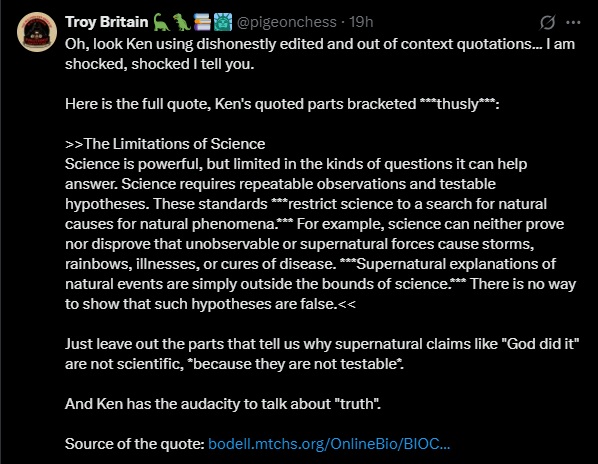
Oh, look Ken using dishonestly edited and out of context quotations… I am shocked, shocked I tell you.
Here is the full quote, Ken’s quoted parts bracketed ***thusly*** (red text not in original response):
>>The Limitations of Science
Science is powerful, but limited in the kinds of questions it can help answer. Science requires repeatable observations and testable hypotheses. These standards ***restrict science to a search for natural causes for natural phenomena.*** For example, science can neither prove nor disprove that unobservable or supernatural forces cause storms, rainbows, illnesses, or cures of disease. ***Supernatural explanations of natural events are simply outside the bounds of science.*** There is no way to show that such hypotheses are false.<<Just leave out the parts that tell us why supernatural claims like “God did it” are not scientific, *because they are not testable*. And Ken has the audacity to talk about “truth”.
Source of the quote: bodell.mtchs.org/OnlineBio/BIOC
So he provides no citation, no context, and not even any ellipses (…) indicating that the sentences were not contiguous in the original source. As I indicated in my response to him, he has a lot of gall to speak of “truth” when pulling these sorts of shenanigans.
Here is some more relevant context from the textbook, specifically regarding theories like evolution(Ham’s cherry picked quote again in bold red):
The Limitations of Science
Science is powerful, but limited in the kinds of questions it can help answer. Science requires repeatable observations and testable hypotheses. These standards restrict science to a search for natural causes for natural phenomena. For example, science can neither prove nor disprove that unobservable or supernatural forces cause storms, rainbows, illnesses, or cures of disease. Supernatural explanations of natural events are simply outside the bounds of science. There is no way to show that such hypotheses are false.Although science is “a way of knowing,” keep in mind that it is not the only way. Not everything you “know” is based on science. For example, you know what kind of music you like and what your favorite color is. These personal tastes are not the results of a careful testing of hypotheses. And you know right from wrong. This concept is an ethical value, not a scientific fact. Each human mind develops a unique database of knowledge of many different kinds. Science-based knowledge is the type built from confirmed observations and testable hypotheses.
Theories in Science
Many people think of science mainly as a collection of facts. But collecting facts is not what really defines science. A telephone book is an impressive catalog of factual information, yet it has little to do with science. It is true that factual data provide the raw material for science. But scientists are mostly interested in finding patterns in the data and explaining these patterns. What really advances science is some new theory that ties together a variety of facts that previously seemed unrelated. People like Isaac Newton, Charles Darwin, and Albert Einstein stand out in the history of science because their theories connected so many observations and experimental results.How is a theory different from a hypothesis? In science, a theory is a well-tested explanation that makes sense of a great variety of scientific observations. It gives rise to many hypotheses that can be tested. This definition contrasts with the everyday use of theory to mean a speculation, as in “It’s only a theory.” Compared to a hypothesis, a theory is much broader in scope. This is a hypothesis: “Mimicking poisonous snakes is an adaptation that protects nonpoisonous snakes from predators.” But this is a theory: “Adaptations such as mimicry evolve by natural selection.” The theory of natural selection explains the evolution of the many cases of mimicry, as well as a variety of other adaptations of organisms to their environments.
Theories, such as the theory of natural selection, only become widely accepted in science when they are supported by an extensive body of evidence. That evidence also provides a framework for further research and predictions. If new evidence that contradicts a theory is uncovered, scientists first verify the evidence many times. They then modify or discard the theory accordingly.
Of course Ken left out all of this which explains why scientific explanations exclude supernatural explanations (their lack of testability) and how scientific theories, like evolution are “well-tested”. This isn’t dogmatic atheistic limitation on science, as Ken would have his readers believe, rather testability is a practical limitation of science because it is the only way to demark fanciful speculations and religious myths from potentially valid explanations.
But Ken and other creationists can’t have this because their particular theology demands a particular interpretation of their scripture that is incomputable with not only evolutionary biology but with the findings of much of the rest of science (which they falsely label as “evolutionist science” or similar). For YEC, whose beliefs require the Earth and universe to be young (6000 to 10,000 years old), whenever they posit a testable hypothesis, such as the fossil record being explainable as the actions of a single event, in this case the Noachian Flood described in the book of Genesis, these hypotheses have been falsified. In the case of Flood geology in innumerable ways, something known to late 18th and early 19th century creationist geologists long before evolutionary theory was accepted.
This, by the way, is what led to the development of so called “Intelligent Design theory” (ID). ID creationists wanted to rid themselves of having to defend already falsified hypotheses, and of making direct references to Genesis, so as to avoid both scientific and First Amendment objections to their ideas being taught in public school science classrooms.
Once Flood geology and a few other potentially testable creationist hypotheses have been ruled out by science (or deliberately left out by ID proponents) all they have is “God did it” (or the “Intelligent Designer did it”) which is not testable against the empirical evidence. An omnipotent creator could create anything, in any way, making any possible observation of the facts potentially compatible with God having done it.
So, anyway, more evidence (as if it were needed) that Ken Ham is not an honest interlocutor.
 Playing Chess with Pigeons
Short version- Lying liars for jebus, tell lies.
Great detective work, and presentation. Good to see a post from your direction.
LikeLiked by 1 person
“In science, a theory is a well-tested explanation that makes sense of a great variety of scientific observations.” NO. A theory is a kind of intellectual construct. It may totally fail to fit the phenomena that it tries to describe (examples: phlogiston theory, Efficient Market theory in economics), may be true only when confounding effects happen to be unimportant (Ideal Gas theory), or may even like any experimental application (String Theory).
Labelling something as a “theory”tells us nothing one way or the other about its usefulness or validity.
LikeLike
Ah, OK Paul, I am not sure what particular nit you are attempting to pick here. That some things people label as “theory” either do not actually rise to the level of theory (String), or that some theories in the past (phlogiston from the17th-18th century) were unsuccessful and overturned?
The definition given in this textbook seems pretty in line with other mainstream scientific organizations for example:
“Theory:
A plausible or scientifically acceptable, well-substantiated explanation of some aspect of the natural world; an organized system of accepted knowledge that applies in a variety of circumstances to explain a specific set of phenomena and predict the characteristics of as yet unobserved phenomena.”
[ “…And predict the characteristics of as yet unobserved phenomena.” implies testability, however I wish they had been more explicit about this in their definition – TB.]
https://www.nationalacademies.org/evolution/definitions
“theory
A broad explanation for a wide range of phenomena. Theories are concise, coherent, systematic, predictive, and broadly applicable. They usually integrate many individual hypotheses. A scientific theory must be testable with evidence from the natural world. If a theory can’t be tested with experimental results, observation, or some other means, then it is not a scientific theory.”
https://evolution.berkeley.edu/glossary/theory/
Would it be better for you if they have added “successful” in front of the word “theory” to make a distinction? Or do you have an issue with the whole demarcation thing in general [This last sentence was edited for form but not content]?
LikeLike
“Or do you have a whole issue of demarcation in general?” An insightful comment. Discussion of what is meant by the word “theory” can only shed light on how the word is or should be used.
The definitions that you present are incorrect and self-serving, as shown by the fact that we speak of “phlogiston theory,” although this did not succeed in explaining the phenomena, and of “string theory,” although string theorists have still to tell us which particular phenomena they hope to explain. Moreover, critics of Efficient Market theory attack it by pointing out that its presumptions are unrealistic and its predictions repeatedly falsified, but because of its intellectual structure they do not deny that it can be called a theory.
So I’m really making two separate links points. One is regarding the usefulness or otherwise of appealing to the alleged meaning of the term “theory.” We accept the evolutionary framework on its merits, so that arguments of the form
are fundamentally misguided because we should simply say
and cut out the middleman, without getting bogged down in definitions. The other one is that the actual definitions offered are incorrect and self-serving, as shown by the way they are violated in actual use.
LikeLike
OK, so I don’t think I read you as necessarily taking issue with how we demark a potential scientific explanation from non-scientific explanations, vis a vis testability. Rather it seems you are making a semantic argument about how the word theory has been used historically and that the label is being used as some sort of authority argument, i.e. “This is a theory, respect it!”. Yes, no?
Anyway my main point in the OP was not really about the labels we put on these ideas but rather the demarcation of testable vs untestable (and how Ham left this important bit out).
As for your “respect the THEORY” complaint, I think this is a bit of a strawman. Who is making this sort of argument? The people on “our side” of the CvE debate seem to me to be, for the most part, only trying to counter the propaganda put out by creationists who use the average layperson’s unfamiliarity with the scientific definition of the term theory to make people think that evolution is merely a (wild) speculation.
LikeLike
On rereading, our disagreement seems to be a very minor one, about how words are, or should be, used. However, I would be even harsher my discussion of Ham then you are.
Take his truncated quotation: “Supernatural explanations of natural events are simply outside the bounds of science.” This, he tells us, means that the definition of science in the textbook “cannot allow the supernatural” (his words), whereas all it says is that science refrains from discussing the supernatural.
This, from his point of view, is just as bad, since his entire mission is built on the doctrine of “creations science,” which presupposes the supernatural and imposes whatever absurd interpretations are necessary on our observations of the natural. The dishonesty of which you rightly complain is not just in this single instance, but is built into the foundations of his entire doctrine.
LikeLiked by 1 person